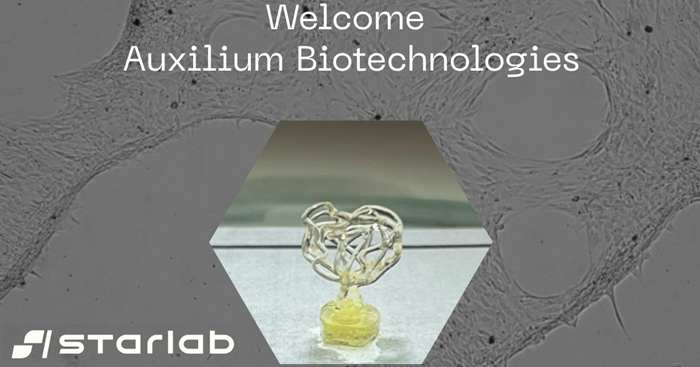
Starlab Space LLC, the commercial space station developer expanding access to low Earth orbit research, announced a partnership with Auxilium Biotechnologies. This agreement represents a significant advancement in 3D bioprinting and biofabrication in orbit and underscores Starlab’s commitment to growing scientific discovery beyond the limits of Earth.
Auxilium will provide orbital 3D bioprinting and biofabrication capabilities aboard the Starlab space station to support advanced research, device development, and manufacturing workflows in regenerative medicine, implantable medical technologies, and complex tissue engineering applications. Auxilium’s proprietary AMP-1 3D bioprinter has demonstrated the mass production of implantable medical devices and other complex structures, such as perfusable blood vessels, in microgravity aboard the International Space Station. With Starlab, Auxilium will accelerate translation from experimental biology to manufacturable products, positioning AMP-1 as a production facility for the next generation of life science technologies in space.
“3D printing in microgravity enables tissue architectures and material properties not achievable under standard 1g manufacturing,” said Isac Lazarovits, director of engineering at Auxilium. “This biomanufacturing facility on board the future Starlab space station will expand access to low Earth orbit, lower barriers for industry and academia, and enable high-impact research and manufacturing that will benefit Earth.”
This announcement highlights one piece of Starlab’s expansive network dedicated to advancing life sciences research and biomanufacturing in orbit. Microgravity enables breakthroughs impossible on Earth by allowing enhanced protein crystallization for improved drug development, 3D cell growth and disease modeling that better replicates human biology, and advanced stem cell research with applications for treating conditions such as Parkinson’s disease, diabetes, and Alzheimer’s.
“This partnership demonstrates Starlab‘s commitment to fostering innovation in life sciences,” said Marshall Smith, CEO of Starlab. “By providing companies like Auxilium with the infrastructure to advance biomanufacturing in microgravity, we’re creating pathways for breakthrough therapies that will improve lives on Earth.”
Starlab’s market-driven business model aims to reduce costs, complexity, and risks for researchers and commercial partners. With its single-launch, no-assembly-required design enabling full certification and operation within weeks, Starlab minimizes delays and maximizes efficiency for payload customers. Through joint venture partners, customers can conduct research on the International Space Station today, ensuring a seamless transition to Starlab for future advancements.