Enduralock, headquartered in Lenexa, Kansas (USA), develops mechanically locking fasteners and structural interfaces engineered for aerospace, defense and commercial applications. The company’s product suite centers on secure, vibration-resistant fastening mechanisms designed to maintain clamping force under extreme thermal, mechanical and dynamic loads. Within this portfolio, the Universal Connector represents one of Enduralock’s key contributions to spaceflight architectures: a reusable, tool-actuated, self-locking connection system intended to simplify structural attachment, accelerate integration and improve long-term reliability across launch vehicles, spacecraft and deployable mechanisms.
Universal Connector for Field-Serviceable Mechanical Interfaces

Enduralock’s Universal Connector is engineered as a repeatable, field-serviceable fastening system that maintains joint integrity in high-load aerospace environments. Traditional aerospace fasteners rely on torque values, lock-wire, adhesives, or staking to prevent loosening under vibration or shock. The Universal Connector incorporates Enduralock’s patented geometric locking mechanism, which provides a positive mechanical retention feature independent of torque, ensuring that preload is preserved even during sustained dynamic loading such as launch vibration, acoustic excitation and shock events.
Technical documentation from Enduralock shows that the Universal Connector is engineered to provide high tensile and shear performance comparable to standard aerospace bolted joints, while preventing backing-off or preload loss under vibration by eliminating micro-slip at the interface. The design enables repeatable installation and removal with a single tool, without wear to threads or locking components, and incorporates an intrinsic mechanical lock that operates independently of torque. Because the connector does not require lockwire, cotter pins, safety clips, adhesives or other consumable hardware, it significantly reduces foreign object debris (FOD) risk during assembly and maintenance, making it suitable for both production environments and mission-critical spaceflight structures.
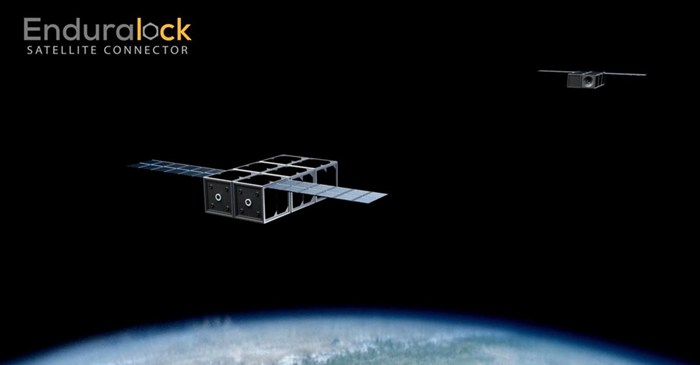
The connector’s reusability and controlled actuation make it suited for environments where components may need to be accessed, replaced, or serviced such as deployable mechanisms, removable payload panels, modular spacecraft structures, fluid-transfer interfaces, or on-orbit servicing and refueling systems. The ability to maintain preload after multiple cycles helps reduce risk and simplify integration across both ground-based assembly lines and in-space servicing architectures.
Mechanical Locking Architecture – Preload Stability Without Torque Reliance
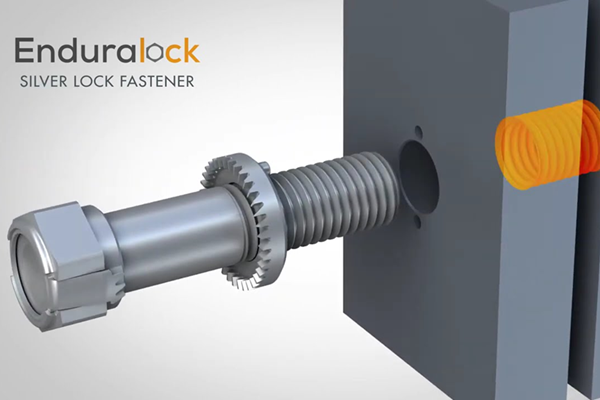
Enduralock’s Universal Connector incorporates a mechanically actuated locking mechanism designed to secure joint preload without depending on torque retention, a known limitation of conventional threaded fasteners in launch and on-orbit environments. The fastener uses interlocking mechanical elements that engage fully during actuation, holding the joint under both axial and radial loading conditions. Unlike torque-dependent systems, the locking action is independent of thread friction, enabling the connector to maintain clamping force despite thermal cycling, vibration, or long-duration static loading. The mechanism provides single-direction actuation to reduce the likelihood of partial engagement, along with clear tactile or visual confirmation that the lock is fully deployed. According to Enduralock’s engineering descriptions, the connector supports multiple installation and removal cycles while maintaining consistent preload and is designed to interface with standard aerospace fastener geometries. These characteristics allow the Universal Connector to provide stable, repeatable fastening performance in applications such as satellite bus structures, deployable payload modules, launch-vehicle hardware and precision mounting points where preload stability is critical.
Tool-Actuated Engagement for Consistent and Repeatable Fastener Installation
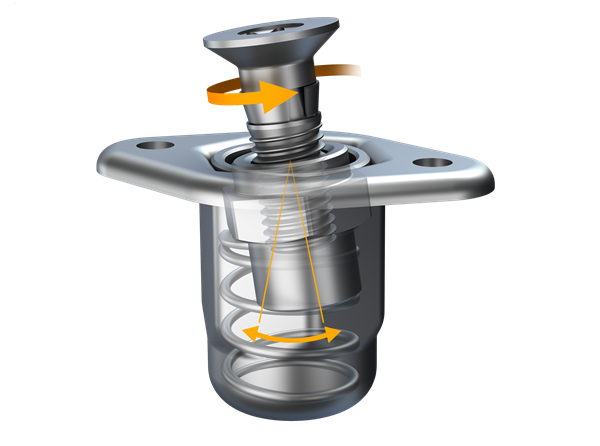
Enduralock’s Universal Connector is designed around a controlled, tool-actuated engagement method that eliminates operator-dependent variability in fastening operations. Instead of relying on torque accuracy, which can vary between technicians and degrade over repeated cycles, the connector uses a dedicated actuation tool to achieve predictable engagement depth and uniform locking performance. This ensures each installation delivers the same preload and locking behavior, improving consistency across production lines and spacecraft integration workflows. The tool-based activation also accelerates assembly by enabling rapid fastening with minimal manual steps, while reducing the risk of improper seating or incomplete locking. Because the connector requires no torque-based calibration or secondary retention hardware, it is particularly effective in cleanroom and contamination-sensitive environments, where simplified procedures lower the chances of handling errors, particulate generation, and foreign object debris (FOD). This approach supports repeatable, high-assurance integration for launch vehicles, satellite structures, and any application requiring reliable mechanical joints with minimal room for human error.
Spaceflight Environmental Qualification – Performance Across Shock, Vibration and Thermal Extremes
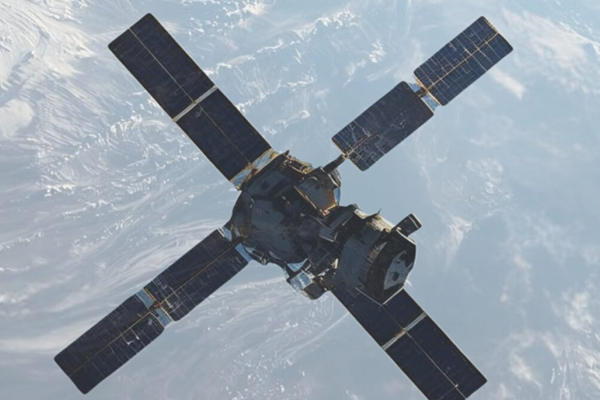
Enduralock’s Universal Connector undergoes qualification testing aligned with aerospace and launch-vehicle requirements to validate mechanical stability under extreme operational conditions. According to the company’s published environmental data, the connector is subjected to random and sine vibration profiles representative of ascent loads, as well as acoustic excitation consistent with liftoff environments. The hardware is also qualified for high-g shock events typical of stage separation or pyrotechnic activations. Thermal cycling is conducted across spacecraft operating temperature ranges to ensure that the locking mechanism maintains preload despite material expansion or contraction. All components are built from vacuum-compatible, low-outgassing materials suitable for long-duration space exposure. These environmental tests confirm that the connector retains its locking force, resists loosening, and remains fully functional throughout launch, orbital operations and reusable servicing scenarios.
Applications Across Spacecraft Launch Vehicles and Deployable Systems
Enduralock’s Universal Connector is designed for use across a wide range of spacecraft and launch-vehicle architectures where secure, repeatable, and serviceable mechanical interfaces are required. The connector can replace conventional bolted joints or latching mechanisms on satellite primary and secondary structures, including removable access panels, instrument decks, payload-support frames and structural panels that may require periodic removal during assembly, integration, or maintenance. The preload-retention characteristics make it suitable for deployment hardware such as solar arrays, antennas, booms, and other mechanisms exposed to dynamic loads during launch and in-orbit operation. In launch-vehicle applications, the connector can be used on fairing structures, separation interfaces, thermal-protection attachment points and reusable vehicle components that undergo repeated assembly cycles. Additional integration opportunities include habitat modules, robotic interfaces involved in on-orbit assembly, and servicing or refueling systems that benefit from fast, tool-controlled engagement. By maintaining joint stability under vibration, shock and thermal gradients, the Universal Connector provides an alternative to traditional torqued fasteners in environments where preload consistency and reusability are critical.
Integration Benefits – Reduced Assembly Time and Lower Mission Risk
Enduralock’s Universal Connector is engineered to streamline mechanical integration while improving joint reliability across the spacecraft lifecycle. The simplified engagement process reduces assembly time by eliminating torque-critical steps and removing the need for secondary retention methods such as lockwire or adhesives. Because installation is performed through a guided tool interface, the connector minimizes operator-dependent variability and lowers the likelihood of human-error-induced preload loss. The fastener’s reusability also supports repeated ground testing, subsystem servicing and disassembly without degrading locking performance, making it suitable for programs involving iterative integration or refurbishment cycles. By providing consistent clamp force, maintaining preload under dynamic loads and simplifying workflow logistics, the Universal Connector contributes to lower mission risk and more efficient, scalable assembly processes for satellites, launch vehicles and in-space structures.
Enduralock’s Universal Connector provides a mechanically locked, reusable fastening solution designed for the mechanical and dynamic challenges of spaceflight. With a tool-actuated engagement method, independent mechanical locking and qualification for launch and orbital environments, the system offers spacecraft designers a robust alternative to torque-dependent fasteners. The adaptability to satellite buses, deployable structures, launch vehicles and in-space servicing operations positions it as a practical component for reusable and modular spacecraft architectures.
About Enduralock
Enduralock, headquartered in Lenexa, Kansas (USA), develops advanced mechanical fastening systems engineered for aerospace, defense, spaceflight and critical-infrastructure applications. The company specializes in vibration-proof, reversible and highly secure fastening technologies that maintain joint integrity under extreme mechanical loads, thermal cycling and high-vibration environments. The product portfolio includes permanently locking but reversible fasteners, captive-reverse mechanisms, keyed-locking systems and shape-memory-alloy (SMA) based actuated fasteners designed to automate separation or release functions in space systems. These fastening solutions are engineered to eliminate loosening, reduce maintenance requirements and improve safety margins while allowing controlled disassembly when needed. Enduralock’s fastening systems undergo rigorous testing protocols including vibration, shock, thermal exposure and torque-retention verification to meet aerospace and military engineering standards. Enduralock continues to expand the role in supplying fastening innovations for launch vehicles, spacecraft mechanisms, defense platforms and high-reliability industrial systems. The engineering approach supports customers requiring secure, reusable and maintenance-efficient fastening solutions across some of the most demanding operating environments.