Cassiopeia Space, headquartered in Virginia Beach, Virginia (USA), develops advanced satellite user terminals engineered for seamless operation across multiple orbital regimes. The company specializes in compact, electronically steered antenna (ESA) systems designed to support high-throughput, multi-orbit connectivity for defense, government, mobility, enterprise and remote-operations markets. The RIGEL terminal family enables continuous communications across GEO, MEO and LEO constellations using a single hardware platform, helping operators reduce equipment footprint while enhancing link availability, network flexibility and operational resilience.
RIGEL Terminal – Multi-Orbit ESA Platform for Fixed and Mobile Deployments
Cassiopeia’s RIGEL terminal is a fully electronically steered antenna (ESA) system engineered to provide broadband-grade connectivity across GEO, MEO and LEO satellite networks using a single hardware platform. Designed for operation in Ka-band and Ku-band configurations, RIGEL eliminates the need for mechanical gimbals or manual alignment by using solid-state beam steering to acquire and track satellites electronically. The terminal integrates its antenna aperture, RF electronics and modem enclosure within a slim, low-profile chassis suitable for mobile platforms, maritime vessels, ground vehicles, aircraft structures and fixed-site installations where minimal footprint and rapid deployment are priorities.
RIGEL is built on a fully digital beam-forming architecture capable of generating multiple independent beams with dual-polarization support. This enables the terminal to maintain a link with one satellite while simultaneously preparing a handover to another, or to manage separate uplink/downlink paths depending on network configuration. The rapid beam-switching capability allows the system to transition between satellites in different orbital layers with minimal interruption, supporting use cases such as on-the-move communications, dynamic network routing and service continuity across heterogeneous constellations. The electronically steered architecture also enhances reliability in harsh environments by eliminating moving parts and reducing mechanical wear.
Antenna Architecture & RF Performance
The RIGEL electronically steered antenna is built around a fully integrated phased-array architecture that enables beam steering without mechanical motion, supporting high-reliability operation in both fixed and mobile environments. Cassiopeia’s design employs a dense array of digitally controlled radiating elements that shape and direct the beam electronically, allowing the terminal to maintain stable connectivity even during platform movement or when satellites are positioned at challenging elevation angles. The RF front-end is engineered to maximise signal efficiency across the full scan range, combining low-loss circuitry with carefully tuned aperture performance to preserve gain and link margin.
RIGEL supports dual linear polarization on both transmit and receive paths, enabling improved spectral efficiency and robust performance under varying atmospheric conditions. The system’s fast beam-switching capability allows rapid transitions between GEO, MEO and LEO spacecraft, supporting seamless handovers for mobility applications such as maritime, land vehicles and airborne assets. Beam patterns are optimised to deliver consistent coverage across the antenna’s field of view, while high EIRP levels in transmit mode ensure the terminal can support broadband-class data rates on modern high-throughput satellite networks. The low-noise amplification chains are incorporated directly into the antenna module to minimise signal degradation, improving performance in environments affected by rain fade, humidity or temperature variation. With all RF electronics, beam-forming hardware and processing units embedded within the antenna enclosure, RIGEL reduces the external equipment footprint and simplifies installation for field, enterprise and government users.
Mechanical Design and Environmental Durability
The RIGEL terminal is built as a low-profile, ruggedized antenna system engineered for reliable performance in diverse and demanding deployment environments. The flat form factor enables installation on vehicles, maritime platforms, fixed ground sites and temporary field structures without requiring structural modifications, making it suitable for both permanent and mobile configurations. The terminal is enclosed in a fully sealed, weather-resistant housing designed to withstand exposure to rain, dust, humidity and temperature extremes. The mechanical structure is qualified to tolerate vibration and shock loads encountered during vehicular movement, maritime operations and field transport. Lightweight construction supports ease of handling and mounting, while connector placement, interface design and cable routing are arranged to simplify field installation and reduce setup time. These characteristics position the RIGEL ESA for operational use in defense, emergency response, remote-infrastructure support and mobility-driven communications scenarios where equipment must remain stable and functional despite limited maintenance access and variable environmental conditions.
Integrated Modem Housing and Digital Processing
A defining characteristic of the RIGEL terminal is the consolidated architecture, which incorporates a dedicated, protected modem compartment inside the antenna enclosure. This enables the installation of customer-selected modems, waveform processors or encryption devices without requiring additional housings or external electronics modules. All RF, digital, and control electronics are internal to the unit, supporting a streamlined setup with fewer interconnects and reduced susceptibility to cabling failures in mobile or field deployments. The terminal’s integrated digital processing subsystem manages real-time beam steering, beam tracking, and switching logic for LEO, MEO and GEO satellites, adjusting pointing vectors based on link conditions and network handover requirements. It continuously evaluates signal strength, polarization alignment, phase control and spectrum usage to maintain stable connectivity as satellites rise and set or as the host platform moves. The processing unit also provides standardized interfaces to external modems, IP routers, power systems, and network-management platforms, allowing the antenna to operate as a single-package terminal for defense, government, mobility and enterprise networks without separate external electronics racks.
Multi-Orbit Capability and Network Flexibility
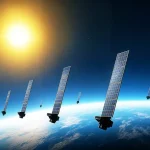
RIGEL is developed as a multi-orbit terminal from the outset, with the electronically steered array designed to acquire, track, and operate across all major satellite-network architectures. The terminal supports connectivity to GEO, MEO and LEO systems without requiring mechanical steering, making it suitable for operators adopting hybrid or fully multi-orbit network strategies. GEO satellites provide wide-area coverage and steady links for fixed or semi-mobile deployments, while MEO constellations offer higher throughput and reduced latency compared to traditional geostationary systems. LEO networks add low-latency communications and higher revisit opportunities, essential for real-time applications.
RIGEL’s digital beam-steering capability enables continuous tracking of fast-moving LEO and MEO satellites while maintaining compatibility with stationary GEO links, ensuring uninterrupted sessions during handovers. This flexibility allows the terminal to adapt to different network conditions, traffic demands and service providers, and is particularly beneficial for defence, mobility, enterprise and government users transitioning from legacy GEO-only terminals to modern multi-layer architectures. With the unified ESA platform, RIGEL supports operators seeking resilient connectivity in environments where network redundancy, link diversity and service continuity are operational priorities.
Mobility and Fixed-Site Configurations
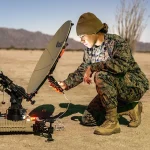
Cassiopeia offers the RIGEL terminal in configurations designed for mobile, maritime and fixed-site operations, allowing a single hardware architecture to serve diverse mission profiles. For ground mobility, the low-profile ESA can be mounted on vehicles, tactical platforms or transport systems where antennas must maintain connectivity during movement or rapid repositioning. Maritime variants support installation on vessels requiring stabilized broadband links in open-water environments, with the flat-panel structure eliminating the need for gimballed mechanics traditionally required at sea. For fixed sites—such as enterprise facilities, remote industrial outposts, border stations, or government field locations, the antenna can be roof- or mast-mounted with minimal integration effort due to its thin form factor and consolidated electronics. The platform is also suited for emergency-response and expeditionary operations where teams must establish communications quickly in areas without infrastructure. Across all configurations, the terminal’s ESA design allows satellite transitions and beam tracking without mechanical motion, supporting continuous service whether stationary or on the move.
The RIGEL terminal is positioned to support a broad range of operational environments where dependable, broadband-class satellite connectivity is required across varying mobility, geographic and mission conditions. In defense and military mobility, the system can provide communications for command-and-control nodes, mobile tactical vehicles, and forward-deployed units that require continuous links while on the move or during rapid redeployment. Government agencies and civil-response organizations can use the terminal for establishing communications at disaster sites, temporary field bases, or remote assessment areas where terrestrial networks are disrupted or unavailable. For maritime users, the flat-panel ESA design supports connectivity for commercial vessels, patrol craft, offshore logistics and research platforms operating under high motion and variable weather conditions. Industrial operators in remote sectors such as mining, oil and gas, utilities, and railway corridors can integrate RIGEL to maintain secure data links for monitoring, automation, and field operations where fiber or terrestrial networks are impractical.
The terminal’s compatibility with enterprise networking architectures also makes it suitable for businesses requiring satellite redundancy or multi-orbit backup for high-availability applications. By integrating multi-orbit support, software-defined beam-forming and an environmentally resilient platform, RIGEL provides a versatile terminal option applicable to both civilian and governmental sectors adopting hybrid satellite-network architectures.
Cassiopeia’s RIGEL terminal provides a unified user-equipment solution for organisations adopting hybrid satellite architectures, enabling a single electronically steered antenna to maintain broadband connectivity across GEO, MEO and LEO networks. The platform integrates digital beam-forming, solid-state steering and a built-in modem enclosure into a rugged, low-profile unit that supports mobile, maritime and fixed-site operations. With its ability to track non-geostationary satellites, perform rapid beam handovers and operate across Ka-band or Ku-band configurations, RIGEL offers operators a practical path toward multi-orbit resilience without deploying multiple antenna systems.
About Cassiopeia Space
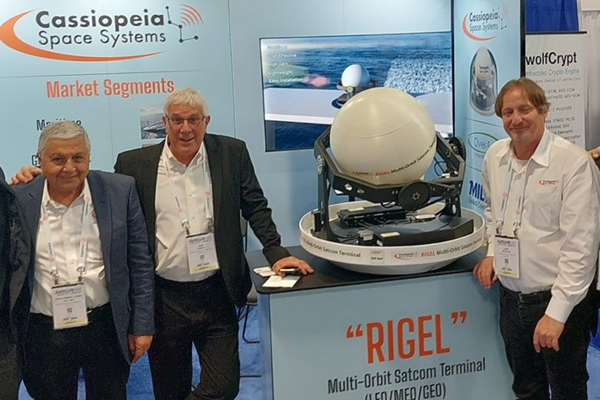
Cassiopeia Space Systems Inc. is a US-based developer of multi-orbit satellite terminals and advanced satcom solutions, headquartered in Virginia Beach, Virginia (4525 Main Street, Suite 710 / Suite 742 listed on the company contact pages). The company, established in 2021, focuses on compact, stabilized tracking platforms and novel RF antenna technologies such as Luneburg-lens based apertures designed for maritime, aerospace, land and cellular-backhaul applications. The RIGEL multi-orbit terminal is engineered to support simultaneous tracking and rapid switching between LEO, MEO and GEO satellites for commercial and defence users. Cassiopeia works with industry partners and attends sector events (for example Satellite 2023) to demonstrate and mature the multi-beam, multi-band terminal concepts.