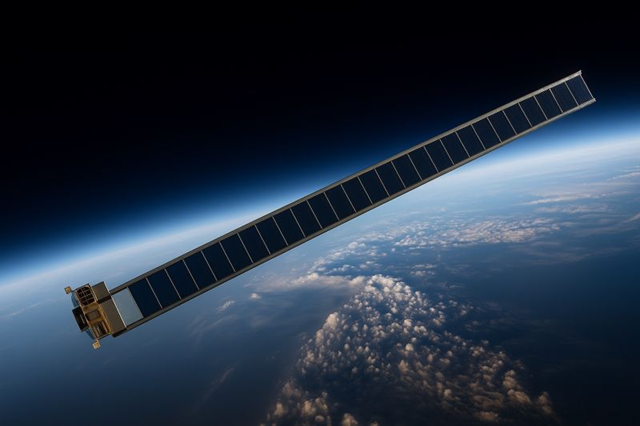
Dcubed, headquartered in Munich, Germany, develops flight-proven deployable solar array systems designed for modern satellite platforms across the commercial, scientific and defence sectors. The company focuses on modular, lightweight and mechanically robust power-generation solutions designed to support the growing range of spacecraft sizes and mission profiles. The portfolio spans body-mounted solar panels for low to medium-power requirements, rigid deployable arrays for missions needing higher electrical output, flexible blanket architectures that maximise deployed area while minimising launch-volume constraints and ultra-compact Origami foldable arrays engineered for CubeSats and rideshare payloads with strict volume limitations. With products qualified for space use and designed for streamlined integration, Dcubed provides scalable solar solutions that address the increasing demand for efficient, dependable and adaptable power generation in Earth orbit and beyond.
Body-Mounted Solar Array

The Body-Mounted Solar Array from Dcubed is designed for spacecraft that require a compact, fixed power-generation solution without the complexity of deployable structures. According to the product specifications, the array can deliver up to approximately 400 W end-of-life (EOL), with configurations available across multiple solar-cell technologies depending on mission efficiency, radiation tolerance and cost requirements. The mechanical and electrical layouts are customisable, allowing the array to be designed to different spacecraft bus geometries and interface needs. By eliminating hinges, deployment arms or actuators, the body-mounted design reduces mechanical risk and simplifies integration, making it well suited for small satellites, auxiliary payloads, or missions prioritising durability, low mass and minimal operational overhead. This type of array provides a stable, maintenance-free power source for platforms with modest energy demands or missions in which deployment space is limited.
Origami Solar Array

Dcubed’s Origami Solar Array is a compact, folding deployable power subsystem engineered for spacecraft constrained by strict launch-volume limits, such as CubeSats, microsatellites and secondary rideshare payloads. The product is offered as a 100 W deployable array that stows entirely within a 1U envelope (100 × 100 × 100 mm), enabling integration into standard CubeSat architectures without occupying additional payload volume. The system is designed for a five-year operational lifetime and supports spacecraft power buses in the 14–28 V range. Its mechanical concept uses a fold-out geometry inspired by origami structures, incorporating redundancy in the actuation sequence to ensure reliable deployment in orbit. This approach maximizes available panel surface area relative to stowed size, offering high power density while avoiding more complex hinge or arm assemblies. The Origami Solar Array provides mission designers with a practical means of achieving substantially higher electrical output within tight packaging constraints, supporting applications where every cubic centimeter of launch volume is critical.
Rigid-Deployable Solar Array

Dcubed’s Rigid-Deployable Solar Array product line is designed for missions that require higher power output than a body-mounted configuration can provide, while still maintaining a mechanically robust structure once deployed. Dcubed characterizes the array family as a hybrid solution that combines compact stowage for launch with a rigid panel-based architecture after deployment. The design uses hinged or panel-fold mechanisms that allow multiple rigid sections to be packed into a small launch volume and then unfolded in orbit to create a significantly larger power-generating surface. This approach enables spacecraft to achieve higher power levels without adopting flexible blanket structures or more complex deployment assemblies. The panels lock into a rigid configuration once deployed, they offer improved structural stiffness, thermal stability and predictable mechanical behavior, beneficial for medium-class satellites operating with higher payload power demands. Dcubed’s rigid-deployable arrays serve missions that need a balance of scalability, durability and efficient use of launch volume while retaining straightforward integration and reliable in-orbit operation.
Flexible Blanket Solar Array
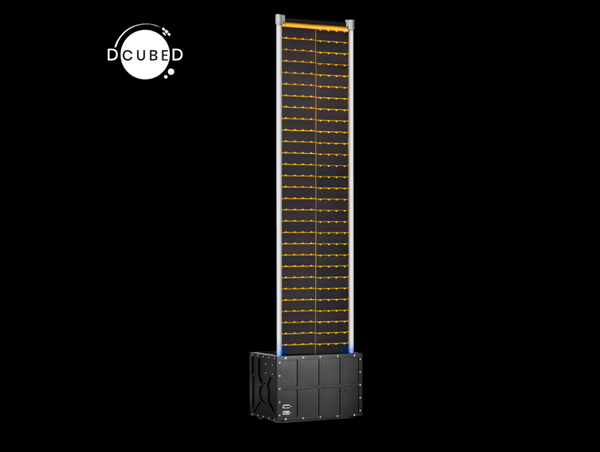
Dcubed’s Flexible Blanket Solar Array is designed for spacecraft requiring the highest possible power-to-mass and power-to-volume ratios. Unlike rigid panel systems, these arrays use ultra-thin photovoltaic blankets that can be rolled, folded, or accordion-packed into very small stowage envelopes for launch. Once deployed, the blanket structure provides a much larger illuminated surface area than equivalently sized rigid or hinged configurations, enabling substantially higher electrical output without incurring significant mass or structural penalties. Dcubed highlights that the key advantages of this architecture are minimal launch volume, low structural mass, and maximal deployed-area efficiency. These characteristics make flexible blanket arrays well suited for spacecraft where power availability is a defining requirement such as high-throughput communications payloads, electric-propulsion spacecraft, in-orbit servicing vehicles, and emerging solar-power-satellite concepts. The blankets are engineered to maintain electrical performance and structural integrity under thermal cycling, radiation exposure and micro-gravity deployment conditions, ensuring consistent operation throughout the mission lifetime.
Modular Approach & In-Space Manufacturing Readiness
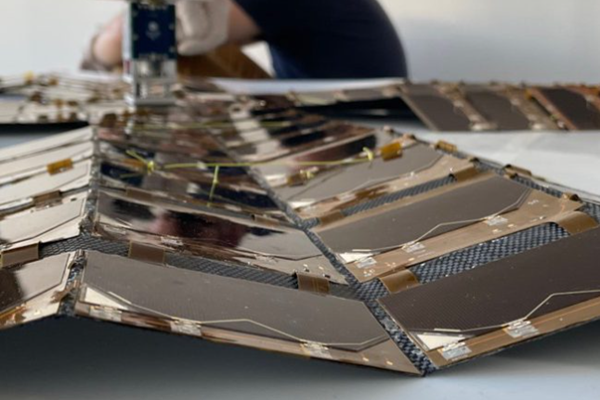
Dcubed’s solar-array portfolio is built around a modular design philosophy that enables spacecraft manufacturers to select standardized components such as substrates, solar-cell configurations, deployment locks, hinges, actuators and electrical interfaces and integrate them as a fully assembled subsystem. This modularity allows the same core architecture to be adapted for CubeSats, microsatellites, and larger satellite buses, reducing non-recurring engineering effort and simplifying qualification. The company notes that all array types are engineered to be compact, lightweight and mechanically robust, supporting missions with tight mass budgets or limited launch volume. Dcubed is developing hardware intended for compatibility with emerging in-space manufacturing and assembly techniques. This includes array designs suitable for on-orbit production or assembly of very large surface areas, which may be required for future high-power missions such as power-beaming demonstrators, in-orbit servicing vehicles or scalable space-energy infrastructures. Through this approach, Dcubed positions the solar-array technology to support both current small-sat power needs and longer-term architectures that will rely on modular, expandable power-generation systems assembled directly in space.
Mission Impact & Use Cases
Dcubed’s range of solar-array products allows mission designers to match power-generation capabilities to specific spacecraft size, stowage and lifetime requirements. Body-mounted and Origami-style arrays offer compact, low-mass solutions for CubeSats and small-sat constellations that operate under strict launch-volume constraints, enabling higher electrical output without increasing spacecraft size. For medium and larger satellite classes, the rigid-deployable and flexible-blanket arrays provide substantially greater power capacity while maintaining efficient stowage for launch vehicle integration. Dcubed’s work toward ISM-compatible array structures supports emerging mission categories including cislunar infrastructure, in-orbit servicing spacecraft and large distributed power systems where scalable, modular power generation will be required. The product lines give operators a path to meeting both current and future spacecraft power demands across commercial, scientific and government missions.
Dcubed provides power-generation subsystems engineered for compact launch volume, scalable surface area and compatibility with a wide range of spacecraft buses. The company’s emphasis on modularity and readiness for in-space manufacturing reflects a strategy aimed at supporting both current satellite missions and future orbital systems requiring larger and more adaptable power infrastructure. The company offers spacecraft integrators a flexible power-generation subsystem choice that supports current missions while anticipating future demands in orbit.
About Dcubed
Dcubed, headquartered in Munich, Germany, develops flight-qualified deployable structures and power-generation systems for small and medium-sized satellites. The company specialises in compact, modular solar arrays and deployment mechanisms designed to optimise stowage volume, reduce system complexity and provide reliable on-orbit performance. The product portfolio includes body-mounted panels, rigid-deployable arrays, flexible blanket solar generators and Origami-style foldable subsystems tailored for CubeSats and microsatellites. With products delivered to customers worldwide and participation in more than 160 space missions, the company supports spacecraft manufacturers with hardware that meets mass, volume, thermal and lifetime constraints. Dcubed is further expanding the portfolio toward in-space manufacturing readiness, positioning the solar-array technology for future large-scale, modular power systems assembled on orbit.