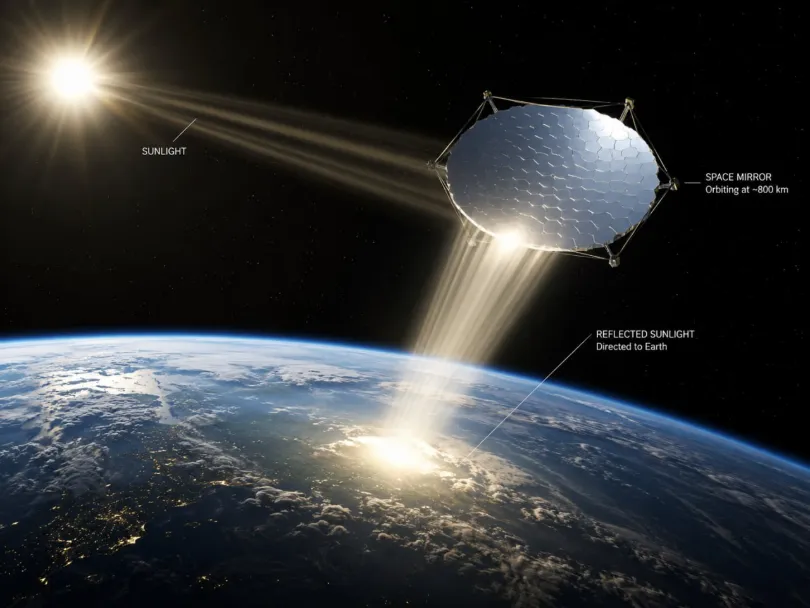
Reflect Orbital is attempting to provide on-demand sunlight using in-space mirrors, and the demo flight will test its core hardware, an 18 meter film reflector designed to redirect sunlight down to the surface. The mission and the company’s broader plan to launch a constellation of 50,000 additional mirrors have drawn opposition from astronomers, who argue the hardware will have long-reaching effects on their ability to conduct space science from terrestrial telescopes. Other scientists have warned that reflecting sunlight onto the planet during periods of darkness could disrupt local flora and fauna by interfering with the natural cycle of day and night.
In its review, the FCC said concerns about how the spacecraft will affect the environment and astronomy fall outside the Commission’s scope. The license authorizes a single mission, and the FCC declined to address concerns about the larger constellation. “The harms that commenters allege are unlikely to materialize from the operations of a single satellite, and commenters have not sufficiently justified the necessity of conditions on or denial of Reflect Orbital’s application,” the Commission wrote in its decision. The company has responded directly to researchers, stating that the debut mission is built to prove it can operate in a way that mitigates impacts on astronomy and local environments.
“Reflect Orbital is earning the right to operate and to scale. That means proving that reflected sunlight can be controlled precisely, used only where appropriate, limited in brightness and duration, and coordinated with affected communities and scientific institutions,” said Tristan Semmelhack, the company’s chief product officer and cofounder.
The approval means a company is now legally cleared to place mirrors in orbit that redirect sunlight to Earth, while the regulatory body that granted the clearance has stated that environmental and astronomical impacts are not within its authority to evaluate. That jurisdictional gap leaves open the question of who, if anyone, is positioned to assess the effects of a constellation numbering in the tens of thousands.
The Eärendil-1 demonstration is scheduled to fly this year. The single license does not extend to the broader constellation, and the FCC has not indicated how or whether the larger plan will be reviewed.