General Atomics was founded in 1955 as a division of General Dynamics and has its headquarters in San Diego, California. General Atomics is a diversified technology leader operating across defense, energy, aerospace, and electronics. Its core mission is pioneering advanced technologies to meet national security, commercial and scientific needs.
The General Atomics Electromagnetic Systems (EMS) division develops EMALS (Electromagnetic Aircraft Launch Systems) and related launch/recovery tech, which provide high-power pulsed energy technologies potentially adaptable for future satellite-launch or spaceport systems. GA Aeronautical Systems, Inc. (GA-ASI), the company’s aerospace subsidiary based in Poway, CA, is a world-leader in unmanned aerial systems (UAS), producing platforms such as the Predator, Gray Eagle, Reaper, SkyGuardian (MQ-9B), and advanced experimental models like MQ-20 Avenger, XQ-67A, YFQ-42 (Gambit), LongShot, Mojave, and Eaglet. These systems provide persistent surveillance, signals intelligence, and combat strike capabilities globally, with customers including the U.S. military and allied governments.
General Atomics Electromagnetic Systems (GA-EMS) is working with NASA on nuclear thermal propulsion fuel testing, especially at NASA’s Marshall Space Flight Center. These collaborations aim to validate reactor systems for safe operation in spaceflight environments. General Atomics participated in this public–private NASA research consortium alongside Aurora Flight Sciences, AeroVironment, and others to develop high-altitude unmanned aircraft systems. GA-EMS holds major contracts with the U.S. Navy (EMALS, rail guns), and GA-ASI has ongoing work with the U.S. DoD and DARPA, including development of LongShot air-launched drones and CCA (Collaborative Combat Aircraft) prototypes.
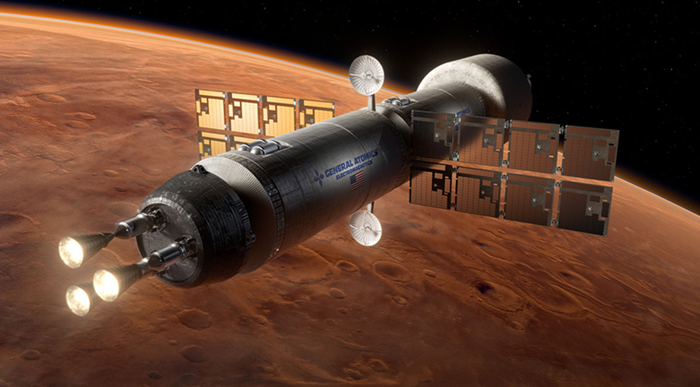
General Atomics was awarded DARPA Contract to design Nuclear Thermal Propulsion System for the DRACO Mission. Under the DARPA contract awarded in April 2021, GA-EMS leads Track A, delivering the NTP reactor design and engine for an orbital demonstration targeted around 2025–2027. In January 2025, GA successfully tested its proprietary NTP fuel elements at NASA’s Marshall Space Flight Center (MSFC) using the CFEET facility. These fuel samples endured six thermal cycles up to ~2,600 K (≈ 4,220 °F) in hot hydrogen gas for 20 minutes per cycle, demonstrating erosion resistance and material integrity.
Key products
Through its affiliate General Atomics Electromagnetic Systems (GA-EMS) and related divisions, General Atomics has expanded significantly into the space domain, offering innovative solutions that support satellite operators, scientific researchers, and commercial space ventures.
Satellite Launch Services and Rideshare Missions
GA-EMS (General Atomics Electromagnetic Systems) offers turnkey solutions for launching and operating small satellites, including payload hosting on their own platforms and rideshare opportunities on other launch vehicles. They provide end-to-end solutions for missions ranging from single satellites to constellations, leveraging their expertise in satellite design, manufacturing, integration and launch services. General Atomics (GA) builds modular satellite platforms designed to support a variety of sensors and payloads, offering tailored solutions for diverse mission requirements. They leverage flight-proven technologies, scalable architectures, and modular designs to create optimized spacecraft for single and multiple payload needs.
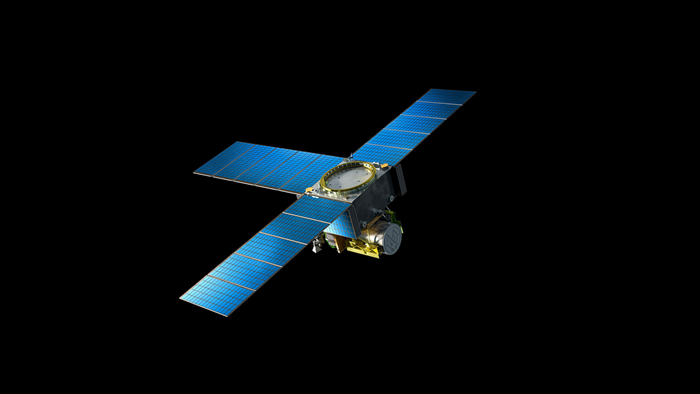
Orbital Test Bed (OTB) Platform
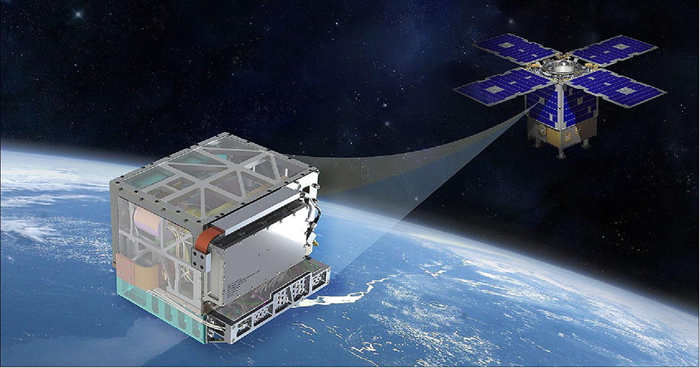
GA’s Orbital Test Bed (OTB) platform is designed for both technology demonstration and hosted payload missions. It serves as a versatile platform for on-orbit testing of various scientific, research and prototype payloads. The OTB allows for the simultaneous launch of multiple demonstration payloads, including those from NASA and other customers. It enables rapid deployment and cost-effective access to space for organizations that need to test technologies or conduct space-based research.
Electric Propulsion Systems
GA-EMS develops advanced Hall-effect thrusters and plasma propulsion systems for satellite station-keeping and orbital maneuvers. They offer scalable electric propulsion suitable for small to medium satellites. These systems provide efficient, long-duration thrust, critical for extended missions and deep space operations.
Space Nuclear Power Systems
General Atomics Electromagnetic Systems (GA-EMS) is actively involved in developing nuclear thermal propulsion (NTP) and space reactor technology, particularly for NASA and DoD programs. They have been making significant strides in testing and validating their nuclear fuel designs for NTP systems. Their work aligns with broader efforts by NASA, the Department of Defense (DoD), and the Department of Energy to advance space nuclear propulsion. General Atomics is actively engaged in developing compact fission reactors for space applications, specifically to provide long-duration power on lunar and planetary surfaces. They are leveraging their experience in nuclear technologies and space systems to create robust and scalable fission surface power (FSP) systems for lunar and Martian exploration.
General Atomics leverages its deep technical expertise to provide end-to-end space solutions, from propulsion and power to satellite platforms and launch integration. The company’s emphasis on modularity, propulsion innovation, and hosted payloads provides flexible and affordable space access for a broad spectrum of users. Whether enabling precision timekeeping in deep space, powering satellites with advanced propulsion, or launching multiple payloads efficiently, GA continues to be a key enabler of next-generation space missions, especially for defense, research, and commercial sectors.