ION-X has successfully performed the first-ever in-orbit firing of a European developed ionic liquid electrospray thruster. This milestone marks only the second global demonstration of this advanced propulsion technology in space, nearly a decade after the inaugural mission by BUSEK for the LISA-PATHFINDER mission in 2015.
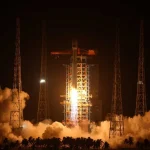
On May 6th, 2025, onboard a spacecraft built by Danish satellite manufacturer Space Inventor and launched on SpaceX’s Transporter-12 mission in January 2025, ION-X’s thruster emitted its first ion beam in Low Earth Orbit. Triggered by its onboard computer and powered by ION-X’s proprietary Power Processing Unit (PPU), the system successfully generated thrust estimated at 20 µN, with an ion beam of 200µA at 5kV.
Tests in orbit are still on-going, and this is already a significant achievement for the company. The first ionic liquid electric propulsion system was developed by BUSEK under a NASA contract and launched in 2015 for the LISA PATHFINDER mission. Ten years later, ION-X demonstration is only the second occurrence worldwide of an ionic liquid electrospray firing in space and the 1st from a European company.
“We worked really hard over the past three years to achieve these first results. I am immensely proud and grateful to the ION-X team. We could not have done it without their dedication and professionalism. There is still a lot of work to increase the performances and the reliability of our thruster but this is a clear sign that we are going in the right direction.” Thomas HIRIART – ION-X CEO.
This achievement is the culmination of three years of intense R&D made at C2N, the nanoscience laboratory of CNRS located in Palaiseau, south of Paris. It marks a major step toward the deployment of European-made electrospray propulsion technologies for the next-generation of space missions.
A Broad Demonstration of Capabilities in Orbit
Beyond this historic firing, the EDISON mission also allowed ION-X to validate a wide range of capabilities, including:
• End-to-end communication between Earth and the thruster, via the satellite
• Embedded software in-flight updates
• Automatic FDIR (Failure Detection, Isolation and Recovery) algorithms
• High-voltage generation and control
• Safe handling and storage of ionic liquid propellant
• Orbital conditions transfers and telemetry management
• Precise control of ionic emission through current-voltage algorithms
ION-X’s compact and scalable thruster is tailored to meet the growing demand for high-precision, lowpower propulsion systems. It addresses critical use cases such as constellation deployment, collision avoidance, and station-keeping for small satellites. Its electrospray design enables extreme miniaturization, low plume contamination, and high pointing accuracy, key performance drivers for satellite manufacturers and mission integrators.
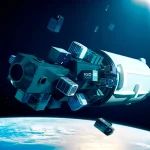
The first flight model was integrated on the Space Inventor’s EDISON spacecraft in May 2024, just three years after ION-X’s incorporation and with a total budget under €4 million, a remarkable programmatic, financial and technical achievement in the field of space propulsion.
As the EDISION mission is expected to terminate this summer, ION-X is already gearing up towards its next space missions. The second flight of the company’s thruster shall be publicly announced in the coming weeks, for a launch expected by mid-2026. This will give the opportunity to the company’s team of engineers and scientists to fly an even more sophisticated version of its propulsion system, with the aim to demonstrate increasing performances and accelerate its commercial and industrial development.