Magna Petra, a lunar resources extraction company, has signed a Cooperative Research and Development Agreement (CRADA) with NASA’s Kennedy Space Center in Florida, securing the use of a specialised mass spectrometer previously flown on government-led lunar missions. This marks the first time a commercial company has been granted access to this technology – an instrument originally developed to detect water ice, now being repurposed to assess the presence of helium-3 on the Moon. The agreement will materially accelerate Magna Petra’s efforts to establish a scalable, low-impact helium-3 supply chain from the Moon to Earth.
The CRADA allows Magna Petra to integrate a government-developed, lunar-hardened mass spectrometer into their commercial mission framework. Information from the instrument will help the company validate its proprietary lunar “digital twin” – an AI model that simulates the density and distribution of helium-3 over four billion years of solar wind activity on the lunar surface.
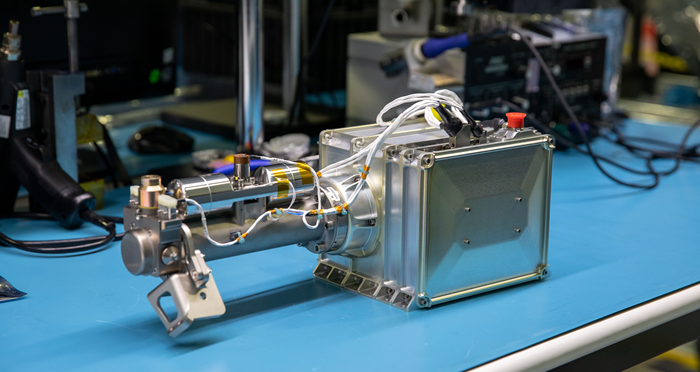
The highly specialized mass spectrometer – known as Mass Spectrometer Observing Lunar Operations (MSOLO) – was originally developed for the space agency’s missions. The instrument is engineered to operate in the harsh conditions of the lunar surface and ultimately will be used to take direct measurements of gases locked within the Moon’s dusty topsoil, known as regolith.
Magna Petra intends to deploy the device to assess the presence of helium-3, a rare isotope with major potential as the only truly “clean” fuel for nuclear fusion, and as a critical operating component for quantum computing. The readings will also provide a critical test of the company’s AI-based “digital twin” of the Moon – an ambitious simulation that models how helium and other volatiles have migrated through the regolith over billions of years of solar wind bombardment.
Jeffrey Max, CEO of Magna Petra comments on the agreement, “This agreement is a landmark moment – not just for Magna Petra, but for what it represents in the evolution of lunar exploration and the utilization of lunar resources here on earth. For the first time, a commercial company has been granted the opportunity to deploy a government-developed instrument in pursuit of validating a resource that could fundamentally transform how we power the planet. We’re building the foundations of a sustainable supply chain for helium-3 – an element that’s virtually unobtainable on Earth, but abundant on the lunar surface – and crucial for future fusion energy and quantum systems. By combining public-sector ingenuity with private-sector agility, this agreement allows us to ground our science in real-world data, fast-track innovation, and bring the Moon a step closer to being an active part of Earth’s clean energy future. It’s a meaningful milestone – but it’s also just the beginning.”
Helium-3, a rare isotope on Earth but abundant in the lunar regolith, is drawing increasing attention for its role in next-generation fusion reactors and ultra-low temperature quantum systems. Its fusion properties allow for direct conversion of energy without the radioactive by-products of traditional fuels, and it plays a vital role in cooling systems for quantum computing and sensor technologies.
Michael Baczyk, Director of Investment Advisory at Global Quantum Intelligence added, “Helium-3 sits at the heart of some of the most transformative technologies of our time – playing a vital role in quantum computing, where it helps achieve the ultra-low temperatures needed for superconducting quantum processors to function at their best.”
“As quantum systems mature and clean energy solutions like fusion edge closer to reality, securing a reliable helium-3 supply chain becomes strategically essential. This agreement is a forward-thinking move – unlocking lunar resources to meet the demands of Earth’s most advanced technologies. Beyond its scientific importance, it’s a crucial step in building resilience into the supply chains that will power the next generation of computing and energy systems.”
Magna Petra’s mission architecture includes a series of upcoming reconnaissance missions followed by a return-validation campaign. The MSOLO instrument, originally deployed on earlier U.S. government missions, will serve a new commercial purpose – providing insights to help the company validate helium-3 predictions and paving the way for a new kind of lunar logistics.