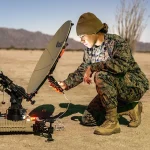
Cobham Satcom, a business unit within Cobham plc, provides satellite communications equipment engineered for operational environments where reliability is essential. With ground-based and mobile satcom technologies, the company supplies terminals and antenna systems used across land, maritime, and airborne platforms.The Government & Defence portfolio, Cobham Satcom emphasises systems that are portable, quickly deployable and adaptable to multi-orbit network architectures. This includes transportable tracking terminals, tactical antennas and satcom platforms designed to operate in austere or rapidly changing conditions, ensuring that defence and government operators can maintain secure and resilient communication links wherever they are deployed.
Tactical Tracker – Core Terminal Platform
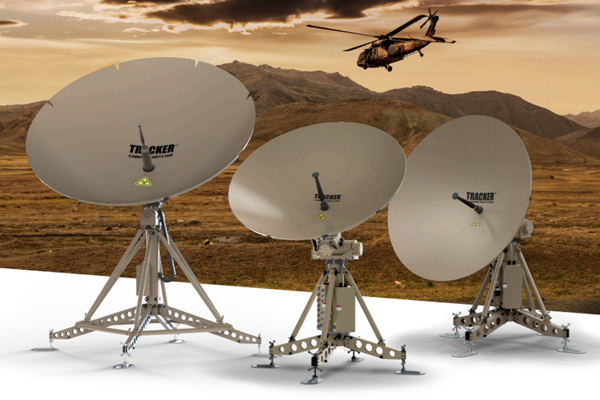
Cobham Satcom’s TACTICAL TRACKER family forms the central component of the deployable Government & Defence communications portfolio. These systems are designed as transportable, high-reliability satellite tracking terminals that can establish communications links across GEO, MEO and LEO satellite constellations. The platform is built for missions where mobility, fast setup and multi-orbit adaptability are operational requirements, making it suitable for defence forces, emergency response teams and government field units.
The TACTICAL TRACKER series is engineered to achieve rapid field deployment, with Cobham specifying that two operators can assemble and activate the system in under 30 minutes. This is made possible through a tool-free mechanical design, modular assemblies and compact transit cases that streamline logistics whether the system is transported by land vehicles, aircraft, or maritime platforms. The baseline configuration weighs approximately 149.7 kg, enabling mobility while maintaining the rigidity necessary for precision tracking. A key operational feature of the system is the ability to lock onto satellites in less than 10 seconds, supported by Cobham Satcom’s proprietary tracking algorithm. This capability reduces time-to-link during mission deployment or after relocation, ensuring that users can restore connectivity quickly in dynamic operational environments.
The latest model, the TACTICAL TRACKER 2600, incorporates several technical updates aimed at improving efficiency, reliability and compliance with defence communication standards. It is currently undergoing certification for the US Wideband Global SATCOM (WGS) network and is the only X/Y mounting terminal type progressing through that certification pathway. Engineering refinements include a reduction in external ports as well as the introduction of a simplified, app-based graphical user interface that allows operators to complete setup and diagnostics with greater ease. These updates reduce potential error sources, streamline user interaction and support faster operational readiness in the field.
Multi-Orbit & Multi-Band Capability
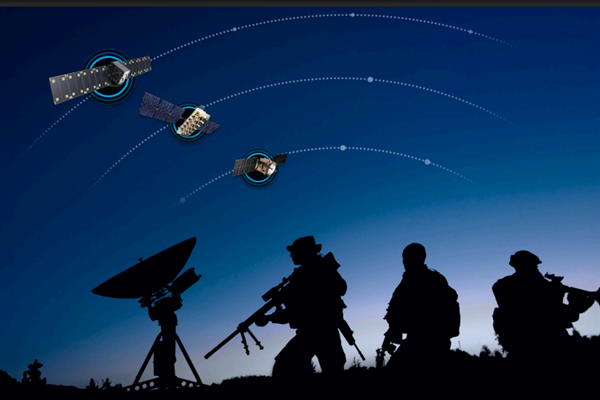
Cobham Satcom designs the tactical terminals to operate seamlessly across multiple satellite network types, offering built-in support for Ku-band and Ka-band frequencies and compatibility with GEO, MEO and LEO constellations. This multi-orbit interoperability is central to the TACTICAL TRACKER product family, which Cobham describes as a set of lightweight yet robust antenna systems engineered for rapid deployment and flexible mission profiles. The ability to access different orbital layers allows a single terminal to maintain connectivity as operational needs shift. The TACTICAL TRACKER is designed to perform rapid orbital handovers, enabling the antenna to switch between GEO, MEO and LEO satellites without mechanical reconfiguration. This feature supports modern battlefield mobility, where communications units must frequently reposition or operate in areas with variable satellite coverage. The system is engineered for operation in harsh and unpredictable environments, including extreme temperatures, vibration and dust exposure often encountered in land and maritime operations. The multi-band electronics and tracking system allow the terminal to maintain stable links even under movement or environmental strain. The architecture is also designed to remain compatible with future satellite networks, ensuring that operators can adopt new service providers or upgraded constellations without requiring major hardware changes. This forward-compatibility allows defence and government users to sustain long-term satcom capability as the global space communications landscape evolves.
Operational readiness is a core requirement in defence communications and Cobham positions its solutions accordingly. The TACTICAL TRACKER range is purpose-designed for transportable deployment, with ruggedised components, simplified logistics and a modular build. The system can be deployed from crate to operational state in under 30 minutes, without tools, facilitating rapid relocation or repositioning. The design includes 3-axis inertial balanced tracking, which reduces power consumption compared to traditional X/Y mounts, simplifying field power logistics and thermal load management. The terminal also supports legacy and emerging waveforms, enabling interoperability and future-proofing.
Applications in Defence, Tactical Networks & Satellite Infrastructure

Cobham Satcom’s tactical antenna systems and satellite ground solutions are deployed across a wide spectrum of defence, government and humanitarian missions where secure and dependable communications are required. Defence organisations use these systems to establish and maintain satcom links for command, control, intelligence and logistics, particularly in locations where terrestrial networks are unavailable or have been compromised. The TACTICAL TRACKER terminals, with their transportable and rapid-deployment architecture, support satcom-on-the-move and satcom-on-the-halt operations, enabling units to maintain communications continuity while relocating or operating from temporary field positions. These systems are also integrated into forward operating bases, mobile command posts, maritime patrol vessels and airborne platforms, providing scalable connectivity across mission types. Humanitarian response agencies deploy Cobham terminals to coordinate relief operations, establish communications hubs in disaster-affected regions and support emergency medical and logistics networks. The ability to deploy a fully functional satellite terminal in a short timeframe, without specialised tools, is particularly valuable when network restoration is urgent.
Cobham Satcom’s support for GEO, MEO and LEO constellations enhances operational flexibility as modern tactical networks increasingly rely on multi-orbit approaches for resilience and performance. This adaptability ensures the equipment remains compatible with evolving satellite infrastructures, including next-generation low-latency services and high-capacity MEO networks. Beyond mobile field use, the TACTICAL TRACKER systems can be integrated into national gateway networks and fixed installations, strengthening the continuity of defence communication architectures. Their multi-orbit capability and ruggedised design help ensure network survivability in contested, denied or degraded environments, allowing military and government operators to maintain critical connectivity during high-stress or rapidly changing situations.
About Cobham Satcom
Cobham Satcom is a global provider of satellite communications terminals and antenna systems serving government, defence, maritime and land-based markets. Headquartered in Lyngby, Denmark, the company delivers a broad portfolio of solutions spanning transportable tracking antennas, tactical terminals, maritime satcom, and airborne communication systems. The technologies support connectivity across GEO, MEO and LEO networks, enabling resilient communications for mission-critical operations. With more than 40 years of engineering heritage in satellite ground equipment, Cobham Satcom continues to advance terminal designs focused on portability, rapid deployment, and multi-orbit interoperability supporting defence agencies, government users and commercial operators that rely on secure, robust satellite connectivity in challenging environments.