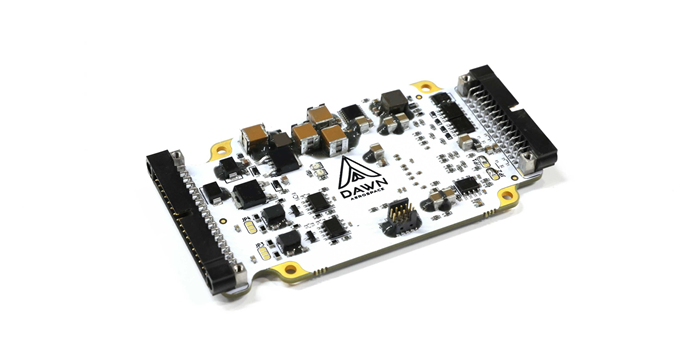
Dawn Aerospace has completed the development and qualification of radiation-tolerant electronics for its SatDrive propulsion systems, paving the way for missions beyond Low Earth Orbit (LEO) to Geostationary (GEO) and Cislunar space. This milestone follows a rigorous testing campaign, including radiation test campaigns at leading facilities in the Netherlands and NASA’s Space Radiation Laboratory.
Since Dawn launched the first nitrous oxide (N2O) propellant satellite in 2021, its propulsion systems have flown aboard over 30 spacecraft. Dawn’s customers are no longer the only operators using N2O in LEO. Industry leaders like Impulse Space, founded by SpaceX propulsion chief Tom Mueller, are operating a growing fleet of N2O-propelled spacecraft in LEO.
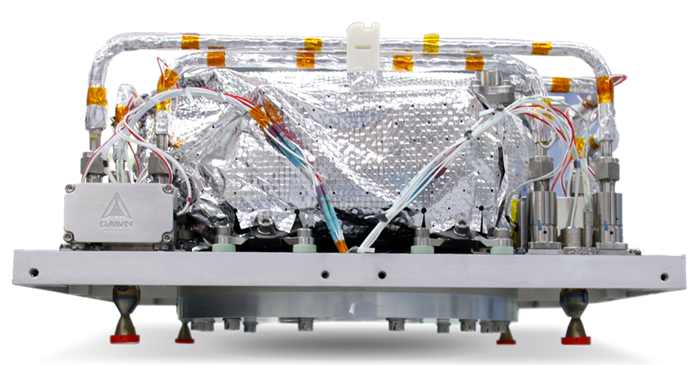 Dawn Aerospace SatDrive
As demand rises for missions in higher radiation orbits, Dawn has responded with a fully qualified electronics stack optimised for radiation tolerance, resilience, and extended mission life. This advancement is already enabling customers like Blue Canyon Technologies on their Lunar Relay Satellites and Infinite Orbits with their Lifetime Extension Vehicle Endurance. These missions require both six-degree-of-freedom manoeuvrability in challenging radiation environments, capabilities that Dawn now delivers in a turnkey propulsion package, including integrated electronics and flight software.
By extending SatDrive’s proven flexibility into GEO and Lunar orbits, Dawn is enabling a new class of mission architectures:
- Space Domain Awareness (SDA)
- Proximity Operations & Rendezvous in GEO
- Lunar Communications and Logistics
- Dynamic Space Operations across a variety of orbits