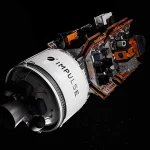
Dragonfly Aerospace has announced the launch of its new satellite platform, the ηDragonfly Bus, a revolutionary system designed to bridge the historical performance gap between cost-effective nano-satellites and highly capable microsatellites.
Dragonfly Aerospace states that ηDragonfly combines the agility and cost benefits of smaller satellites with the high reliability and long-term performance traditionally found only in larger platforms. The bus is built around the company’s flight-proven, TRL 9 Dragonfly Aerospace Avionics Suite, integrated within an ultra-compact, mass-efficient composite bus structure featuring a Carbon Fibre Reinforced Polymer (CFRP) honeycomb core.
“ηDragonfly delivers the best of both worlds,” said Kannas Wiid, Satellite System Engineer at Dragonfly Aerospace. “We’re bringing microsatellite-level capability to a smaller, flexible platform, so operators no longer have to compromise between performance and cost.”
Moving beyond the typical limitations of nano-satellites, the ηDragonfly is engineered for fault-tolerant, long-duration missions. Key reliability features include:
- Dual-redundant, single-fault-tolerant components.
- A radiation-tolerant OnBoard Computer (OBC) with advanced Fault Detection, Isolation and Recovery (FDIR).
- Rigorous testing aligned with ECSS and NASA standards.
- A design built for over five years of dependable operation in harsh space environments.
The platform also provides exceptional stability for mission-critical operations. Its advanced Attitude and Orbit Control System (AOCS) boasts a 10 Hz autonomous control loop and achieves a pointing stability of 0.005°/s, essential for precise, long-duration missions.
Scalable Power and Flexible Design
The new bus design eliminates the volume constraints of standardized CubeSats (1U–16U), allowing it to support larger and heavier payloads while maintaining comparable or lower launch costs than a typical 16U unit. Powering this enhanced capability is a 7th-generation Electrical Power System (EPS) capable of delivering up to 1.2 kW peak power. The modular and scalable system utilizes expandable battery modules and deployable solar arrays that provide 20–70W of average power.
With a 450mm³ payload deck, the ηDragonfly is designed to accommodate a wide range of demanding instruments, including high-resolution optical imagers and Synthetic Aperture Radar (SAR) payloads, positioning it as a versatile foundation for the next generation of Earth observation missions.