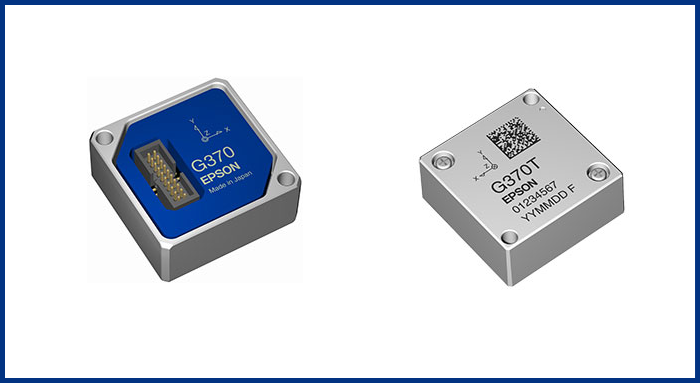
Epson, a leading global supplier of high-performance components including quartz crystal-based inertial sensors and semiconductors, announced its milestone moment at the ION GNSS+ 2025 Trade Show on September 10–11, 2025, at the Hilton Baltimore Inner Harbor. Epson is showcasing the M-G370PDT Inertial Measurement Unit (IMU), one of their latest sensors engineered for advanced navigation and stabilization applications where reliability, precision, and performance are critical.
Having delivered over 5000 devices since introduction in 2024, the M-G370PDT IMU represents the latest evolution of Epson’s inertial sensor portfolio, delivering very low-noise performance in a compact 1-inch form factor. Purpose-built for demanding applications, it empowers engineers working in:
- Optical stabilization – enabling high accuracy for imaging and observation systems.
- Spacecraft guidance – enabling resilience in extreme environments beyond Earth’s atmosphere.
- Machine control – driving precision and efficiency in industrial and autonomous platforms.
- Structural health monitoring – providing unparalleled sensitivity to detect and measure vibration, tilt, and shifts in large-scale infrastructure.
“The M-G370PDT IMU is more than a sensor—it’s a gateway to enabling innovation in navigation and control systems,” said Bhushan Chaudhari, Senior Product Marketing Manager, Epson Microdevices. “Engineers across aerospace, robotics, and industrial markets demand performance without compromise. With a spaceflight heritage that includes two trips to Mars, it delivers the performance the industry requires and offers the precision and reliability needed for future projects.”
Combining compact size (24 × 24 × 10 mm), lightweight design (~10 g), and ultra-low power consumption (16 mA @ 3.3 V), the M-G370PDT achieves high-end performance which is often seen in systems which consume more power and are greater in size. It also features gyroscopes with 0.8°/h bias instability and 0.03°/√h angular random walk, along with accelerometers offering ±8 G or ±16 G ranges for high accuracy across mission-critical conditions. With SPI and UART interfaces, up to 2 kSps digital output, and factory calibration from –40 °C to +85 °C, the device is designed to perform reliably across diverse and extreme operating environments. The M-G370PDT is designed for various applications, from mid-to-low Earth orbit satellites, airborne unmanned vehicles and land-based navigation systems. Epson’s proven space heritage is underscored by the deployment of select M-G370 series IMUs in the Internal Ball Camera 2 aboard the International Space Station (ISS), where they deliver microgravity stabilization in one of the harshest environments imaginable.
With Epson’s heritage as a pioneer in crystal device technology since the 1960s and backed by fully integrated in-house quartz and semiconductor manufacturing, the M-G370PDT embodies the company’s commitment to power savings, miniaturization, and uncompromising quality.