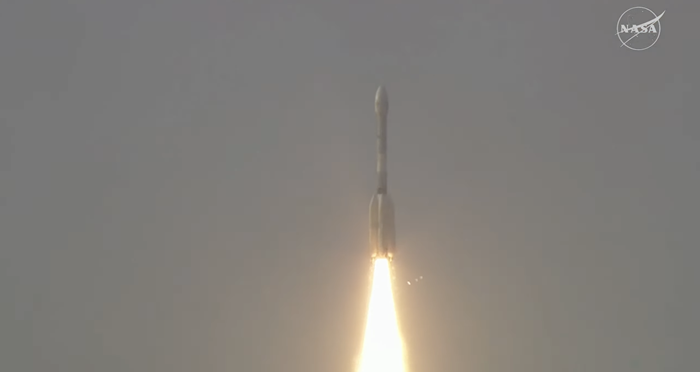
NISAR (NASA–ISRO Synthetic Aperture Radar), a satellite carrying an advanced radar system that will produce a dynamic, three-dimensional view of Earth in unprecedented detail, has launched from Satish Dhawan Space Centre in Sriharikota, Andhra Pradesh, India. The first-of-its-kind satellite will provide actionable information in a range of areas, including disaster response, infrastructure monitoring, and agricultural management.
Jointly developed by NASA and the Indian Space Research Organisation (ISRO), and a critical part of the United States–India civil space cooperation highlighted by President Trump and Prime Minister Modi earlier this year, the satellite can detect the movement of land and ice surfaces down to the centimeter level. The mission will help protect communities by providing unique, actionable information to decision-makers in a diverse range of areas, including disaster response, infrastructure monitoring, and agricultural management.
A collaboration between NASA and ISRO (Indian Space Research Organisation), the powerful new NISAR satellite will provide high-resolution data to help decision-makers, communities, and scientists monitor major infrastructure, agricultural fields, and the movement of land and ice surfaces.
The satellite lifted off aboard an ISRO Geosynchronous Satellite Launch Vehicle (GSLV) rocket at 8:10 a.m. EDT (5:10 p.m. IST), Wednesday, July 30. The ISRO ground controllers began communicating with NISAR about 20 minutes after launch, at approximately 8:29 a.m. EDT, and confirmed that it is operating as expected.
“Congratulations to the entire NISAR mission team on a successful launch that spanned across multiple time zones and continents in the first-ever partnership between NASA and ISRO on a mission of this sheer magnitude,” said Nicky Fox, associate administrator, Science Mission Directorate at NASA Headquarters in Washington. “Where moments are most critical, NISAR’s data will help ensure the health and safety of those impacted on Earth, as well as the infrastructure that supports them, for the benefit of all.”