Rapidtek Technologies, headquartered in Taipei, Taiwan, specializes in space communication modules and phased-array antenna technologies. Rapidtek recently unveiled the FoldSAT portable LEO satellite user terminal at the 2025 Taipei Aerospace & Defense Technology Exhibition (TADTE). The product was co-developed with a customer, launched under the customer’s brand, while the core RF and phased-array antenna technology was provided by Rapidtek, highlighting the company’s role as a critical technology enabler in the LEO communications ecosystem.
FoldSAT is lightweight, rugged, and can be deployed within minutes. It is designed for unmanned surface vessels, defense operations, disaster recovery, remote agriculture and fisheries, and energy infrastructure. Featuring a Ku-band full-duplex electronically steered antenna, it supports up to 195 Mbps downlink / 32 Mbps uplink, with built-in Wi-Fi 6 connectivity. Certified to MIL-STD 810H/461G standards and equipped with portable battery power (180 minutes endurance), FoldSAT ensures reliable performance in the harshest conditions, particularly for tactical operations and high-mobility platforms.
Chairman Arthur Wang commented: “FoldSAT represents the close collaboration between Rapidtek and our customer. We provide the enabling technologies, while the customer brings it to market under their brand. This co-development model marks a major step forward as Rapidtek expands from RF design into LEO communications applications.”
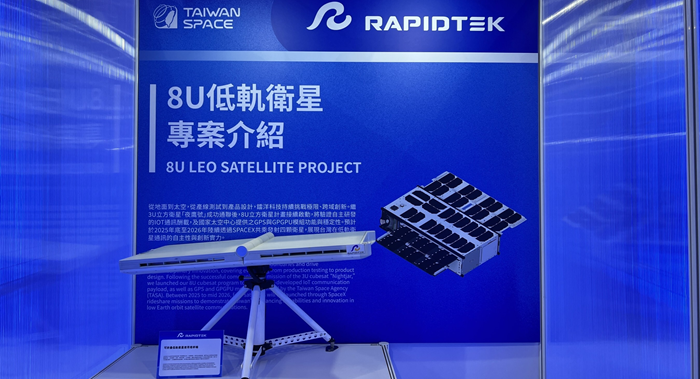
In addition to FoldSAT, Rapidtek also showcased the 8U IoT satellite “Black Kite-1”, developed in collaboration with Taiwan Space Agency (TASA). Following the successful 3U “Nightjar” mission, the 8U satellite is scheduled for launch aboard a SpaceX rocket later this year to validate IoT payload performance and space-grade processing. The combined display of FoldSAT and the 8U satellite underscores Rapidtek’s integrated Earth-to-Space strategy.
Looking ahead, Rapidtek will continue to advance its co-development model with customers, driving the parallel growth of ground terminals (FoldSAT) and space platforms (8U satellites). Over the next three years, the company plans to deploy a constellation of multiple satellites paired with diverse ground terminal solutions, supporting a wide range of applications from national defense and disaster response to smart agriculture and energy operations. This integrated approach will reinforce Taiwan’s position as an emerging player in the global LEO communications market.