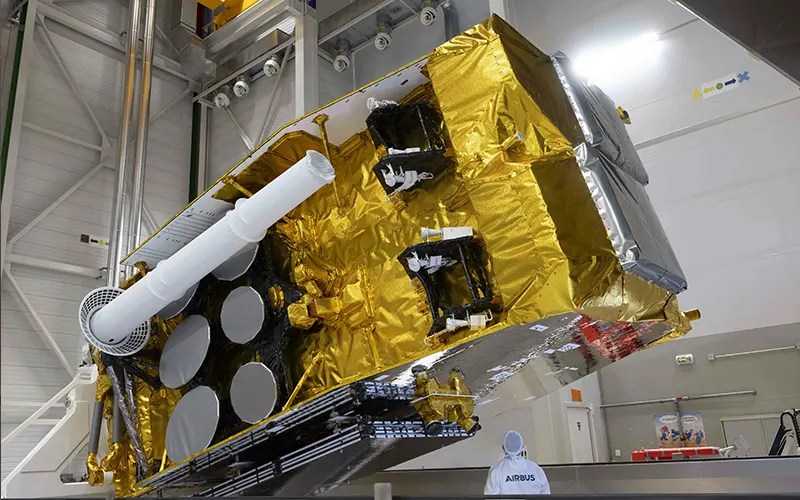
Hisdesat said the SpainSat NG II military communications satellite has suffered non-recoverable damage after being struck by a space particle, prompting the company to begin the process of procuring a replacement spacecraft.
In a statement issued on January 16, Hisdesat said the satellite was hit by a particle estimated to be only a few millimetres in size and weighing a few grams. Despite its small size, the object’s high velocity and the location of the impact caused damage that cannot be repaired, the company said. The satellite’s highly eccentric orbit means it poses no risk or interference to other space missions, according to Hisdesat.
SpainSat NG II was launched aboard a SpaceX Falcon 9 rocket in October 2025 and was one of two next-generation secure communications satellites built by Airbus for Spain’s armed forces. The spacecraft was operated by Hisdesat on behalf of the military.
Following the incident, Hisdesat said it has initiated a request for quotation (RFQ) for a replacement satellite, to be designated SpainSat NG III. The company added that SpainSat NG II was fully insured against this type of event and that the loss would not result in direct economic damage to Hisdesat. However, industry analysts note that large insurance claims can lead to higher premiums for future satellite programmes.
While the cost of individual satellites has not been disclosed, Invest in Spain has previously said the overall SpainSat NG programme is valued at around €2 billion, suggesting the insurance claim could run into the hundreds of millions of euros.
Airbus secured the contract to build the first two SpainSat NG satellites in 2019. The first satellite, SpainSat NG I, was launched in January 2025, more than five years after the contract award. Based on that timeline, a replacement for SpainSat NG II may not be delivered and launched until around 2030.
In the interim, Hisdesat said it will continue to provide secure communications services to Spain’s armed forces using SpainSat NG I and the original SpainSat, which was launched in 2006 aboard an Ariane 5 rocket and remains operational despite being close to 20 years into its originally planned 15-year design life.