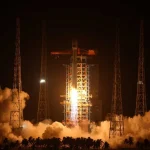
United Launch Alliance (ULA) is preparing to make history as its next-generation Vulcan rocket undertakes its first US national security mission. The USSF-106 mission, carrying a classified payload for the U.S. Space Force’s Space Systems Command, is scheduled to lift off from Space Launch Complex-41 at Cape Canaveral Space Force Station during a one-hour launch window between 7:59 and 8:59 p.m. EDT (2359–0059 UTC). The mission will deliver its payload directly to geosynchronous orbit, marking Vulcan’s debut in the National Security Space Launch (NSSL) program and a major milestone for the vehicle’s operational career.
The USSF-106 flight will employ the Vulcan Centaur VC4S configuration with four solid rocket boosters, providing the additional thrust required for this high-energy insertion. This is the first time Vulcan will be used to support a national security payload, a role previously dominated by ULA’s Atlas V and Delta IV Heavy rockets.
The spacecraft is housed within a 5.4-meter-diameter composite payload fairing, constructed with a vented aluminum-honeycomb core and graphite-epoxy face sheets for maximum protection. The Centaur V upper stage, powered by two RL10C-1-1A cryogenic engines fueled by liquid hydrogen and liquid oxygen, will deliver precise orbital insertion, producing 23,825 pounds of thrust per engine. The booster stage, 109.2 feet tall and 17.7 feet in diameter, is fueled by liquefied natural gas and powered by two BE-4 engines generating a combined 1.1 million pounds of thrust. At liftoff, four GEM 63XL solid rocket boosters will add nearly 1.84 million pounds of extra thrust.
ULA uses a “clean pad” approach at SLC-41, where Vulcan is assembled in the Vertical Integration Facility (VIF) before rolling 1,800 feet to the launch pad for final countdown and fueling. The complex, built in the 1960s for the Titan program, includes facilities for solid rocket booster storage, mission control at the Advanced Spaceflight Operations Center, Centaur stage preparation at the Delta Operations Center, spacecraft testing and encapsulation in the Spacecraft Processing Facility, and full vehicle integration in the VIF.
Building Vulcan is a nationwide effort. The BE-4 engines are manufactured by Blue Origin in Kent, Washington; the GEM 63XL solid rocket boosters by Northrop Grumman in Magna, Utah; and the RL10 engines by Aerojet Rocketdyne in West Palm Beach, Florida. ULA’s Denver headquarters handles engineering and design, while its Decatur, Alabama, plant produces the booster, Centaur tanks, and payload fairings, with Beyond Gravity contributing to fairing fabrication.
If successful, the USSF-106 mission will not only demonstrate Vulcan’s capabilities for critical defense operations but also mark the beginning of its service as a cornerstone of U.S. heavy-lift launch capability for years to come.