The German Aerospace Center (DLR) will establish a new Human Exploration Control Center (HECC) at its Oberpfaffenhofen site near Munich to support future human and robotic missions to the Moon and Mars.
The facility will expand the existing German Space Operations Center and is intended to manage complex, long-duration missions beyond low Earth orbit. Officials said the project will strengthen Germany’s and Europe’s ability to conduct independent spaceflight operations.
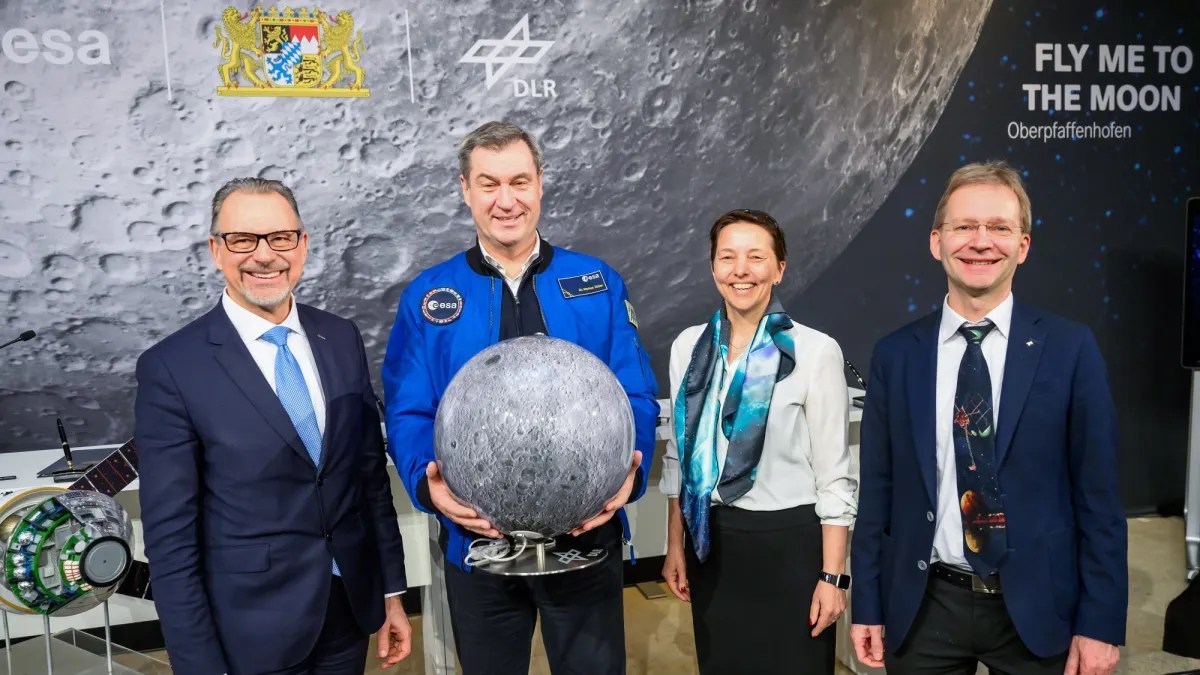
Construction will be funded with €58 million from the Free State of Bavaria and an additional €20 million from DLR. Bavarian Minister-President Markus Soder formally presented the funding notice at the site, alongside DLR Chair Anke Kaysser-Pyzalla and other officials.
Kaysser-Pyzalla said decades of experience in space operations and astronaut training have made Oberpfaffenhofen an internationally recognized center, describing the HECC as the start of a new era in exploration operations.
A primary role of the HECC will be managing European contributions to the planned Gateway in lunar orbit, part of NASA’s Artemis Program. From Germany, operators will oversee key components including the International Habitat module, communications systems linking the station to the lunar surface and refueling infrastructure.
The center will feature mission control rooms, clean-room facilities and high-security operational areas capable of supporting multiple missions simultaneously. It is designed to accommodate about 200 staff members.
German Federal Minister Dorothee Bar said the project would position Oberpfaffenhofen as Europe’s future hub for human and robotic exploration. Bavarian officials also emphasized the economic and technological benefits, including high-skilled jobs and new research initiatives.
Beyond lunar missions, the HECC is expected to support future Mars exploration. Because communication delays between Earth and Mars can reach up to 40 minutes, the center will incorporate advanced autonomy tools, including artificial intelligence systems such as METIS (Mars Exploration Telemetry-driven Information System) to assist spacecraft operations.
Construction of the facility is scheduled to begin in 2028, with operational readiness targeted for 2030. Supported by the European Space Agency (ESA), the HECC is intended to become Europe’s central command hub for deep-space exploration as international missions move beyond Earth orbit.