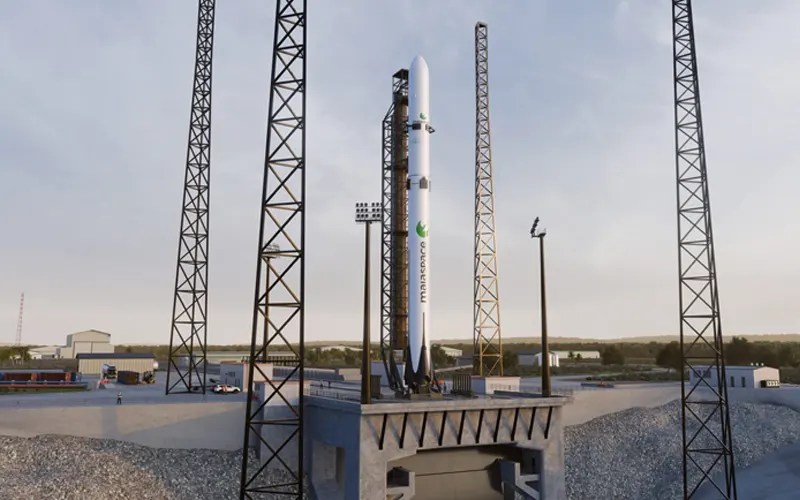
French launch startup MaiaSpace said an initial flight of its Maia rocket planned for 2026 will focus on validating core flight phases using what the company described as a “minimum viable product,” as it works toward commercial launch services from 2027.
MaiaSpace, founded in 2022 as a wholly owned subsidiary of ArianeGroup, is developing a partially reusable, two-stage small launch vehicle designed to place up to 1,500 kilograms into low Earth orbit. The company is also developing an optional kick stage that could increase payload capability by up to 1,000 kilograms, according to company disclosures.
The first flight, planned as a suborbital demonstration mission in late 2026, will use the rocket’s full two-stage configuration but with a reduced propellant load. MaiaSpace said the vehicle will target a minimum altitude of 100 kilometres, allowing engineers to validate key systems before attempting orbital missions.
“For what concerns our first flight, we will deploy a minimum viable product designed to test critical phases,” a MaiaSpace representative told European Spaceflight, citing lift-off, stage separation and second-stage engine ignition among the objectives. The company said the flight is intended to validate the essential features needed for a first orbital launch.
MaiaSpace said the approach reflects an iterative development strategy aimed at accelerating entry into the commercial launch market.
“We are convinced that this way of rebalancing time spent for testing versus time spent running simulations is the most effective way to meet our ambitious goal of bringing a new launcher to market within four to six years, an unprecedented timeline in the global space sector,” the representative said.
Following the demonstration flight and the start of commercial operations in 2027, MaiaSpace plans to gradually introduce reusability features over its first eight to nine orbital missions. The company said the first attempt to recover a Maia first-stage booster is expected in 2028.
Europe has seen renewed interest in small launch vehicles as governments and commercial customers seek independent access to space amid growing demand for satellite deployments. MaiaSpace has positioned Maia as part of that effort, targeting flexible launch services for institutional and commercial payloads.