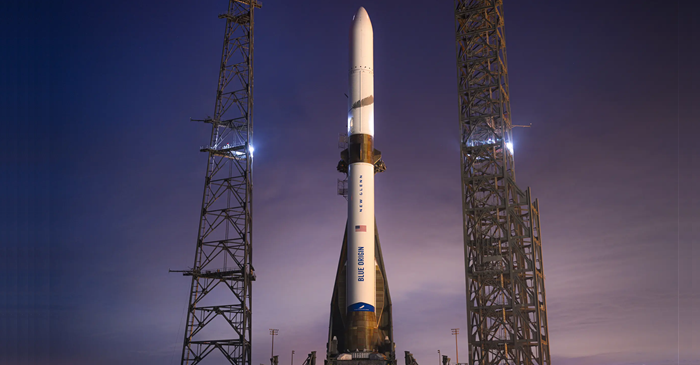
Blue Origin, a US aerospace company founded by Jeff Bezos and focused on expanding access to space, has successfully completed Mission NG-2, the second orbital flight of the New Glenn heavy-lift launch vehicle. The mission, conducted on November 13, 2025, delivered NASA’s twin ESCAPADE (Escape and Plasma Acceleration and Dynamics Explorers) spacecraft into a designated orbit and marked a key milestone in Blue Origin’s heavy-lift launch program, while advancing deep-space science objectives in collaboration with NASA and academic partners.

Mission NG-2 lifted off from Launch Complex 36 at Cape Canaveral Space Force Station, carrying two identically configured ESCAPADE spacecraft developed to study the Martian upper atmosphere, magnetosphere and plasma interactions. After stage separation, the New Glenn first stage successfully returned to Earth, completing a controlled booster recovery on the ocean-based platform Jacklyn—a critical demonstration of reusability that supports Blue Origin’s long-term goal of lowering launch costs and increasing flight cadence. New Glenn’s architecture features a two-stage design optimized for heavy payloads and mission flexibility. The first stage is powered by seven BE-4 engines, utilizing liquid methane and liquid oxygen propellants. This stage is designed for multiple reuses, enabling more sustainable operations across repeated missions. The second stage, equipped with two restartable BE-3U engines, uses liquid hydrogen and liquid oxygen to propel payloads into higher energy orbits for deep-space missions.
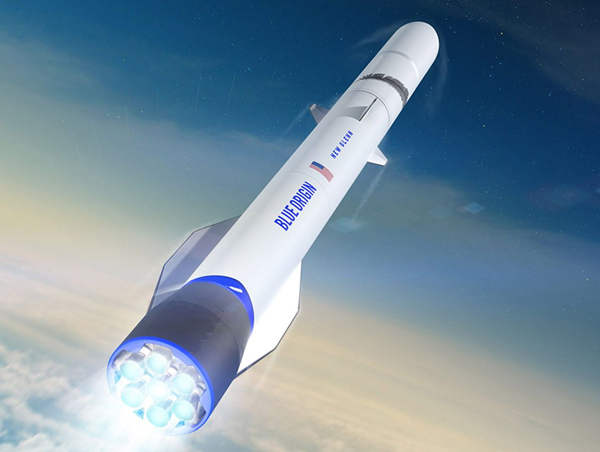
The successful deployment of ESCAPADE underlines New Glenn’s capability to support mission profiles that extend beyond low Earth orbit (LEO) and geostationary transfer orbit (GTO). ESCAPADE’s twin spacecraft, once released, will phase into a trajectory that allows them to use Earth’s gravity to begin a transfer toward Mars, where they are scheduled to arrive and begin their scientific investigations in 2027. These studies will focus on atmospheric escape processes and magnetic field dynamics, helping to enhance understanding of planetary atmospheres and space weather environments.
Mission NG-2 also demonstrated improvements in vehicle performance and operational maturity over New Glenn’s maiden flight (designated NG-1) earlier in 2025. In addition to delivering a combined payload mass exceeding 1,000 kg, the flight executed reliable guidance, navigation, and control operations throughout ascent, fairing jettison, and spacecraft separation phases. Following payload deployment, the New Glenn second stage was safely safed and inerted to comply with NASA’s orbital debris mitigation practices. Beyond scientific payloads, the NG-2 mission carried a Viasat technology demonstration in support of NASA’s Communications Services Project, further showcasing New Glenn’s ability to fly multi-manifest payloads and support technology validation alongside primary mission objectives.

Blue Origin’s New Glenn launch system is designed to provide a reusable orbital heavy-lift solution with a large payload fairing and competitive payload capacity (over 45 metric tons to LEO and greater than 13 metric tons to GTO). The vehicle’s first stage can be reused for multiple flights, aligning with industry trends toward sustainability and cost-effective access to space. Mission NG-2 contributes to the United States’ broader space architecture by supporting NASA science missions and validating commercial launch capabilities for deep-space exploration.
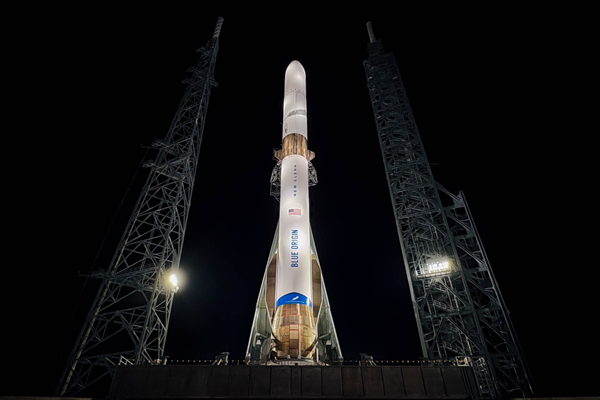
The successful booster recovery also strengthens Blue Origin’s position in the evolving commercial launch sector and builds operational confidence as the company gears up for future New Glenn flights with enhanced performance and increased cadence. As Blue Origin continues New Glenn operations and partners with government agencies, commercial customers, and scientific institutions, Mission NG-2 represents both a technical achievement in reusable heavy-lift propulsion and a practical demonstration of the rocket’s ability to support complex, multi-payload missions that span Earth orbit to interplanetary trajectories.
About Blue Origin
Blue Origin is a privately funded US aerospace manufacturer and space-services company founded by Jeff Bezos in 2000. The company is headquartered in Kent, Washington. Blue Origin’s core mission is to develop and operate reusable rocket propulsion systems, launch vehicles and in-space systems, aiming to enable increased access to space. The engine portfolio, launch vehicle development and spacecraft ambitions span suborbital, orbital and deep-space applications. Blue Origin has developed a portfolio of reusable liquid-fueled rocket engines, utilizing both hydrogen/oxygen and methane/oxygen propellant combinations, each engineered for multiple flight cycles to reduce operational costs and enhance reliability. The company’s launch vehicle lineup includes the New Shepard, a suborbital rocket designed for crewed and research missions, and the New Glenn, a heavy-lift orbital vehicle capable of delivering large payloads to orbit. These facilities form the backbone of the company’s end-to-end development approach, covering everything from design and assembly to static testing and launch operations. Blue Origin emphasizes propulsion reusability, high efficiency and long-term cost reduction, positioning itself for missions including commercial launches, lunar landers and beyond.