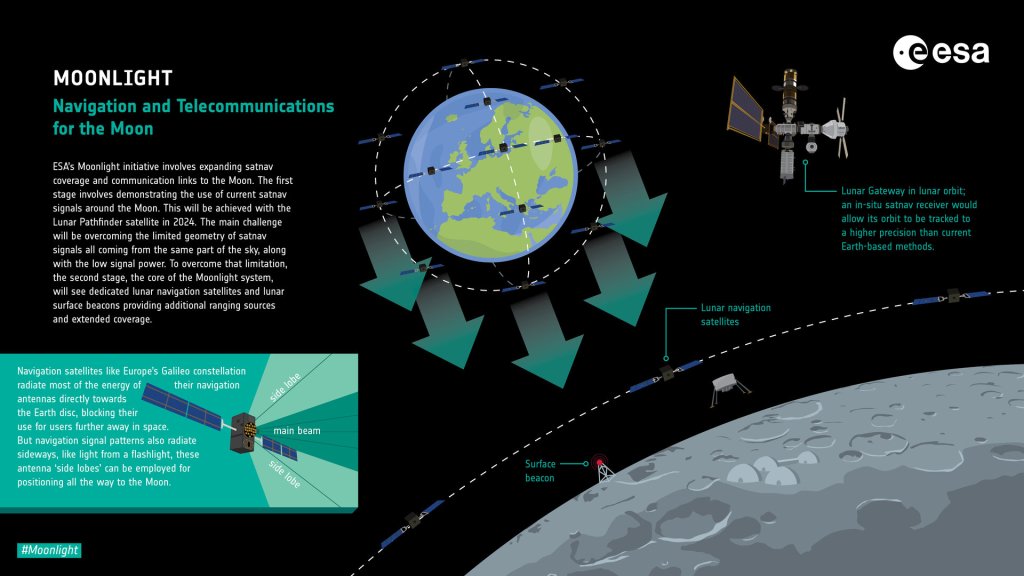
An international collaboration is underway, according to ESA, as to which organization should be responsible for determining the time and its maintenance.
Clocks work differently on the moon, ESA said. They run faster than Earth time, which is measured in relation to the rotation of its own axis, due to the strong gravitational field of our planet.
Moon time gains around 56 microseconds per day with the exact rate depending on the position of the Moon progressing at an even different speed on the surface with a lunar day lasting the equivalent of 29.5 Earth days.
ESA contends the need to maintain communication between the Moon and Earth in lunar time will be of great importance.
Space astronomer Francisco Diagonal, an astronomer at University College London, agrees. On March 4, he told Euronews that there is a “need to maintain communication between the Moon and Earth from all these missions,” and there will be a need to agree on what the Moon’s “Greenwich Mean Time” will be.
“But on the other hand, once we already have many missions in orbit around the Moon from several countries, then communication with Earth takes a back seat and then it becomes more independent and that’s where lunar time is going to be very important,” Diego said.
Image credits: 1, 2.