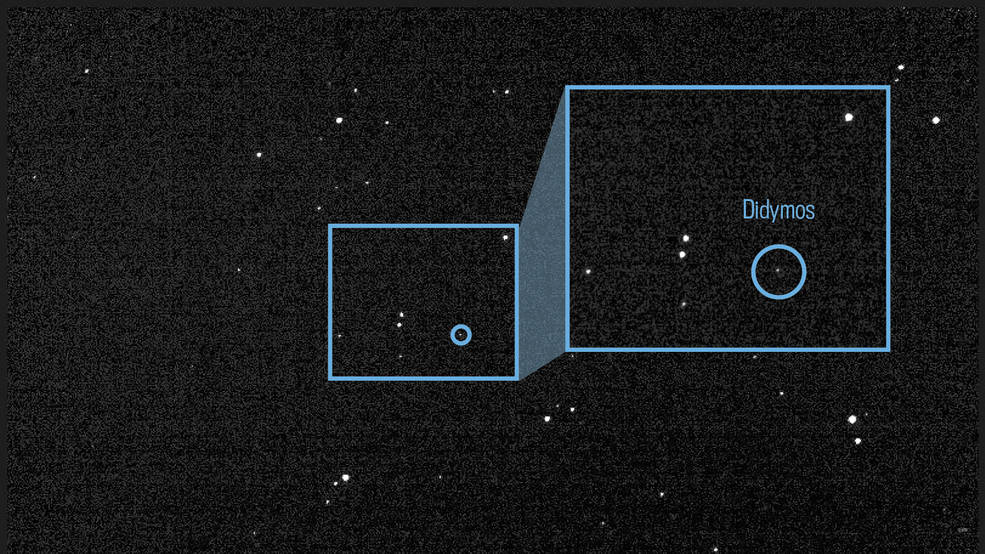
“It is important to show that DRACO is working properly and can see its target to make any adjustments needed before we begin using the images to guide the spacecraft into the asteroid autonomously,” said Elena Adams, the DART mission systems engineer at the Johns Hopkins Applied Physics Laboratory (APL) in Maryland.
On September 26, DART will impact the moonlet Dimorphos at about 6.6km/s (14,768 mph) to change its orbit within the Didymos binary asteroid system. But why not send the spacecraft hurtling toward the large asteroid itself? Well, a few reasons. Scientists predict that by crashing into the smaller moonlet, and not the larger asteroid Didymos, they can more significantly change its orbit through the gravitational pull that the moonlet has. The slightest change in the moonlet’s orbiting motion will offset the Didymos’ path.
“The extent of the deflection caused by the crash will be easier to detect as astronomers have been carefully observing its path around the bigger asteroid,” says Jay Tate, the director of the National Near Earth Objects Information Centre in Knighton, Powys.
Why is DART so important?
The threat of asteroids to Earth is small but real. This mission will be crucial in collecting data to help determine if intentionally crashing a spacecraft into an asteroid is an effective way to change its course through space. If only dinosaurs had a space program.