On October 1, 2021, the joint European Space Agency (ESA) and Japan Aerospace Exploration Agency (JAXA) BepiColombo spacecraft successfully performed its first flyby of the solar system’s innermost planet, Mercury. The flyby is the first in a set of six such events BepiColombo will complete before entering orbit around Mercury in late 2025.
Following the flyby, initial science returns from different instruments onboard BepiColombo revealed interesting details about the environment surrounding Mercury, as well as details on the planet itself.
The flyby
BepiColombo’s first Mercury flyby sequence took place on October 1 and October 2, with the closest approach occurring at 23:34 UTC on October 1 at a distance of 199 km from the surface of Mercury as the spacecraft’s monitoring cameras captured images of the planet.
These same cameras returned images of Venus from BepiColombo’s second flyby of that planet in August 2021.
The three monitoring cameras onboard BepiColombo’s Mercury Transfer Module (MTM) captured images of the planet for four hours beginning approximately five minutes after the closest approach.
Space Shuttle models
(adsbygoogle = window.adsbygoogle || []).push({});
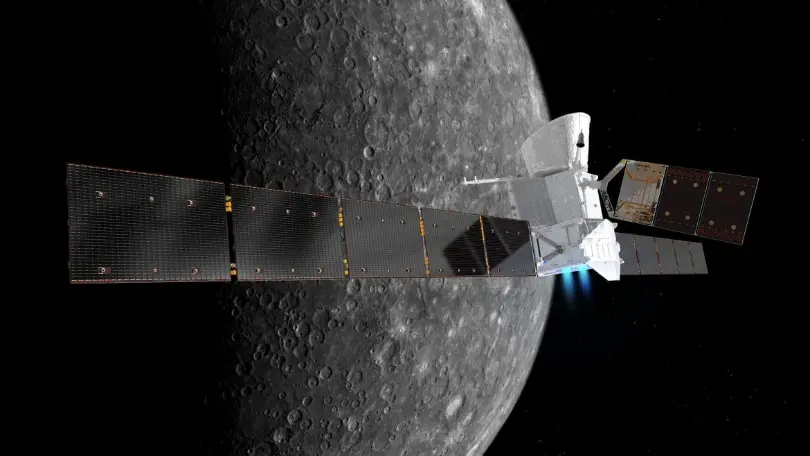
While the images of Mercury are visually impressive — with the planet being seen behind some of BepiColombo’s instruments — and stunningly clear, they also allow scientists to identify certain surface craters on the planet and marked the start of the craft’s scientific objectives at Mercury as some regions around the planet will not be accessible once the craft enters orbit; therefore, they have to be studied during the flybys.
See Also
- BepiColombo Updates
- ESA Forum Section
- L2 Future Spacecraft
- Click here to Join L2
“The flyby was flawless from the spacecraft point of view, and it’s incredible to finally see our target planet,” said Elsa Montagnon, Spacecraft Operations Manager for BepiColombo.
As the flyby progressed, several instruments onboard BepiColombo’s modules simultaneously collected data on Mercury and its surrounding environment.
“It may have been a fleeting flyby, but for some of BepiColombo’s instruments, it marked the beginning of their science data collection and a chance to really start preparing for the main mission,” says Johannes Benkhoff, BepiColombo project scientist at ESA.
“These flybys also offer the chance to sample regions around Mercury that will not be accessible once we’re in orbit.”
Mercury’s exosphere
During the flyby, the PHEBUS ultraviolet spectrometer on BepiColombo’s Mercury Planet Orbiter (MPO) module collected data on Mercury’s exosphere — an extremely thin, low-density atmosphere. Currently, the exosphere is thought to exist due to either solar wind or surface material.

This graph shows the amounts of hydrogen and calcium PHEBUS recorded during the flyby. (Credit: ESA/BepiColombo/PHEBUS)
PHEBUS observed the region for an hour. After BepiColombo exited from the shadow of Mercury, PHEBUS recorded sharp peaks of hydrogen and calcium following closest approach. These two elements are thought to be common in Mercury’s exosphere.
What’s more, the Mercury Gamma-ray and Neutron Spectrometer (MGNS) instrument, also located on the MPO, detected bright fluxes of neutron and gamma rays in the exosphere — phenomena often produced by galactic cosmic rays interacting with the uppermost surface layers of a planet.
Additionally, these emissions could provide insight into the composition of the surface of Mercury.
The BepiColombo science team is currently performing a detailed analysis of the MGNS data as well as the MGNS data from BepiColombo’s second Venus flyby in August.
Once in orbit around Mercury in 2025, PHEBUS and the MGNS will continue to investigate the planet’s exosphere — characterizing its composition and dynamics in great detail. PHEBUS will also watch for changes in the exosphere location over time as well.
Mercury’s magnetic field and solar wind
Due to Mercury’s close proximity to the Sun, one might expect the planet to be often blasted with solar wind that is ejected from the Sun’s corona. However, Mercury’s magnetic field, like Earth, helps shield the planet from the full force of coronal ejections.
Until BepiColombo’s flyby, only the northern hemisphere had been magnetically surveyed by a spacecraft, leaving scientists without an answer to how the planet’s magnetic field and solar wind interacted at Mercury’s southern hemisphere.
During BepiColombo’s flyby, sensors located on the spacecraft’s magnetometer boom recorded data on Mercury’s magnetic field and solar wind as the craft zipped past the planet’s southern hemisphere.
“That makes this flyby particularly interesting, as it is the first time that data from the planet’s southern hemisphere close to the surface is available – even if it is just a small sample,” said Daniel Heyner from TU Braunschweig in Germany, MPO magnetometer researcher group lead.
BepiColombo teams took the magnetometer data and converted it into a sound audible to the human ear. The audio captures the changes in the intensity of the magnetic field and solar wind as well as the moment BepiColombo crossed the magnetosheath — the border region around Mercury where the planet’s magnetosphere and solar wind interact in a highly turbulent way.
Once in orbit, measurements taken by these instruments will be used to perform a detailed analysis of Mercury’s magnetosphere, allowing scientists to get a glimpse into the origin, evolution, and current state of the planet’s interior.
Accelerations and temperature changes
As the flyby progressed, BepiColombo’s Italian Spring Accelerometer (ISA) instrument, located on the MPO module, recorded the spacecraft’s accelerations as Mercury’s gravitational pull tugged on the craft.
The ISA also recorded the temperature change BepiColombo experienced as it entered and exited the shadow of Mercury. These measurements are similar to those taken by the ISA in August as the mission performed its second Venus flyby.
Like the magnetometer data, the BepiColombo team was able to translate the ISA data into an audio file.
“On the acceleration plots that were appearing on our screens, we could see the tidal effects of Mercury on the BepiColombo structure, the drop of the solar radiation pressure during the transit in the shadow of the planet, and the movement of the center of mass of the spacecraft due to flexing of the large solar arrays,” says Carmelo Magnafico of the Italian National Institute for Astrophysics.
In orbit, the ISA will support a study of Mercury’s interior structure and will test Einstein’s theory of General Relativity with great accuracy. The instrument will also measure Mercury’s center of mass as it completes its 88-day orbit around the Sun.
Additionally, the ISA will be used to provide accurate details on the orbit of the MPO component of the mission.
BepiColombo’s second Mercury flyby will occur on June 23, 2022.
(Lead image: BepiColombo at Mercury. Credit: ESA/ATG medialab/NASA/JPL)