Do you know how many satellite constellations China will have in 2026? Which of these constellations can truly support the future development of China’s commercial aerospace industry?
When the global commercial aerospace industry enters the era of “low-orbit constellations” and when the satellite production capacity is planned to exceed 7,000, a question is emerging – who can become the next new driving force behind the development of China’s satellite industry after the satellite Internet?
Nihao Space will use a set of core data to provide you with a comprehensive breakdown of China’s satellite constellation needs and future development trends in 2026.
01
China’s 133 constellations and their classification
According to Nihao Space statistics, as of April 2026, China has a total of 133 satellite constellations of various types planned, under construction, and completed, with a total number of planned launch satellites of 50,745 (12 constellations have not disclosed the specific number of satellites planned to launch).
Nihao Space divides the 133 constellations currently planned in China into six major categories, namely: communication, navigation, remote sensing, computing power, space situational awareness and other types of constellations.
Classification according to constellation function:
Remote sensing constellations (including various optical, SAR, and meteorological remote sensing constellations): 83 in total, accounting for approximately 63% of the total number of constellations; the total number of planned satellites is 12,036 (of which the planned number of constellations has not been disclosed for 8 constellations), accounting for approximately 24% of the total number of planned satellites;
There are 23 communication constellations (including satellite Internet, narrowband Internet of Things, relay communications, and high-orbit mobile communication constellations), accounting for 17%. The total number of planned satellites is 33,690, accounting for approximately 66% of the total number;
Navigation constellations (including navigation and navigation enhancement constellations), a total of 4, accounting for 3%, the total number of planned satellites is 435, accounting for about 1% of the total number of planned satellites;
There are a total of 8 computing power constellations, accounting for 6%, with a total planned number of 3,926 satellites to be launched (of which the planned number of 3 constellations has not been disclosed), accounting for approximately 8% of the total planned number of satellites;
There are 8 space situational awareness constellations (satellite orbit safety and debris monitoring), accounting for 6%, with a total planned launch number of 596 satellites (one constellation has not disclosed the planned number of constellations), accounting for approximately 1% of the total planned number of satellites;
Other types of constellations include: 5 scientific experiment constellations, 1 lunar resource survey constellation, and 1 on-orbit service constellation, a total of 7, accounting for about 5%. A total of 62 satellites are planned to be launched, accounting for less than 1% of the total number.
Divided according to the number of constellations planned:
Micro-constellation (planned number of satellites ≤ 20): 45 in total, accounting for about 34% of all constellations;
Small constellations (20 < planned number of satellites ≤ 100): 40 in total, accounting for about 30% of all constellations;
Medium-sized constellations (100 < planned number of satellites ≤ 1,000): 28 in total, accounting for about 21% of all constellations;
Large constellations (1,000 < planned number of satellites ≤ 5,000): 6 in total, accounting for about 5% of all constellations;
Mega constellation (planned number of satellites > 5,000): 2 in total, namely the GW National Grid constellation and the Qianfan constellation, accounting for about 1% of all constellations;
There are 12 constellations with undisclosed number of satellites, accounting for about 9% of all constellations.
02
The biggest bubble in China’s commercial aerospace industry?
Judging from the data, my country’s commercial aerospace industry is still in the early stages of capacity building. Among them: There are 3 constellations that launch more than 100 satellites; there are only 10 constellations that launch more than 20 satellites; there are 23 constellations that launch more than 10 satellites; among the 50,745 satellites planned in the overall plan, the number of network launches is only 1,065, and the actual launch rate is only 2%. Divided according to construction progress
A total of 21 constellations have been completed, and a total of 171 satellites have been launched, with an average of about 8 satellites planned for each constellation;
There are a total of 70 constellations under construction (including networking, verification satellites that have been launched, and verification satellites that have failed to launch), with 38,558 satellites planned to be launched, and a total of 893 satellites have been launched, with an average of about 13 satellites launched in a single constellation;
A total of 42 constellations are planned, with 12,022 planned satellites;
The five constellations that launch the most satellites are: GW State Grid Constellation (168), Jilin-1 (152), Qianfan Constellation (126), Space-Time Daoyu Constellation (64), and Yunyao-1 (47).
03
Commercial aerospace is still in the early stages of construction, and satellite Internet is the cornerstone of the industry.
In addition to navigation satellites, the development of downstream application scenarios for domestic satellite remote sensing and satellite communications is limited. Most commercial applications are still limited to special scenarios such as finance, energy, maritime affairs, and public utilities. As for the more emerging constellations such as satellite Internet, space computing power, and space situational awareness, they currently do not have the ability to provide commercial services.
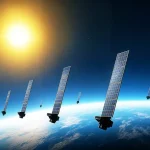
Judging from the planned proportion, the satellite Internet industry is still the cornerstone of the current development of China’s commercial aerospace industry. Among the 50,745 planned satellites, the planned launch number of two giant low-orbit satellite Internet constellations, GW State Grid Constellation and Qianfan, has reached 27,992, accounting for 55%. In particular, the GW national grid constellation led by Star Network is a strategic layout of the country for “maintaining frequency and keeping track”. It is another typical case of “national system” in the development of high-end manufacturing industry in my country, and has a high construction priority.
For the satellite industry, which often costs tens or even hundreds of millions to build a single satellite, and also requires expensive launch costs, is it really useful to plan so many constellations? What is the future development trend of commercial aerospace?
04
The Red Sea Crisis for Commercial Remote Sensing
What deserves the industry’s vigilance is that China’s remote sensing satellite market has become a fiercely competitive Red Sea.
According to statistics, 83 of the 133 constellations currently planned in the country are remote sensing constellations, and a total of more than 489 remote sensing satellites have been launched (only including the number of launches of the above 83 constellations, not the number of Chinese remote sensing satellites). This number has exceeded the upper limit of the existing domestic remote sensing market demand. According to industry insiders, the current data application rate of the domestic remote sensing satellite industry is less than 5%, and the biggest reason for data waste is insufficient business development.
What’s even more frightening is that the number of satellites planned to be launched by these 84 remote sensing constellations in the future has reached an astonishing 12,036. This means that if the manufacturing cost of future remote sensing satellites cannot be reduced by at least one order of magnitude, or application scenarios are insufficiently developed, 90% of these remote sensing constellation operating companies will face brutal overseas competition, mergers and acquisitions, and even the risk of bankruptcy.
05
Who will be the next satellite internet?
Judging from the development trend of the global low-orbit satellite industry, the answer is obvious: the next driver of the development of the low-orbit commercial satellite industry will be “space computing.”
With the development of AI technology, human demand for computing power is constantly expanding. According to the “China Artificial Intelligence Computing Power Development Assessment Report” jointly released by IDC and Inspur Information, IT energy consumption of artificial intelligence data centers will exceed 146.2 terawatt hours in 2027, exceeding Beijing’s total electricity consumption in 2022. In addition, the “water consumption per kilowatt hour” of the data center is about 1.1 liters. According to this data estimate, China’s artificial intelligence data center water consumption will reach 161 million tons in 2027.
The United States, which is extremely “sensitive” to electricity and fresh water resources, has become more aggressive in facing the power dilemma caused by AI. Most Silicon Valley giants have begun or are about to make plans in the field of space computing. Google announced the “Lightcatcher Project”, planning to launch satellites equipped with its own TPU chips and conduct launch exercises in 2027; Musk acquired xAI and applied to the US Federal Communications Commission (FCC) to build a “space data center”. The application was approved and publicized in February 2026.
According to statistics from Nihao Space, China currently has a total of 8 computing power constellations planned or under construction. Only 6 of them have announced their constellation sizes, namely National Star Aerospace’s star computing plan (2,800 satellites) and Earth’s satellite space computing constellation. (1,000 satellites), Bailing Aerospace’s computing power constellation (100 MW level), China Science and Technology Tiansuan’s Tianshu Plan (96 satellites), Orbital Chenguang’s morning and dusk orbit giant computing power satellite constellation (Gigawatt level), Beiyou University of Technology’s Tianshu constellation (6 satellites).
Among them, Orbital Chenguang’s computing power constellation is the largest. Even if the power of a single satellite is 100 kilowatts, it needs to deploy more than 10,000 satellites.
Even though China, as the world’s largest power country, is not as sensitive to the power pressure brought by the development of the AI industry as the United States, the inexhaustible solar energy in space can reduce the cost of the AI industry by hundreds of billions every year. Space computing has the potential to become the second new driving force behind the development of the low-orbit satellite industry after the satellite Internet industry.
Conclusion
China’s commercial aerospace industry has shown great vitality in constellation planning, but it also faces practical challenges such as low implementation rate and insufficient application. In the future, only by being demand-oriented and continuing to make efforts in technological innovation and scenario expansion can China’s commercial aerospace industry break through the bubble and truly embark on a new journey of high-quality development.