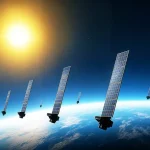
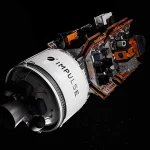
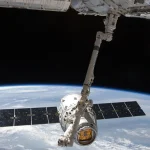
Traditional rigid solar wings are no longer able to meet the needs of high-power satellites. In contrast, flexible solar wings are becoming the core infrastructure of the “high-power era” of commercial aerospace due to their thinness, rollability, and large-area deployment characteristics.
Today we will learn about: 10 new tracks for commercial aerospace in 2025 – flexible solar wings.
01
What is a flexible solar wing?
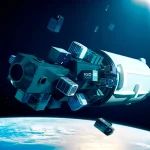
In space, for satellites to continue operating, they first need a stable energy supply. While chemical and nuclear energy can also provide power, solar energy, which is abundant in space, is the most reliable and commonly used. Satellites convert solar energy into electrical energy through solar cells, and a power generation device composed of multiple solar cells is called a solar array. In order to obtain more power, the larger the area of the battery array, the better, but the cost of launching is high, so it must be folded or compressed before launch, which gave rise to “solar wings” – large components that unfold like satellite wings. During the launch process, the solar wings are folded and stored, and then unfolded after the satellite is in orbit, and automatically adjust its direction so that the battery always faces the sun and continuously supplies power to the satellite. Solar wings are mainly composed of substrates, cells, and deployment mechanisms. According to the type of substrate, they can be divided into rigid solar wings, semi-rigid solar wings, and flexible solar wings. Rigid and semi-rigid solar wings have mature structures and low costs, but have larger storage volumes and heavier weights. Flexible solar wings use ultra-thin flexible substrates, with thickness usually not exceeding 0.5 mm, and the overall thickness can be controlled to about 1 mm. The weight can be reduced by 20%-40% under the same area, and the power conversion efficiency of the cell exceeds 30%. The storage volume can be reduced by more than 60% compared with traditional rigid solar wings, and the expanded area can reach 1.5 times or even larger. This design not only significantly reduces launch costs, but also frees up fairing space and improves satellite design flexibility and on-orbit power supply capabilities. From the perspective of industry development trajectory, flexible solar wings are not a gradual upgrade of “lightweight replacement”, but an inevitable choice to cope with the explosion of satellite power demand. Around 2010, the average power of small satellites was only 200-300 watts; by 2023, the power of mainstream commercial satellites has reached 1-3 kilowatts; now, some large platforms are sprinting to more than ten kilowatts or even higher. With the expansion of constellation scale, upgrades of communication and remote sensing loads, and the emergence of new businesses such as space computing and on-orbit services, higher requirements have been placed on the specific power, storage efficiency, and deployment reliability of solar arrays. Flexible solar wings have become the core infrastructure in the era of high-power satellites and one of the key technologies for the development of satellites from low-power and single-function to high-power and multi-mission.
02
Global flexible solar wing market
According to the “2033 Space Flexible Solar Array Market Research Report” released by Market Intelo, the global aerospace flexible solar array market size will be approximately US$1.12 billion in 2024, and is expected to grow to US$4.36 billion by 2033, with a compound annual growth rate of approximately 16.4%. Major factors driving the market include advancements in materials science, increasing number of satellite launches, and demand for lightweight, high-efficiency power supplies for space missions. From the perspective of regional distribution, North America occupies a leading position with its mature commercial aerospace system and strong government demand; the Asia-Pacific region has the fastest growth, driven by China, Japan, and India; Europe is making steady progress with policy support and international cooperation. From a technical perspective, current flexible solar wings mainly focus on three types of battery materials: silicon-based, flexible thin film gallium arsenide and perovskite. Silicon-based solar cells: The raw materials are cheap and the ground industry chain is mature, accounting for more than 95% of the global photovoltaic market. However, the conversion efficiency in the space environment is 14%-18%, the radiation resistance is poor, and the efficiency decays quickly. At the same time, its heavy weight makes it difficult to apply on a large scale before low-cost, high-capacity rockets are launched on flights. Starlink satellites are a representative case of silicon-based solar cells used in aerospace. Flexible thin-film gallium arsenide: Currently the most powerful route for aerospace flexible solar wings, it has high conversion efficiency (about 30%), radiation resistance, thinness and flexibility, and low attenuation. It is suitable for high-value missions such as medium-to-high orbit communication satellites and deep space exploration. However, its manufacturing relies on high-end epitaxy and high-purity materials, which are expensive. For example, gallium arsenide epitaxial wafers are about 200,000-250,000 yuan per square meter, which is equivalent to 30-50 times the cost of crystalline silicon cells. Perovskite: a new generation potential route, high efficiency, lightweight, and low cost (about one-tenth that of gallium arsenide), but its stability and lifespan are insufficient, and large-area preparation is not yet mature, and it is still in the experimental stage. Market research shows that perovskites can be combined with crystalline silicon cells to form perovskite-crystalline silicon stacked cells, and the theoretical efficiency can reach 34.6%. Major foreign players: SpaceX (USA): Founded in 2002, it is a comprehensive aerospace enterprise integrating rocket manufacturing, space transportation, manned spaceflight and satellite communications. Its Starlink V2 mini uses a dual-array flexible silicon-based solar wing structure, with a single-sided expansion area of approximately 52.5 square meters and a length of approximately 30 meters. It is reported that SpaceX is already testing ultra-large-area solar wings of 200-300 square meters, which may be used on Starlink V3 in the future. Airbus (France): Founded in 1970, it is Europe’s leading aerospace and aircraft manufacturing company. The Sparkwing series of commercial solar arrays launched for small satellites has an expansion area of more than 30 square meters and a power of 100W–2000W. It can be configured with wings, and one to three panels are installed on each wing. This series is optimized for LEO orbits, has simple integration and high structural rigidity, and has been successfully used in more than 85 European satellite missions. Redwire (USA): Established in 2020, it is a comprehensive enterprise focusing on advanced aerospace and military technology. Its ROSA flexible gallium arsenide solar wing adopts a rollable and strain-energy deployable structure. It has the characteristics of compact storage, high power density and strong structural rigidity. It is suitable for high-power missions such as LEO, GEO and deep space. Currently, ROSA has delivered 8 sets of SUNSTONE solar wings to NASA to enhance the power generation capacity of the International Space Station.
03
Industry chain analysis
If the flexible solar wing is a system engineering, then there are only two cores that really determine its performance limit and reliability: the flexible battery sheet and the deployment mechanism. The former determines “how much electricity can be generated”, while the latter determines “whether it can successfully generate electricity”. 1. Flexible cells The cells of flexible solar wings are the core that determines the power generation capacity. Its industrial chain mainly covers the following links: Chip preparation: responsible for manufacturing the photoelectric conversion unit of the battery, which is the basis for efficiency and radiation resistance. Interconnection and back contact technology: realize series connection and current output of multiple battery cells, reduce series loss and improve flexibility reliability. Flexible substrate and interconnection lines: carry the battery sheets and realize rolling and folding, while ensuring electrical connection and thermal management. Packaging/SMT process: protect and fix the battery cells to ensure long-term reliable operation in the extreme environment of space. Major domestic players: 1) Gallium Arsenide 811 Institute: It is the only power source professional institute of the Aerospace Science and Technology Group. It has long been responsible for the development of power supply systems, control equipment and power products for “stars, rockets, missiles, ships, (detectors)” and other special equipment, as well as the incubation of new energy industries. Its triple-junction gallium arsenide solar cells have been successfully used on many types of aerospace engineering aircraft in my country, with a conversion efficiency of about 30%. Electronics Technology Blue Sky (18th Institute): Affiliated to China Electronics Technology Research Institute 18, it is the core supplier of domestic aerospace power supplies, with a market coverage rate of more than 50%. Since 2019, multiple rounds of technical research have been carried out around stacked flexible solar wings and chip-based digital power supplies, which have been successfully applied to the Qianfan constellation satellites. In 2024, Dianke Lantian developed a highly reliable thin-film gallium arsenide solar cell with a conversion efficiency of 33%. The weight and area density are only 1/4 of traditional solar cells. Dehua Chip: Founded in 2015, it focuses on the R&D and industrialization of high-end compound semiconductor epitaxial wafers, chips and system-level products. Its business covers space and flexible solar cells, infrared detectors and other products, and has system supporting capabilities for satellite power systems, near-space drones, and infrared detectors. In September 2025, its self-developed fully flexible roll-up solar wing completed on-orbit verification, with a space conversion efficiency of 33.5%. Fuchang Space: established in 2018, focusing on the R&D, design and manufacturing of commercial aerospace satellite power systems and key stand-alone products. On November 27, 2024, its ROSA winding flexible solar wing equipped with the Light Transmission 01 and 02 test satellites completed its first in-orbit flight and successfully deployed. Qianzhao Optoelectronics: Founded in 2006, it is a supplier of gallium arsenide solar cell epitaxial wafers and chips. Its gallium arsenide solar cell products have been applied in batches to large-scale domestic commercial aerospace constellation network satellites operating in orbit. Kaixun Optoelectronics: Established in 2015, its main products include gallium arsenide solar cell epitaxial wafers and chips and LED epitaxial wafers and chips. Among them, high-efficiency gallium arsenide solar cells have been successfully used in many major aerospace projects such as Chang’e 4, Chang’e 6, Tianwen 1 and Land Exploration 1 satellite. Derong Technology: Founded in 2015, it is a high-end semiconductor optoelectronic chip designer and manufacturer. The conversion efficiency of the self-developed triple-junction flexible thin-film solar cell has exceeded 36.2%, and we are launching research into ultra-high-efficiency battery technology of more than 40%. 2) Silicon-based Shanghai Institute of Microsystems, Chinese Academy of Sciences: Since 2011, it has begun research and development of high-efficiency monocrystalline silicon heterojunction solar cells. In 2023, it announced the development of ultra-thin flexible monocrystalline silicon heterojunction solar cells for use in near space and low-orbit space energy systems. The third-party testing conversion efficiency reached more than 22.5%. Yangtze River Delta Solar Photovoltaic Technology Innovation Center: Established in 2022, it is the first domestic technology innovation center focusing on the field of solar photovoltaics. Its self-developed silicon-based solar cells have been used in Tianxieli’s “Rizhao-3” satellite, Galaxy Aerospace’s “Lingxi 03” satellite and Ziwei Technology’s “Di’er-5” space tester, and jointly developed satellites to develop the first generation of commercial satellite silicon-based folding solar wings. Hunan Aerospace Kinetic Energy: Established in 2017, it focuses on commercial aerospace energy systems, covering core components such as solar wings, lithium battery packs, and PCDUs. Its self-developed low-cost flexible crystalline silicon solar cells have passed the StarNet space environment verification and have officially entered the StarNet supplier list. At present, silicon-based batteries have been verified in orbit for 5 years, with a conversion efficiency exceeding 21%. They have provided power for more than 10 satellites and are expected to be applied on a large scale in 2026. 3) Perovskite: Fuxi Xingkong: Founded in 2023, it is a high-tech enterprise specializing in space energy systems under Shanghai Harbor Group. It is mainly engaged in the research and development of satellite power systems. Its products include gallium arsenide solar arrays, perovskite solar arrays, power control units and lithium battery packs. Among them, perovskite satellite new material batteries and energy control systems have been carried on multiple satellites for in-orbit testing. Suzhou University: Many teams within the school have made systematic progress in the field of perovskite solar cells. Among them, the team of Yang Xinbo and Zhang Xiaohong developed a flexible perovskite/crystalline silicon laminated solar cell with a certified efficiency of 33.6%, an open circuit voltage of 2.015V, and an initial efficiency of 91% after being bent 5,000 times. Westlake University: Research by Wang Rui’s team from the School of Engineering shows that the stability of perovskite solar cells can be significantly improved by improving the preparation process, successfully preparing a high-quality FAPbI₃ film, achieving a photoelectric conversion efficiency of 26.1%, and maintaining performance of more than 95% after 1,000 hours of continuous operation, providing strong support for the engineering application of perovskite solar cells. 2. Deployment mechanism The deployment mechanism is the key to the successful deployment and long-term power generation of flexible solar wings. Its industrial chain mainly includes: Mechanism design: including winding, tensioning, self-expanding and other scheme designs, which is the basis for ensuring that the solar wing can be reliably deployed. Key components: including springs, hinges, drive motors and tension controllers, etc., which determine the accuracy and reliability of the mechanism. System integration and testing: Combine the mechanism with the battery array, and conduct ground deployment and durability verification to ensure reliable on-orbit operation. Major domestic players: 501 Institute: Currently the largest domestic solar wing supplier with the most complete product types, it has 6 major series of products, covering rigid, semi-rigid and flexible solar wings. The current annual production capacity is about 400 units, and it is planned to increase to 1,400 units by 2027. Its self-developed flexible solar wing has an extremely small retractable body and a deployment area of up to 34.6 square meters. It adopts a unified architecture and a shared module design with CBB. It supports “Lego-style” flexible assembly, can quickly adjust size and power, and adapts to different battery and component solutions to meet diverse mission needs. Institute 805: It has complete design and manufacturing capabilities for rigid, semi-rigid and flexible solar wings. The large-area deployable flexible solar wings used by my country’s space station originated from this team. In view of the problems of wear and efficiency loss of traditional slip rings in high-power and long-life applications, the 805 Institute innovatively developed an ultra-high-power, ultra-long-life rolling ring electrical transmission mechanism, realizing the first high-power transmission in China that uses rolling instead of sliding contact. Shanghai Shangxing: The self-developed flexible solar wing has been used twice in satellite Internet technology test satellites. The high-stiffness three-dimensional truss-type flexible solar wing achieves efficient folding and deployment through an innovative space truss structure. The storage ratio reaches 96m²/m³, and the on-orbit deployment fundamental frequency is >0.2Hz. The core indicators are at the leading level in the country. Harbin Institute of Technology: In 1999, it took the lead in carrying out aerospace mechanism and control research in China. In 2004, it established a related research center. In 2007, it was approved as one of the first batch of national defense key subject laboratories. It has been deeply involved in the direction of large-scale space folding and unfolding mechanisms for a long time, and the solar wing structure and mechanism subsystem has been applied to many types of satellites. Shenyang Automation Research Institute: It is responsible for the development of flexible solar wings and their deployment mechanisms and sun-facing driving mechanisms for satellite Internet low-orbit satellites, G60 satellites and other satellites. Galaxy Aerospace: Founded in 2018, it is a leading domestic satellite Internet solution provider and satellite manufacturer. On July 23, 2023, its Lingxi 03 satellite was successfully launched, carrying a self-developed flexible solar wing for the first time and using a scissor rod deployment mechanism; related flexible wing missions have achieved stable on-orbit deployment many times between 2023 and 2025. On September 16, 2025, its first independently developed “roll-type fully flexible solar wing satellite” was successfully launched and completed in-orbit deployment. The solar wing deployment area is about 20 square meters. 3. System Integration If flexible solar cells solve the “efficiency limit” and the deployment mechanism solves “reliable deployment”, then system integration determines whether the flexible solar wing can truly become an engineering product that can be delivered at scale and operate for a long time. At present, representative units that have system-level integration of flexible solar wings in China include: 501 Institute, 805 Institute, Shanghai Shangxing, Dianke Blue Sky, Galaxy Aerospace, Dehua Chip, Fuxi Xingkong, Hunan Aerospace Kinetic Energy, Fu Chang Space, Kaoru Satellite, Blue Arrow Hongqing, and Star Intelligence.
04
Current technical bottlenecks
Despite the rapid development of flexible solar wing technology, there are still a number of core bottlenecks in large-scale commercial applications and high-power satellite deployment: 1. Deployment reliability and on-orbit risks. The deployment mechanism and cells need to withstand drastic temperature changes, vacuum environments, micrometeoroid impacts, and long-term radiation in space. At the same time, it is necessary to ensure that the folded solar wings can be fully deployed and generate stable power generation for a long time. However, in practical applications, satellites such as GW and Qianfan have experienced incomplete or slight deviation of the solar wing deployment, which shows that the deployment mechanism and overall system integration are still not mature enough. 2. Insufficient batch production capacity. At present, except for the National Team of the Fifth Academy, Shanghai Commercial Star, etc., almost no commercial companies in China have real batch production capabilities. With the bidding for the second phase of the StarNet next year and the accelerated launch of the Qianfan satellite after the recyclable rocket matures, almost all new satellites will use flexible solar wings. The small-batch production model will be difficult to meet market demand, and insufficient batch production capacity will become the core bottleneck restricting industrial development. 3. Materials and packaging technology problems: Gallium arsenide materials have high costs, long production cycles, and strict packaging process requirements; silicon-based battery ground technology is mature, and aerospace applications still need to solve the problems of radiation resistance transformation and ultra-thin packaging; perovskite batteries are lightweight and efficient, and their stability and large-area preparation have not yet been broken through. No matter which material, packaging or patching process is not in place, it may cause the battery string to fail and reduce the overall system reliability. 4. System integration and power controller adaptation issues Cell sheets with different material routes have differences in interconnections, back contacts and power control interfaces. The mature method of gallium arsenide is difficult to be directly applied to silicon-based or perovskite systems. At the same time, large-area flexible solar wings put forward higher requirements for control system accuracy, current management and thermal management, which are also core technical links that must be solved in the future commercialization process.
05
Future market structure
The flexible solar wing market has huge potential, driven by factors such as the construction of large-scale satellite constellations, the energy needs of space computing platforms, and the declining cost of commercial space launches. In the next few years, industry competition will take on a multi-dimensional pattern: 1. Dispute over technical routes On the surface, competition for flexible solar wings is concentrated on three material routes: silicon-based, gallium arsenide and perovskite. However, what really widens the gap is not which material parameters are better, but which route is easier to create a set of system engineering that is replicable, verifiable, and deliverable in batches. 1) Gallium arsenide The reason why gallium arsenide has long been mainstream in the aerospace field is not just because of its high efficiency, but because of its “strong certainty.” From the battery itself to the interconnection method, packaging process, power controller, and then to the entire star power system, the gallium arsenide system has been repeatedly tested in a large number of tasks. The industry knows how to estimate power attenuation, how to evaluate life, and how to fully understand risks. This level of maturity makes it still the safest choice for satellite missions. But the problems are also very real: high costs, long manufacturing cycles, and insufficient production capacity. At the same time, due to the demonstration effect of Starlink satellites using silicon-based batteries, the country may also turn to it in the future, so commercial companies dare not invest on a large scale to increase production capacity. 2) Silicon-based monocrystalline silicon cells were first used. Later, due to their low power generation efficiency and heavy weight, they were gradually replaced by gallium arsenide. But its advantage is very obvious: low price. After SpaceX’s low-cost Falcon 9 matured, Starlink satellites used silicon-based batteries on a large scale. At present, domestic ground-based silicon-based routes have low costs and mature supply chains, but they cannot be directly moved to space. Ultra-thin, radiation-resistant, flexible packaging, battery interconnection methods, and even the interface logic of the power controller all need to be redesigned. At the same time, my country’s low-cost, high-capacity reusable rockets are not yet mature. Therefore, there is a lack of on-orbit verification of sufficient scale and time span. 3) Perovskite Perovskite is more like a direction that is highly concerned but has not yet entered the main track. Judging from experimental data, it is attractive in terms of efficiency, weight and cost, but what aerospace applications care about is not “the highest efficiency”, but “how much power is left after ten years”. Until issues of stability, large-area consistency, and long-term reliability are engineered to be solved, perovskites are more likely to exist in the form of verification loads or stacking solutions rather than serving as main power supplies independently. It can be seen that gallium arsenide will still occupy the mainstream position in the short term, while silicon-based and perovskite will still exist in verification and supplementary roles. But in the longer term, silicon-based or silicon-based-perovskite stacked cells will become the mainstream of the market. 2. Market and capital competition The flexible solar wing market competition is no longer a pure technical competition, but a game driven by system capabilities and capital. Take Dianke Blue Sky as an example. With its complete system covering power generation, energy storage, control and system integration, once it goes on the market and receives capital support, it will be able to take the lead in batch delivery and on-orbit verification. In contrast, companies with a market value of several billion and only doing partial components or small batch integration will find it difficult to match large-scale constellations and long-term supply rhythms, and their market share may gradually be concentrated by system players. In other words, among commercial companies, whoever can be the first to “go public” may win the “winner takes all” situation.
Conclusion
The accelerated iteration of flexible solar wing technology, material routing, deployment mechanism optimization, packaging process improvement, system integration and batch production capabilities will jointly determine who can occupy the commanding heights in the era of high-power satellites.
In the next few years, with the simultaneous growth in demand for mega-constellation construction, space computing and high-power satellites, the flexible solar wing industry chain is expected to usher in explosive growth.