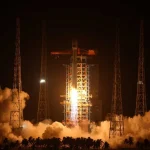
In July 2025, a total of 24 rocket launches were completed around the world, more than 19 investment and financing events were disclosed, and 7 key policies were released…
Let us take a look together: Commercial Aerospace Industry Trends Monthly Report | July 2025.
China commercial aerospace
1. Industrial policy
On July 1, 2025, the General Office of the Heilongjiang Provincial People’s Government issued “Several Policies and Measures for Heilongjiang Province to Support the High-Quality Development of the Aerospace Industry”, which aims to promote the improvement of quality and efficiency of the Heilongjiang aerospace industry and accelerate the construction of a modern aerospace industry cluster. According to news on July 9, 2025, the Natural Resources Department of Ningxia Hui Autonomous Region issued the “Three-Year Action Work Plan for Building Ningxia Natural Resources Remote Sensing Application Capacity Building (2025-2027)”, which aims to comprehensively enhance the support capabilities of remote sensing technology in natural resource management, land spatial planning and other fields. According to news on July 16, 2025, Minhang District issued “Several Policies of Minhang District on Supporting the High-Quality Development of the Commercial Aerospace Industry”, which will focus on engine R&D and manufacturing, rocket launch, satellite R&D, manufacturing and launch, commercial constellation construction, operation and services, and strive to cultivate an internationally competitive commercial aerospace industry cluster. On July 17, 2025, the State Administration for Market Regulation and the Ministry of Industry and Information Technology jointly released the “Action Plan for the Development of New Quality Productivity in Measurement Support Industries (2025-2030)”. Among them, it is clearly proposed to list aerospace as one of the key areas. On July 21, 2025, the National Space Administration’s official website issued the “Notice on Strengthening the Quality Supervision and Management of Commercial Aerospace Projects”, which for the first time systematically clarified the quality supervision requirements for the entire life cycle of commercial aerospace projects. It is proposed that the quality responsibility of the parties responsible for commercial aerospace projects shall be subject to a lifelong accountability system.
2. Launch activities
By rocket type: the national team launched 4 times, including 1 Long March 4C, 1 Long March 6A, 1 Long March 7 Yaoshi, and 1 Long March 8A; commercial rockets launched 2 times, including 1 Hyperbola 1 Yaoshi and 1 Kuaizhou 1A; By launch site: Xichang Satellite Launch Center performed 2 launch missions, Taiyuan Satellite Launch Center, Jiuquan Satellite Launch Center, Wenchang Space Launch Site, and Hainan Commercial Space Launch Site completed 1 launch mission each; Divided by spacecraft type: a total of 14 communication satellites (Satellite Internet Low Orbit 05/06 Group Satellite), 3 remote sensing satellites (Test 28B Satellite 01, Enshi Selendu Shanquan Satellite, Pakistan Remote Sensing Satellite 01 Satellite), and 1 cargo spacecraft (Tianzhou 9) were launched.
3. Product and technology progress
Rocket joint testing and hot testing: Oriental Space: “Gravity 2” completed a three-in-one joint hot testing; Tianbing Technology: Tianlong 3 completed a nine-machine joint static test. Engine R&D and testing: Interstellar Glory: the 70N attitude control engine completed the second round of batch assessment tests; Interstellar Glory: the Hyperbola III sub-stage methane tank completed the low-temperature static test; Yushi Space: the engine-tank-force transmission structure integrated component completed the 100-ton central thrust test; Oriental Space: the “Gravity 2” 50N attitude control engine completed the high-altitude simulated hot test; Deep Blue Aerospace: the “Thunder RS” 130-ton liquid oxygen kerosene engine rolled off the production line; Jianyuan Technology: 4 joint rocking hot tests of the engine and control system. Rocket assembly test: China Aerospace Science and Technology Corporation: Lijian-1 Yaoshi completed the final assembly test and factory review. Launch site and ground facility construction: Tianbing Technology: Tianlong-3 Jiuquan launch station passed completion acceptance and completed joint erection and erection training.
4. Investment and Financing Trends
According to incomplete statistics, my country’s commercial aerospace industry disclosed a total of 14 financing events in July, with a total financing amount of more than 450 million yuan, distributed in different development stages and subdivided tracks. Divided by financing rounds: Seed round: Yiwei Aerospace (10 million yuan); Angel round: Xingchi Skyspace, Zhihang Spacetime, Aerospace Yilong (over 100 million yuan), Zhongke Mingguang; Round A: Tianluhai Navigation, Taihu Nebula (over half a billion yuan); A+ round: Xinglian Xintong, Spacetime World; B round: aerospace engineering equipment (hundreds of millions of yuan); B+ round: Jingji Communications; C+ round: Aerospace Yuxing (hundreds of millions of yuan); Strategic investment: Cangqiong Digital (50 million yuan), Hongqing Technology. Divided by subdivision: Rocket overall: Aerospace Yilong (rocket overall); Power system: Xingchi Sky (engine manufacturing); Satellite overall and constellation operations: Hongqing Technology (Honghu-3 constellation), Taihu Nebula (Taihu Constellation); Satellite supporting equipment: aerospace engineering equipment (friction stir welding), Zhongke Mingguang (photoelectric payload), Jingji Communications (satellite-borne microwave communication), Tianluhai Navigation (high-precision inertial navigation), Yiwei Aerospace (satellite-borne computing power), Aerospace Yuxing (aerospace measurement and operation control); Satellite applications: Starlink Xingtong (satellite communication baseband), Zhihang Space-Time (phased array antenna), Space-Time Space-Time (satellite data operation), Cangqiong Digital (space-time information 3S platform).
5. Important events
Company news: Satellite remote sensing application company Rock Measurement Technology (Inner Mongolia) Co., Ltd. was established; Wenchang Aerospace City Public Service Platform Commercial Aerospace Industry Innovation Center (Hainan) Co., Ltd. was established; Aerospace Yuxing Wuhan Branch was established; Zhenyou Technology established its satellite Internet subsidiary Nanjing Youweixingtong Technology Co., Ltd.; State Grid Power’s “Space-based Eyes” virtual constellation was put into trial operation; Yuanxin satellite rocket launch service bidding announcement was released; Oneworld Satellite announced its half-year results, and the share of newly launched commercial satellites nationwide was 76%; Blue Arrow Aerospace launched guidance for listing on the Science and Technology Innovation Board, and the guidance agency is CICC. Capacity construction: The Interstellar Glory 100-ton liquid oxygen methane engine test bed project in Mianyang, Sichuan was completed and handed over; the Blue Arrow Aerospace Program built a rocket recovery site in Minqin, Gansu Province; the Oriental Space Program built a launch vehicle production and manufacturing base in Tai’an, Shandong; the “Eye of the Sky” constellation for insight into space and time was launched in Tianfu New District, Sichuan; the rocket assembly and testing plant of the Dongfeng Commercial Aerospace Innovation Test Zone of China Aerospace Science and Technology passed the acceptance inspection. Industry cooperation: Radio and Television Measurement & Hongqing Technology: jointly build a satellite full life cycle inspection service system; Spacetime Daoyu & Caocao Travel: deepen the application of satellite data based on the “future travel constellation”; Liangshan Prefecture of Sichuan Province released the “Liangshan Prefecture Aerospace Industry Chain Investment Cooperation Opportunities List”, including 15 aerospace projects with a total investment of 33.4 billion yuan.
international commercial aerospace
1. Industrial policy
On July 8, 2025, the U.S. Space Force released its first “International Partnership Strategy”, laying out a blueprint for how the U.S. Space Force can transition from sporadic global cooperation to establishing a more prudent and integrated space alliance with trusted allies. On July 16, 2025, the U.S. Space Force released the “Commercial Space Strategy” annex “Space Access Resource Decision Principles”. This annex is designed to guide the Space Force’s acquisition strategy, investment direction, and funding allocation, and improve “access to space” capabilities through commercial space power.
2. Launch activities
In July 2025, the world carried out a total of 18 rocket launch missions, one of which failed, sending a total of 269 spacecraft into space. From January to July 2025, a total of 136 space launches were completed (including 5 suborbital missions and 3 starship test flights), 7 of which failed, and 2,207 spacecraft were successfully put into orbit. Launches by country: 13 launches by the United States, 2 launches by Russia, 1 launch each by Europe, Australia, and India; by launch site: Cape Canaveral Space Force Base 7 launches, Vandenberg Space Force Base 5 launches, Kennedy Space Center 1 launch, Baikonur Space Launch Center 1 launch, Vostok 1 launch site, Kourou Space Center in French Guiana 1 launch, Bowen Orbital Spaceport 1 launch, Satish Dhawan Space Center 1 launch; Divided by spacecraft type: 236 communication satellites, 6 remote sensing satellites, 1 meteorological satellite, 14 technical test satellites, 1 manned space flight, and 11 other satellites.
3. Product and technology progress
Ariane Group: Prometheus engine achieves Europe’s first four-fire test in a single day. Voyager Space: Starlab commercial space station completes five key research and development milestones.
4. Investment and Financing Trends
According to incomplete statistics, a total of 5 financing incidents were disclosed in international commercial aerospace in July, with a total financing amount of more than 950 million US dollars. Divided by subdivision: Rocket overall: Interstellar Technologies (rocket overall) Satellite overall: Space42 (satellite overall) Satellite support: Cascade Space (satellite communication system) Satellite application: Spaceflux (space situational awareness) On-orbit application: Varda Space Industries (space pharmaceuticals)
5. Important events
Corporate news: Canada’s MDA acquired Israel’s SatixFy for US$280 million to strengthen its satellite communication chip capabilities; Britain’s Open Cosmos acquired Portugal’s Connected to expand space IoT 5G and NB-IoT technologies; American Firefly has submitted an IPO application and plans to be listed on Nasdaq; T-Mobile was approved to acquire UScell for US$4.3 billion to further integrate wireless spectrum resources; US SES completed its US$4.07 billion acquisition of Intelsat and will operate 120 satellites; US Auriga Space announced the development of the magnetic levitation space launch system “Zeus”; York Space’s parent company plans to acquire the Atlas ground station operator; iRocket will be listed on Nasdaq through a merger with BPGC, with a valuation of approximately US$400 million; India approves Starlink’s five-year operating license in India; Malaysia’s Measat is approved by India to enter the local market; SpaceX Starlink services are disrupted globally, affecting more than 61,000 users. Capacity construction: France’s Latitude plans to rebuild its Zephyr rocket production base with an annual output of 50 rockets; the United States’ Globalstar plans to expand its Hokkaido ground station to enhance global access capabilities; SatRev delivers a ground station in Oman to expand the Middle East’s communications infrastructure. Industry cooperation: Germany’s Exolaunch and Britain’s Orbex reached a rocket launch service cooperation; the United States’ Globalstar signed a second launch service contract with SpaceX; the United States’ Maxar Intelligence signed a US$205 million data and service contract with the Middle East and Africa; India’s Space TS and Synergy Quantum jointly developed India’s first quantum safety satellite; Japan’s Space BD and Australia’s Gilmour reached a launch and satellite sales cooperation; Japan’s Synspective signed a 10-satellite launch service contract with Germany’s Exolaunch; The U.S. NSF and Amazon’s Kuiper Project have reached an astronomical research cooperation; Arab Arabsat has integrated resources with the Saudi FGC to promote VSAT and IP hosting services; the U.S. Sierra Space has won a contract from Mitsubishi Heavy Industries to provide key components such as docking mechanisms for the International Space Station; France’s ThrustMe has formed a tripartite cooperation with Germany’s Marble Imaging and Reflex Aerospace to promote electric propulsion systems. Government projects: The U.S. Planet Labs signed a 240 million euro contract with the German government to provide Pelican satellite imaging services; the U.S. Atomic-6 won a $2 million Space Force contract to promote the militarization of solar array technology; the U.S. Boeing won a $2.8 billion Space Force satellite communication system development contract; ESA will provide launch contracts and R&D funding support to the winners of the “Launch Rocket Challenge”; the U.S. Congress passed the Budget Reconciliation Act, allocating $9.995 billion to NASA; The British Space Agency launched a US$103 million debris removal mission procurement plan; the United States’ Solestial received a US$1.2 million contract from the Space Force to develop a new solar wing; the US House of Representatives released a draft spending bill for fiscal year 2026, proposing to allocate US$24.838 billion to NASA; NASA’s Mars ESCAPADE mission will ride on the Blue Origin New Glenn rocket; the US EraDrive won a NASA contract to develop space target identification technology; Firefly of the United States won another NASA lunar lander contract, and “Blue Ghost 4” will perform a lunar South Pole landing in 2026; Portugal’s Neuraspace received hundreds of thousands of dollars from ESA to develop satellite navigation signal enhancement software technology; Viasat of the United States announced its participation in the ESA lunar communication and navigation system program and was responsible for the end-to-end design of the communication system; Peru’s national telecommunications project Pronatel signed a $60 million contract with Gilat to improve broadband in remote areas; NASA continues to expand the U.S. Hydrosat infrared data procurement plan; France’s Thales Alenia Space signed a contract with ASI to design a lunar multi-purpose residential module for the Artemis program; the British and French governments invested 1.5 billion euros in Eutelsat to support the deployment of the sovereign satellite communication system IRIS2; the Korean Aerospace Administration released the 2045 lunar base plan. Others: US Space Foundation report: The global space economy will exceed US$613 billion in 2024, an annual increase of 7.8%.