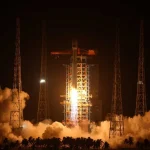
Recently, the launch station built by the Aerospace Science and Technology Group at the Jiuquan Satellite Launch Center passed the acceptance inspection. This is also the first self-built research and test launch station of the Aerospace Science and Technology Group. The completion of the station will provide a solid foundation for the Aerospace Science and Technology Group to better cope with future commercial space flights and high-density launch needs, shorten the launch preparation period, improve launch efficiency.
This incident is not only of great significance to the Aerospace Science and Technology Group, but also marks that our country is building a more flexible, efficient, and open space launch system. Commercial aerospace is making breakthroughs in key technologies and moving towards a new stage of large-scale and industrialized operations.
It can be said that 2025 is destined to be an extraordinary year in the history of my country’s commercial aerospace industry, with good news coming frequently. In June, Blue Arrow Aerospace conducted a test run of the first-stage power system of Zhuque-3 through the dedicated launch station it built for Zhuque-3 at the Jiuquan Satellite Launch Center. Then in October, it conducted the fueling and joint training and static ignition test of Zhuque-3 at this station. These two tests are of the same origin, from the core sub-system to the entire rocket process, step by step, and have done enough ground verification for the first flight. The station built by Blue Arrow Aerospace at the Jiuquan Satellite Launch Center provides the most critical core infrastructure and enabling platform for the entire verification system. In July, the dedicated launch station built by Tianbing Technology for Tianlong-3 at the Jiuquan Satellite Launch Center successfully passed the completion acceptance, laying a key hardware foundation for Tianlong-3’s first flight and low-cost, high-frequency launches. In October, the dedicated launch station built by China Aerospace for Lijian 2 at the Jiuquan Satellite Launch Center passed the completion acceptance. So far, China Aerospace has become the only domestic commercial rocket company with dedicated launch stations for both solid and liquid rockets. This means that China Aerospace can plan launch missions for different types of rockets more flexibly and efficiently.
In addition, Hainan Commercial Space Launch Company’s second phase project has also started in January this year. It plans to build two liquid rocket launch stations, which are expected to be completed before the end of 2026. By then, the Hainan Commercial Space Launch Site will have an additional launch capacity of 30-40 launches per year. It will also effectively alleviate the “station anxiety” of companies that do not have self-built launch stations, allowing them to obtain more stable and predictable launch schedules.
Currently, my country’s low-orbit satellite Internet constellation is under construction in full swing, and the premise of all this is to launch satellites into the sky. If the satellites cannot reach the sky, everything is in vain, and the work station is the prerequisite for all of this. Without the work station, the rocket cannot go to the sky, let alone the satellite. There is an essential cycle for a work station from rocket transfer, erection, filling, testing to final launch, and then to recovery state to prepare for the next launch. Therefore, the number of work stations is also an important indicator that directly determines how many payloads we deliver to space every year. It has an important impact on the speed, cost and final competitiveness of our network.
This series of good news this year has created a solid launch station foundation and the most fundamental cornerstone for us to build a national strategic capability for independent, controllable, global coverage of satellite Internet. With these benefits, I believe that our satellite Internet constellation will be able to operate as planned or even exceed expectations. Although the constellation’s networking progress may not be ideal in the short term, as my country continues to build new commercial rocket launch stations and optimize the potential of launch sites such as Jiuquan, Taiyuan, and Xichang, the construction progress of my country’s satellite Internet constellations will surely usher in a gratifying change. At the same time, the construction of these space infrastructure will eventually bring a new, strategic economic ecology to our country, transforming the vast space into a new engine and new frontier that drives the high-quality development of our country’s economy and society.