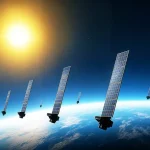
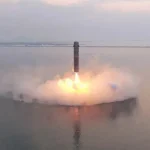
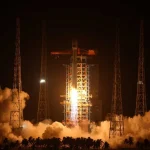
At 0:31 on August 9, 2025, the Jielong 3 Y6 carrier rocket was ignited and lifted off in the offshore waters of Rizhao City, Shandong Province, using 11 satellites in one rocket to send Geely Constellation 04 satellites into the LEO (600 km, 50°) orbit. Spacetime Daoyu and Long March Rocket Company signed a framework agreement for 10 Jielong-3 rockets. This mission is the first of three consecutive launch missions completed within 2 months. As the first rocket of the Jielong 3 batch 01, the successful launch of the Y6 arrow not only efficiently completed the key network launch of the Geely constellation of Spacetime Daoyu Company, but also marked the move of the Jielong 3 rocket from “customization” to “mass production”.
1. Basic information
The Jielong-3 launch vehicle is invested and operated by China Long March Rocket Co., Ltd., a subsidiary of the First Academy of Aerospace Science and Technology, and developed by the First Academy of Aerospace Science and Technology. It is a four-stage tandem solid rocket specially launched for the domestic and foreign mid- and low-orbit satellite network commercial launch markets. It is mainly used to launch sun-synchronous orbit and low-Earth orbit spacecraft. The total length of the rocket is about 31m, the total mass is about 140t, and the fairing diameter is available in two configurations: 3.35m and 2.9m. It can be adapted to a variety of satellite and rocket interfaces, providing reliable, convenient and economical exclusive launch and carry services for domestic and foreign commercial satellite users for constellation networking, network repair, load verification, etc.
2. Development background
In 2020, the First Academy of Aerospace Science and Technology comprehensively analyzed the current situation and future development trends of the domestic and foreign commercial space launch markets, and carried out in-depth demonstration of the Jielong 3 plan on the basis of fully inheriting the development experience of Long March 11. On March 31, 2021, the Aerospace Science and Technology Group officially issued an approval for the Jielong 3 project, requiring full use of mature technologies and products to quickly break through the key technologies for sea thermal launch of large-tonnage solid launch vehicles (Long March 11 uses sea cold launch).
The First Academy of Aerospace Science and Technology is responsible for the overall model design and development management of Jielong 3, and the Long March Rocket Company is responsible for financing and dispatching dispatching and quality management personnel. At the beginning of 2020, Long March Company completed Series A financing to raise start-up capital for Jielong 3. It will subsequently raise social capital through “debt financing + equity financing” to provide sufficient funding for model development. Different from the traditional fundraising model in which the development of models relies entirely on research funds allocated by the state or self-raised research funds by the entire unit, Long March uses equity financing to raise project start-up funds, and at the same time regards the expected operating income of Jielong 3 as an important part of the Series B financing. The successful development of the model can support the company to raise a larger scale of social funds in the Series B financing for the development of new models and technological improvements, forming a positive incremental effect of technology and assets.
3. Rocket composition
The Jielong 3 launch vehicle is composed of rocket body structure, power system, control system, measurement system, separation system and safety self-destruction system. The rocket body structure consists of a fairing, a control cabin, a third- and fourth-stage interstage section, a third-stage tail section, a second- and third-stage interstage section, a second-stage tail section, a first- and second-stage interstage section, and a first-stage tail section. The second-stage tail section and the following sections adopt a modular metal structure design, while the second- and third-stage interstage sections and the third- and fourth-stage interstage sections adopt a composite material structure plan. In the power system, the main power uses cost-effective conventional propellant, and the total charge of the four engines exceeds 100t; the main components of the attitude control engine include thrust devices, pipelines, valves, cylinders and storage tanks. The control system consists of the rocket’s electrical system, guidance system, attitude control system, and ground measurement and launch control system.
Ground equipment mainly consists of launch support system, ground measurement and launch control system and supporting equipment. The launch support system mainly consists of launch area equipment, technical area equipment and transportation equipment from the assembly plant to the launch site. The launch support system can adapt to both sea launch and land launch modes. The command and control system is used for long-distance wireless testing and launch control of rockets, providing high-speed, reliable and safe communication guarantee for the front and back ends of the control and measurement system, and transmitting rocket test and launch information back to the ground command center to achieve real-time mission monitoring.
4. Rocket characteristics
(1) Flexible launch method
Jielong 3 mainly focuses on thermal launch at sea, is compatible with land launch, and can adapt to three modes of transportation: road, railway and sea.
(2) Fast performance
The Jielong 3 development team merged the traditional “plan + preliminary prototype + test sample” into “plan + engineering development”, and carried out design and production, production and testing, testing and final assembly in parallel, greatly shortening the development cycle. At the same time, by adopting methods such as early production, comprehensive de-mission, and rocket-like satellites, the performance cycle is greatly shortened. The performance cycle from contract signing to rocket launch is only 3-6 months.
(3) Short test and launch cycle
Jielong 3 breaks the traditional test and launch mode of multiple disassembly and assembly. After completing the final assembly and testing, docking with the satellite, it is transferred for full system training. After being transported to the scheduled launch sea area, the launch can be completed. The whole process only takes 3-4 days. The single-engine rocket has the capability of high-frequency launches once a week.
(4) The product is cost-effective
In the development of Jielong 3, a large number of mature shelf products were selected, and the Long March series rocket technology and a large number of simulation technologies were extensively applied, achieving a certain degree of universality of stand-alone machines, tooling, equipment, facilities, etc., effectively reducing model development costs and improving product cost performance.
5. Carrying capacity
(1) Sea launch
SSO(300 km):1630 kg
SSO(500 km):1450 kg
SSO(700 km):1270 kg
(2) Land launch (Jiuquan)
SSO(300 km):1680 kg
SSO(500 km):1500 kg
SSO(700 km):1320 kg
6. Sea launch process
Rocket body status inspection and handover → Horizontal test → Star and arrow docking → Fairing docking → docking of the second, third and fourth stages + star cover assembly with the first sub-stage → Test before transfer → Transfer of the rocket body to the launch platform → Preparation before transfer → Transfer of rocket and ground equipment on board → Combined ship and arrow training → Confirmation of quality and product status before going to sea → Rocket transportation to sea → Launch ship anchored → Pre-launch test in the launch area → Rocket launch
7. Launch records
At 14:35 on December 9, 2022, the Jielong-3 Y1 rocket successfully completed its first flight in the Yellow Sea. The mission team was the Taiyuan Satellite Launch Center maritime launch team, and the launch platform was the Terry barge.
At 3:24 on December 6, 2023, the Jielong-3 Y2 rocket was successfully launched in the South China Sea, successfully sending the satellite Internet technology test satellite 03 into the predetermined orbit. The mission team was the Taiyuan Satellite Launch Center maritime launch team, and the launch platform was the Borun Kyushu cargo ship.
At 11:06 on February 3, 2024, the Jielong-3 Y3 rocket was ignited and launched into space near Yangjiang, Guangdong, successfully launching the DRO-L satellite, the Egyptian NExSat-1 satellite, the Yantai-2 satellite (the Oriental Eye constellation high score 01 star), Weihai-1 01/02 satellite, and Star Times – On 18/19/20, 9 satellites including Zhixing 2A were sent into space. This launch is the first commercial launch mission of Jielong 3, marking the official start of the commercialization stage of Jielong 3. The mission team for this launch is the Taiyuan Satellite Launch Center maritime launch team, and the launch platform is the Borun Jiuzhou cargo ship.
At 10:31 on September 24, 2024, the Jielong-3 Y4 arrow was ignited and lifted off from the sea near Haiyang, Shandong Province, and the Tianyi 41 star, Star Times-15, Star Times-21, Star Times-22, and Luojia 4-01 star (Yuxing-2 05), Fudan-1, Tianyan 15, and Jitianxing A-01 (a total of 8 satellites) were successfully put into the scheduled orbit. The mission team was the Taiyuan Satellite Launch Center maritime launch team, and the launch platform was the Oriental Spaceport rocket launch ship.
At 11:00 on January 13, 2025, the Jielong-3 Y5 rocket was ignited and lifted off in the Yellow Sea, successfully sending Microspace 01 satellites (10 satellites in total) into the predetermined orbit. The mission team was the Taiyuan Satellite Launch Center maritime launch team, and the launch platform was the Oriental Spaceport rocket launch ship.
At 00:31 on August 9, 2025, the Jielong 3 Y6 rocket was ignited and lifted off in the offshore waters of Rizhao City, Shandong Province. It used 11 satellites in one rocket to send the Geely Constellation 04 satellite into the LEO (600 km, 50°) orbit. The mission team was the Taiyuan Satellite Launch Center maritime launch team, and the launch platform was the Oriental Spaceport rocket launch ship.