Phase I project
1. Overview of the first phase project
The Hainan Commercial Space Launch Site is located in Dongjiao Town, Wenchang City, Hainan Province. The first-phase project investment is about 4 billion yuan, including the technical area and the launch area. The technical area covers an area of about 695 acres; the launch area covers an area of about 1,866 acres, located southwest of the Wenchang Space Launch Site. Two liquid rocket launch stations and two solid rocket launch stations will be constructed in the launch area.
2. Composition of the first phase project
(1) Workstation No. 1
1. Overview of workstation No. 1
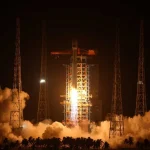
Station No. 1 is a dedicated launch station for the Long March 8 series launch vehicles. It is also the first launch station in China to use a guide cone. The launch mode is changed to three-vertical, vertical transportation, and vertical launch. The rocket occupies the position for 7 days before launch and recovers for 7 days after launch. Taking into account the synergy and maintenance time, the station has an annual saturated launch capacity of 16 times. Station 1 is designed and planned according to a 600-ton take-off mass rocket, which can meet the launch requirements of a core stage diameter of 3.35 meters + four 2.25-meter-diameter booster configuration rockets, and has liquid oxygen/kerosene, liquid hydrogen/liquid oxygen filling capabilities.
2. Composition of workstation No. 1
(1) Service tower
The No. 1 service tower is 83 meters high and consists of an all-steel structure. It provides a fixed place and related support for the work of gas supply, filling, air conditioning, power supply and other systems. The tower crane at the top of the service tower has a dead weight of 110 t and a maximum lifting capacity of 55 t, providing hoisting support when performing launch missions.
(2) Lightning tower
There are four lightning protection towers at Work Station No. 1, each of which is 120 meters high. The lightning protection tower adopts a three-dimensional network lightning protection system to prevent severe weather effects such as lightning strikes and thunderstorms.
(3) Diversion cone
Station No. 1 uses a ground guide cone to realize the high-temperature flame discharge function through the launch pad, guide device and water spray system. The diversion device is manufactured by Shanxi Aerospace Tsinghua Equipment Co., Ltd. It is divided into three parts: left, middle and right, with a total weight of about 129.5 tons. The size of the diversion device is approximately 11.4 meters × 10.5 meters × 4.5 meters. The gas flow ground drainage scheme greatly simplifies the construction process, improves construction efficiency, and makes subsequent maintenance easier, significantly reducing construction costs.
(4) Water spray system
Station No. 1 uses a squeeze water spray system for cooling and noise reduction for the first time. The water spray system mainly consists of water tanks and pressure tanks, which can release 500 tons of water in 15 seconds. Different from other launch stations, the squeeze water spray system of station No. 1 is placed on the ground and does not need to be pumped to the top of the tower in advance. The whole process is more convenient. However, the water tanks of other stations are on the top of the launch tower and the water needs to be pumped to the top of the tower in advance.
3. Important time node events for No. 1 work
On July 6, 2022, construction of Station No. 1 started.
On December 29, 2023, Station No. 1 was completed.
At 0:38 on March 12, 2025, the No. 1 station was launched. The rocket used was the Long March 8, and the payload was the Qianfan Polar Orbit 04 satellite (a total of 18 satellites).
(2) Station No. 2
1. Overview of workstation No. 2
Station No. 2 is a universal liquid launch station that is compatible with Type 19 rockets from 10 rocket companies. The core diameter covers 3.35 meters, 3.8 meters, 4.2 meters, and 5 meters. It supports the filling of liquid oxygen, liquid hydrogen, methane, and kerosene. The No. 2 station adopts the three-level test and launch mode, occupying the position for 3 days before launch and 7 days for recovery after launch. The annual saturation launch volume is designed to be 16 rounds.
2. Composition of No. 2 workstation
(1) Raise the erecting frame
The erection frame of the No. 2 station weighs more than 200 tons and was designed taking into account the maximum needs of various types of rockets.
(2) Lightning tower
There are four lightning protection towers in Station No. 2. Each lightning protection tower is 125 meters high, which is 5 meters higher than the lightning protection tower in Station No. 1.
(3) Diversion trough
The diversion channel at station No. 2 is 73.8 meters long, 23.6 meters wide, and 22.5 meters deep at the bottom.
(4) Water spray noise reduction system
The water tower at station No. 2 is 80 meters high, with a water tank capacity of approximately 650 cubic meters and a total water spray power of approximately 30 megawatts.
3. Important time events at station No. 2
On October 30, 2022, construction of Station No. 2 started.
On June 6, 2024, Station No. 2 was completed.
At 22:48 on the evening of November 30, 2024, the No. 2 station was launched. The rocket used was the Long March 12, and the payload was the satellite Internet technology test satellite and the technology test satellite 03.
(3) Solid launch station
Plan to build two small solid rocket launch stations
Phase II project
Overview of the first and second phase projects
The second phase project is located in Dongjiao Town, Wenchang City, Hainan Province, adjacent to the first phase project. On January 25, 2025, the second phase of the project started. On the morning of February 24, 2025, a centralized signing ceremony for the construction contractors of the second phase of the project was held, marking that the second phase of the project has officially entered the full implementation stage.
2. Composition of the second phase project
The second phase of the project mainly constructs the launch area, technical area and Gusong measurement and control station.
1. Launch area: Construct two liquid rocket launch stations No. 3 and No. 4, and construct a propellant filling system, gas supply system, etc. with a “one-to-two” supporting system.
2. Technical area: Construction of command and control center, rocket assembly and testing plant and other facilities.
3. Other facilities: Build a new launch area measurement and control system, and renovate and expand the meteorological system, communication system, C3I system, etc.
3. Work station composition
Stations No. 3 and 4 adopt the “three-level” test and launch mode, with a designed annual launch capacity of no less than 32 rounds.
Supporting projects
1. Filling system
(1) Kerosene filling reservoir area
The kerosene filling warehouse area consists of a kerosene storage warehouse, a power supply room control room, a filling pump room, a hose cleaning room and a heat exchanger cover. Aerospace kerosene is transported from Xinjiang to the launch site. After passing the sampling and testing, it enters the kerosene storage tank. The storage capacity of the kerosene filling depot can meet 5-6 filling tasks. During the storage process, the kerosene is kept under pressure with nitrogen. When filling, the kerosene is pressurized through the storage tank and enters the pipeline above the storage tank. It enters the pump room through the pipeline, and enters the rocket storage tank through the flow meter, filter, and external pipeline.
(2) Liquid hydrogen filling reservoir area
The liquid hydrogen filling storage area consists of a hydrogen torch, a supercharger, a reheater, a filling pipeline, a hydrogen storage cover, and auxiliary rooms. Before liquid hydrogen enters the pipeline, the pipeline is purged and gas checked, and the liquid hydrogen filling system is debugged with liquid nitrogen to check whether the pipelines, valves, etc. are working normally at low temperatures. After the liquid hydrogen vehicle enters the site, a pressure boost test and a hydrogen emission test are required. The day before the rocket is launched, the liquid hydrogen filling pipeline, discharge pipeline, hydrogen tank, etc. need to be replaced with helium or hydrogen. It usually needs to be replaced more than a dozen times. Liquid hydrogen filling can only be carried out after passing the test. The excess hydrogen generated during the filling and replacement process is discharged and burned through a hydrogen torch.
(3) Liquid oxygen filling reservoir area
After passing the inspection and testing, the liquid oxygen enters the liquid oxygen tank through the transfer port and the control system controls the opening and closing of the valve. It then enters the subcooler through extrusion or pressurization by the liquid oxygen pump, and then enters the filling pipe after cooling. After the filling is completed, the excess liquid oxygen will enter the collection tank through the discharge pipeline. After the liquid oxygen vaporizes in the collection tank, it will be discharged by the discharge tower.
2. Air supply system
(1) Nitrogen source system
The nitrogen source system consists of liquid nitrogen storage tanks, vaporizers, gas cylinder groups, gas distribution stations, and external gas supply pipelines. The liquid nitrogen storage tank has a volume of 750 m3 and a weight of 14.4 tons. After the liquid nitrogen is pressurized and vaporized, it becomes nitrogen, which passes through the nitrogen source distribution station and is supplied to other areas of the launch center or stored in nitrogen bottles. Nitrogen can be used for purging instrument compartments, air tightness inspection, etc.
(2) Helium gas source system
The helium gas source system consists of a gas cylinder group, a gas distribution station, a membrane press unit, and external pipelines. The boiling point of liquid helium is -268.93°C, and it is not easy to liquefy and store. Helium is usually stored in gaseous form. The membrane press compresses the helium and stores it in the gas cylinder group. The helium in the cylinder group passes through the gas distribution station and is supplied to the liquid hydrogen filling reservoir and rocket power system. Helium is mainly used for blowing, replacing and pressurizing. It is used for blowing and replacing liquid hydrogen pipelines and liquid hydrogen storage tanks in the liquid hydrogen refueling area. It is used for engine blowing and pressurizing of cold helium bottles and oxygen tanks on rockets.
(3) Air source system
The air source system consists of an oil-free screw compressor, a dryer, a low-pressure buffer tank, an oil-free piston compressor, a high-pressure gas cylinder, and a gas distribution station. The oil-free screw compressor inhales and compresses the air, removes moisture through a dryer, and inflates it into a low-pressure buffer tank. The low-pressure buffer tank is connected to an oil-free piston compressor. The oil-free piston compressor compresses the low-pressure air in the low-pressure buffer tank to 35 MPa. The 35 MPa air is used to inflate the cylinder through the air distribution station or directly provide online air supply through the air distribution station. The air source has three functions. The first is that it is used to blow out the cabin when the rocket transfers to the launch tower. The second is that when the hydrogen and methane reservoir area is released in an emergency, some fuel does not need to be used, and the air can help the excess fuel burn. The third is that when a nitrogen pipeline leak occurs during daily inspections, people cannot enter directly and need to carry a first aid bottle. The air source for the first aid bottle is the air source reservoir.
operating unit
1. Company Profile
Hainan International Commercial Space Launch Co., Ltd. is responsible for the investment, financing, construction, operation, management, and maintenance of the Hainan Commercial Space Launch Site. Hainan Shangfa Company was established on June 2, 2022, with a registered capital of 1.5 billion, all paid in.
2. Equity ratio
Shareholder name
Investment ratio
Amount of investment
Hainan Provincial State-owned Assets Supervision and Administration Commission
35%
525 million
China Academy of Launch Vehicle Technology
25%
375 million
China Huateng Industrial Co., Ltd.
25%
375 million
China StarNet Network System Research Institute Co., Ltd.
15%
225 million
3. Core members
(1) Yang Tianliang–Chairman
Born in January 1965, a native of Weinan, Shaanxi. He has a master’s degree from Beijing University of Aeronautics and Astronautics, a doctorate in control theory and control engineering from University of Science and Technology Beijing, and a postdoctoral fellow at the State Key Laboratory of Intelligent Technology and Systems in the Department of Computer Science, Tsinghua University. He once served as deputy director of the Department of Science and Technology of Hainan Province.
(2) Liu Hongjian—General Manager
Born in November 1970, a native of Daye, Hubei. He started at Hainan Iron and Steel Company and served as a member of the Standing Committee of the Sansha Municipal Party Committee and deputy mayor.
(3) Fan Ruixiang—Deputy General Manager
Born in June 1965 in Wuwei City, Gansu Province, he is an academician of the Chinese Academy of Sciences and the chief designer of the Long March 7A launch vehicle.
(4) Shou Junming—Assistant to the General Manager, General Manager of Wenchang Aerospace Launch Support Co., Ltd.
Born in June 1974, he has participated in the entire construction demonstration, engineering construction, and launch capability generation of the Wenchang Space Launch Site.