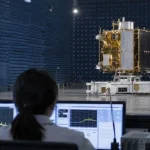
Recently, the Wall Street Journal published an interview with Deep Blue Aerospace CEO Huo Liang. He revealed that Deep Blue Aerospace expects to catch up with SpaceX in 2030.
01
Who’s going to catch up with SpaceX?
1.Deep Blue Aerospace
Recently, the Wall Street Journal published an interview with Deep Blue Aerospace CEO Huo Liang. Huo Liang said that Deep Blue Aerospace expects to catch up with the industry-leading SpaceX by 2030.
this company
Founded in 2016
, mainly engaged in the development of liquid recyclable rockets, headquartered in Wuxi, Jiangsu.
So how is the progress of Deep Blue Aerospace?
Currently, the company’s rocket under development is the “Nebula-1”
, is a medium-sized liquid recyclable reusable rocket equipped with the “Thunder-R1” liquid oxygen kerosene engine developed by Deep Blue Aerospace. It is planned to conduct orbital flight and recovery tests in June or July this year.
(Picture: Nebula-1 sub-stage. Source: Deep Blue Aerospace official website)
2.Zero One Space
In addition to Deep Blue Aerospace, Shu Chang, founder and CEO of Zero One Space, said at a press conference: There is still a big gap between Zero One Space and SpaceX in terms of products, but there will be opportunities to compete in some fields in the next 5 to 10 years.
At that time, my country’s first privately developed commercial suborbital rocket OS-X “Chongqing Liangjiang Star” self-developed by Zero One Space was successfully ignited and launched into space.
In July 2021, Zero One Space released the Spirit Dragon series of rockets, but this series of rockets has not made any substantial progress so far.
The business focus has also shifted to rocket supporting products such as solid rocket motors, measurement and control products, and launch vehicles.
(Picture: Linglong series launch vehicle Source: Zero One Space public account)
3.Interstellar Glory
In 2018, Huo Jia, then vice president of StarGlory, said in an exclusive interview with Phoenix Finance that the difference between StarGlory and SpaceX was not in technology, and it was only a matter of time before StarGlory caught up with and surpassed SpaceX.
However six
Years have passed, and Hyperbolic One is still on the verge of success or failure.
Its self-developed liquid recovery and reuse rocket
Hyperbola No. 3
, from December 20 to December 24, 2024, it just completed the assessment and test run of the Focus No. 2 liquid oxygen methane engine and entered the mass production and delivery stage. There is still a long way to go before the first flight.
(Picture: Focus No. 2 Engine Source: Interstellar Glory)
02
China’s Private Rockets: Valuation Bubbles and Technical Bottlenecks
my country’s commercial aerospace has developed rapidly in recent years with policy support and capital enthusiasm, but it still faces core problems such as high valuations, insufficient technology accumulation, and slow progress in recyclable rockets.
1. Imbalance between valuation and technology
The valuations of leading commercial aerospace companies have soared. Deep Blue Aerospace’s latest valuation reached 5 billion yuan, Eastern Space’s pre-B+ round valuation was 7 billion yuan, and Blue Arrow Aerospace’s valuation exceeded 20 billion yuan. However, behind the high valuations, there is still a big gap between private rocket companies and SpaceX in terms of technical strength.
From the perspective of transportation capacity, most companies’ LEO transportation capacity is only 1-6 tons. Even Gravity One, “the world’s largest thrust solid rocket”, has a LEO transportation capacity of only 6.5 tons, which is significantly different from the 22.8 tons of SpaceX Falcon 9.
(Picture: The first flight of Gravity 1. Source: Our Space)
2.
Insufficient transportation capacity and slow progress in recycling
At present, China’s commercial rockets are
Mainly small solid rockets
, such as Ceres 1 (LEO capacity 400 kg) and Hyperbola 1 (LEO capacity not less than 300 kg), can only support the launch of micro satellites.
Even though reusable liquid rockets such as Zhuque-3 (LEO capacity 21.3 tons) and Tianlong-3 (LEO capacity 17 tons) are scheduled to fly for the first time in 2025, the first flight capacity is usually not full, and the reliability needs to be verified.
In terms of recyclable rocket technology, although Chinese private rocket companies are actively engaged in research and development of recyclable technology, currently only a few such as Blue Arrow Aerospace, Deep Blue Aerospace, and Interstellar Glory have conducted vertical takeoff and landing flight tests, and stable and reliable recovery has not yet been achieved.
In October 2024, the Deep Blue Space Nebula-1 high-altitude vertical take-off and landing recovery test encountered an abnormality during the landing shutdown section and failed to complete the set mission.
In contrast, SpaceX achieved first-level reuse of Falcon 9 as early as 2016, and has now reused a single rocket 26 times.
(picture:
Part of the Nebula-1 rocket body was damaged
)
In general, Chinese commercial rocket companies are still in the catching-up stage compared with SpaceX in terms of carrying capacity, technology maturity, recovery technology and stability.
03
Set a small goal first: catch up with SpaceX in 2020?
Although there is a clear gap between China’s private rocket companies and SpaceX at this stage, and technical bottlenecks need to be broken urgently, aerospace development must follow objective laws, and there is no need to be hasty. We might as well set a small goal first:
Catch up on SpaceX in 2020.
2020 is a key turning point in the development of SpaceX, which has made breakthrough progress in rocket technology, spacecraft technology, manned spaceflight, satellite constellations and other aspects.
rocket technology
, Falcon 9 launched 26 times throughout the year in 2020, setting a new record. The first-stage booster was successfully recovered and reused many times, with the highest number of reuses reaching 7 times. The technology has become mature and the launch cost has been significantly reduced;
starship
The research and development of the aircraft also made important progress in 2020. The two prototypes SN5 and SN6 completed low-altitude jump tests at an altitude of 150 meters in August and September 2020 respectively. In December 2020, SN8 attempted a high-altitude flight test for the first time, flying to a height of 12.5 kilometers. Although it finally landed and exploded, it successfully verified key technologies such as aerodynamic control, engine multi-machine coordination, and free-fall flipping;
(Picture: SN8 high-altitude flight test Source: SpaceX)
Spaceship
, SpaceX’s Dragon cargo spacecraft, carried out the CRS-20 and CRS-21 missions in 2020 to deliver supplies to the International Space Station. The December mission used the second-generation cargo Dragon spacecraft for the first time;
In May 2020, the Manned Dragon spacecraft carried out its first manned mission, sending two American astronauts to the International Space Station. This was the first time that an American company sent astronauts into space since the retirement of the U.S. space shuttle in 2011. It verified the reliability and safety of the Manned Dragon spacecraft. SpaceX has made key progress in the field of manned spaceflight;
Satellite constellation
, SpaceX intensively deploys Starlink satellites, launching 14 batches of approximately 833 Starlink satellites throughout the year. The satellites adopt a flat design, with a single satellite weighing approximately 260 kilograms, and are deployed in batches through the Falcon 9 “60 satellites in one arrow” mode;
Engine
The Merlin 1D engine is the main power source of Falcon 9. After years of development and improvement, the technology has become mature and stable. In addition, SpaceX’s new generation full-flow staged combustion cycle Raptor engine has also undergone ground testing and been mounted on the Starship test aircraft for multiple test flights.
(Picture: Merlin 1D engine test run. Source: Wikipedia)
In contrast, China’s private rocket companies only launch more than ten times a year, and they mainly focus on small solid rockets. The recyclable liquid rocket technology has not yet been verified into orbit.
If Chinese private rocket companies can reach the technical level and business capabilities of SpaceX in 2020 in the short term, it will be a huge improvement.
Summarize
Deep Blue Aerospace claims to catch up with SpaceX in 2030, which may have its own considerations. Such a statement can attract more attention and investment to a certain extent. By proposing a big goal, it can obtain more capital injection and provide sufficient financial support for technology research and development, project promotion, etc.
At present, China’s commercial aerospace appears to be prosperous with the help of capital, but its technological accumulation and commercial capabilities are still immature. If we can achieve breakthroughs in recyclable technology, reduce launch costs, and use policy dividends to build a full industry chain ecosystem, we may be able to approach the “past” of SpaceX in 2030. The outcome of this technological race is yet to be determined, but commercial aerospace is like a marathon, where patience and pragmatism are more important than speed.