AI is reshaping every aspect of commercial aerospace
, from reducing costs to achieving what was once “impossible”.
With the advancement of algorithms and computing power, its application boundaries will be further expanded, pushing humans to explore and utilize space more efficiently.
01
USA
First government agency to ban DeepSeek
According to a report on the US Consumer News and Business Channel website on January 31, NASA’s Chief Artificial Intelligence Officer sent a memorandum to all employees on January 31, prohibiting employees from using China’s DeepSeek artificial intelligence technology and blocking their systems from accessing the DeepSeek platform on the grounds that DeepSeek’s servers “operate outside the United States and have national security and privacy issues.”
(Photo: U.S. House of Representatives
ban
end
Congressional offices use DeepSeek Source: Bitrue)
NASA also became the first federal agency to issue an internal administrative order prohibiting employees from using DeepSeek. At the same time, in the report we also noticed a position that many people have not heard of before: NASA’s Chief Artificial Intelligence Officer.
On May 13, 2024, former NASA Administrator Bill Nelson appointed David Salvagnini, then NASA’s chief data officer, as the agency’s new chief artificial intelligence (AI) officer, effective immediately.
(Picture: NASA Chief Artificial Intelligence Officer Salvagnini Source: NASA)
This appointment is from 2024
On March 28, the U.S. Federal Office of Management and Budget issued a directive requiring each federal agency to establish a chief artificial intelligence officer.
Nielsen said: Artificial intelligence has been used safely at NASA for decades.
So, what are the applications of AI in the aerospace field?
02
AI helps the rapid development of aerospace
In fact, the application of AI in the commercial aerospace field is very comprehensive. From upstream spacecraft design and manufacturing to data analysis and service optimization, AI is reshaping every aspect of commercial aerospace.
1. Spacecraft design and manufacturing optimization
Through AI technologies such as generative design and machine learning, the development cycle of spacecraft can be accelerated, manufacturing costs can be reduced, and the aerospace industry can help reduce costs and increase efficiency.
For example:
① During the design process of the starship, SpaceX used AI to simulate different materials and structural designs to optimize the heat resistance and weight of the rocket and reduce the risk of re-entry into the atmosphere.
(Picture: Insulation tiles behind the Starship spacecraft Source: SpaceX
)
②Relativity Space’s 3D printed rocket Terran One uses AI algorithms to control the 3D printing process, adjust parameters in real time, reduce manufacturing defects and shorten production time.
2. Launch process automation and fault prediction
Use AI to achieve real-time decision-making and risk control in rocket launches. like:
①Rocket Lab’s launch system uses AI to analyze weather, sensor data and engine performance to dynamically adjust the launch window to improve the success rate.
(Picture: Rocket Lab’s Electron launch Source: SpaceX)
②Astra’s anomaly detection uses a machine learning model to monitor the status of the rocket in real time. It once detected a fuel valve abnormality 10 seconds before launch and automatically aborted the mission.
3. Autonomous navigation and space exploration
AI enables spacecraft to operate independently in complex environments. like:
①NASA’s Perseverance Mars rover uses computer vision to identify terrain, plan a safe path, and avoid sand dunes and rocks.
(Picture: Perseverance Mars Rover Source: NASA
)
②Intuitive Machine Company (
Intuitive Machines
)’s lunar lander used AI to process navigation data in real time during the landing phase and adjust its attitude to avoid craters.
4. Satellite constellation management and collision avoidance
AI coordinates the operation of large-scale satellite networks and reduces the risk of collisions. like:
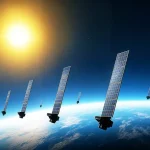
①SpaceX’s Starlink uses an AI management system to track the orbital data of 60,000 satellites, predict the possibility of collision with other satellites or debris, and automatically adjust its orbit.
(Picture: Starlink concept map Source:
SpaceX)
②LeoLabs’ space traffic management uses AI to analyze radar data and provide real-time collision avoidance suggestions to commercial satellite operators.
5. Satellite data analysis and earth observation
AI quickly processes massive remote sensing data and extracts commercial value. like:
①Planet Labs’ disaster monitoring uses AI to automatically compare satellite images before and after floods, assess the affected area, and assist in rescue decisions.
(Picture: Planet Labs’ Pigeon Constellation Satellite Concept Image Source:
Planet Labs
)
②Orbital Insight’s energy forecast predicts global crude oil inventories by analyzing changes in oil tank shadows, serving the financial and energy industries.
6. Aerospace supply chain and customer service optimization
AI optimizes resource allocation and improves user experience. like:
①Blue Origin’s supply chain management uses AI tools to predict parts demand and dynamically adjust supplier orders to avoid launch delays.
(Picture: Blue Origin’s New Glenn rocket first flight Source: Blue Origin
)
②ICEYE
Flood insurance service: Based on satellite radar data, AI generates real-time flood maps for insurance companies to quickly determine losses.
03
The future development trend of AI+aerospace
In the future, the application of AI technology in the aerospace field will focus on improving autonomy, efficiency breakthroughs and mission complexity, and will deeply integrate the entire chain of spacecraft design, operation and deep space exploration. Solve the limitations of human exploration in deep space and the efficiency of near-Earth space development, and achieve major breakthroughs in the following fields:
1. Fully autonomous spacecraft: “AI pilot” from Earth to deep space
AI will enable autonomous decision-making throughout the entire life cycle of a spacecraft, including launch, orbit change, fault repair and scientific target selection, reduce reliance on ground control, solve the problems of “communication delay” and “celestial body blocking signals” encountered in deep space exploration, allowing spacecraft to work autonomously and reduce “sleep” time.
(Picture: Voyager 1 deep space probe Source:
Orbital Today
)
2. On-orbit manufacturing and space factories: AI-driven “space craftsmen”
In the future, AI can also control space robots to independently build in orbit (such as space power stations), and even use lunar resources to 3D print buildings. Use AI technology to analyze changes in material properties in microgravity environments, dynamically adjust manufacturing parameters, build lunar scientific research stations, and reduce the reliance on “ground material transportation” for the construction of lunar and Mars bases.
(Picture: China’s Lunar Base Plan Source: China Aerospace
)
Speaking of this, some people will definitely think of China’s lunar exploration program. At present, China’s lunar exploration project has included in-situ 3D printing of lunar soil bricks in the plan to provide technical support for the construction of long-term lunar scientific research stations.
Summarize
It is foreseeable that in the future, AI will be deeply involved in every aspect of aerospace and become an important means for humans to explore space and develop space resources. However, the application of AI technology also comes with huge risks. Aerospace is a huge system project. AI decision-making errors may lead to the failure of space missions worth hundreds of millions or even billions of dollars. The development of more interpretable aerospace-specific AI is also the only way to achieve aerospace + AI in the future.
Find the commercial space sector
“Startup”
We will gradually launch
commercial aerospace startups,
The company with the most investment potential and innovation
We welcome start-ups or companies with financing needs to contact us.
Through Nihao Space, you can reach hundreds of top investment institutions, tens of thousands of industry experts and technical talents for free.
if
You or the companies you have worked with