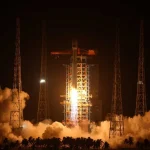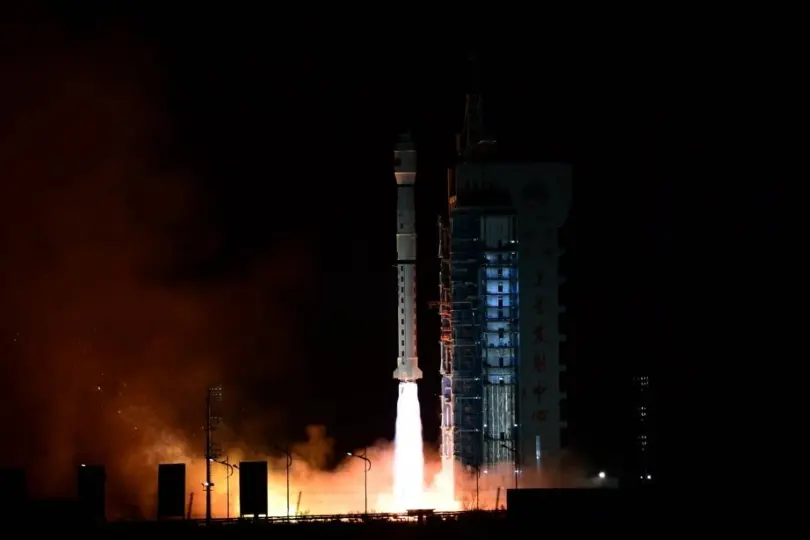
China launched a new remote sensing satellite on December 27 from the Jiuquan Satellite Launch Center. The launch of Yaogan Weixing-33(R) took place at 15:44 UTC from the LC43/94 launch complex using the Long March-4C (Y35) – Chang Zheng-4C – rocket.
Weather conditions at launch were extremely cold, bringing great challenges to the launch preparations. The launch team reviewed various winter launch safeguard measures for this mission, covering ground equipment operation, propellant refueling, payloads environmental protection systems, etc.
As usual, Chinese media refers to the new satellite as a new remote sensing bird that will be used mainly for scientific experiment research, marine and land resource surveys, and other tasks. But as was the case in the last launches of the Yaogan Weixing series, it is believed this class of satellites is used for military purposes.
See Also
- Chinese Forum Section
- 65 Launch Vehicle Manuals (L2)
- Click here to Join L2
China named the satellite ‘Yaogan Weixing-33’, but on May 22, 2019, another Yaogan Weixing-33 was lost on a Long March-4C launch failure that occurred a few minutes after launch from the Taiyuan Satellite Launch Center.
The lost Yaogan-33 was likely the second satellite of the successor series to the Yaogan Weixing-1 (Jianbing-5) class space-based synthetic aperture radar (SAR) system. The first satellite of this second generation SAR was Yaogan-29, launched on November 26, 2015.
Another small satellite, Weina Jishu Shiyan, was also launched on this mission. The small satellite will be used for scientific research, according to the Chinese media.
Both satellites have become the final satellites to be orbited by China in 2020 and the last satellites on the nation’s 13th Five-Year Plan.
With its main commonality matched to the Long March-4B, the Long March-4C first stage has a 24.65-meter length with a 3.35-meter diameter, consuming 183,340 kg of N2O4/UDMH (gross mass of first stage is 193.330 kg).
The vehicle is equipped with a YF-21B engine capable of a ground thrust of 2,971 kN and a ground specific impulse of 2,550 Ns/kg. The second stage has a 10.40-meter length with a 3.35-meter diameter and 38,326 kg, consuming 35,374 kg of N2O4/UDMH.
Aerospace & Defense
(adsbygoogle = window.adsbygoogle || []).push({});
It includes a YF-22B main engine capable of a vacuum thrust of 742 kN and four YF-23B vernier engines with a vacuum thrust of 47.1 kN (specific impulses of 2,922 Ns/kg and 2,834 Ns/kg, respectively).
The third stage has a 4.93-meter length with a 2.9-meter diameter, consuming 12,814 kg of N2O4/UDMH. Having a gross mass of 14,560 kg, it is equipped with a YF-40 engine capable of a vacuum thrust of 100.8 kN and a specific impulse in vacuum of 2,971 Ns/kg.
The Jiuquan Satellite Launch Center, in Ejin-Banner – a county in Alashan League of the Inner Mongolia Autonomous Region – was the first Chinese satellite launch center and is also known as the Shuang Cheng Tze launch center.
 The site includes a Technical Centre, two Launch Complexes, Mission Command and Control Centre, Launch Control Centre, propellant fuelling systems, tracking and communication systems, gas supply systems, weather forecast systems, and logistic support systems.
Jiuquan was originally used to launch scientific and recoverable satellites into medium or low earth orbits at high inclinations. All Chinese crewed missions are launched from this site.
The LC-43 launch complex, also known as the South Launch Site (SLS), is equipped with two launch pads: 91 and 94. Launch Pad 91 is used for the crewed program for the launch of the Long March-2F launch vehicle (Shenzhou and Tiangong).
Launch Pad 94 is used for uncrewed orbital launches by the Long March-2C, Long March-2D, and Long March-4C launch vehicles.
Other launch zones at the launch site are used for launching the Kuaizhou, the CZ-11 Chang Zheng-11, and commercial launch vehicles using solid rocket motors.