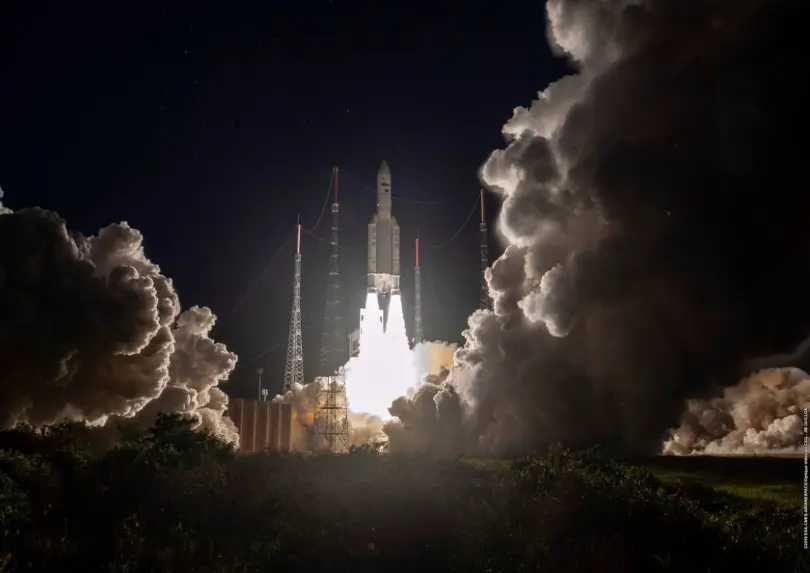
After a short three-month break between flights, Arianespace returned to action with the launch of two telecommunications satellites in TIBA-1 and Inmarsat GX5 on an Ariane 5 rocket. Liftoff from Ariane Launch Complex No. 3 (ELA 3) at the European Spaceport in Kourou, French Guiana finally occurred on Tuesday after several delays due to technical and weather issues.
This mission (officially known as Ariane Flight VA250) was the fourth Ariane 5 launch of the year, and the eighth launch for Arianespace as a whole in 2019.
This goes in the books as the 106th launch of an Ariane 5 to date since its debut in 1996, and the 73rd flight of the ECA variant of the launcher.
The attempt on Friday was scrubbed due to an issue with ground systems at the pad.
Ariane 5 launch SCRUBBED. pic.twitter.com/7MeoY6dJEj
— Chris Bergin – NSF (@NASASpaceflight) November 22, 2019
It was initially hoped the delay would only last until the next available window on Saturday, before that too was ruled out, eventually settling on a reset for Monday.
However, weather then played a factor in the launch preparations, moving the launch another 24 hours to Tuesday. Red Upper Level Winds tested the patience of the rocket again during Tuesday’s countdown. However, the constraint soon cleared, allowing for the launch to take place.
Ariane 5 is one of three vehicles that Arianespace currently operates at the European Spaceport in Kourou, along with the medium-lift Soyuz-ST launch vehicle (provided by the Russian Space Agency, Roscosmos) and their small-lift Vega rocket.
Space Shuttle models
(adsbygoogle = window.adsbygoogle || []).push({});
Watch @Ariane5 #VA250 launch live TONIGHT, Mon 25 November, at 22:08 CET on the @Arianespace channel https://t.co/fGngeCG2vZ or https://t.co/E5vatWkk5s
Photos by @TrevorMahlmann & @johnkrausphotos pic.twitter.com/VR3SaeNjuP
— ESA Space Transport (@ESA_transport) November 25, 2019
The two satellites that launched on this mission – TIBA-1 and Inmarsat 5 F5 (also known as GX5) – both function as mobile telecommunications relay platforms that will be operated on behalf of the government of Egypt and Inmarsat, respectively.
The Ariane 5 rocket that launched these two spacecraft was lifting a total payload mass of approximately 10,495 kilograms (23,138 pounds).
TIBA-1 – which is based on the Eurostar 3000 satellite platform and was developed by Thales Alenia Space & Airbus Defence and Space – occupied the larger upper portion of the Ariane 5 payload fairing, and was released first during the launch.

TIBA-1 Satellite
The civil and governmental communications satellite will be stationed at the 35.5 deg East longitude orbital slot position following its deployment by Ariane 5 and will provide communications services to the country of Egypt via a Ka-band payload. The spacecraft’s estimated mass at liftoff is 5,600 kilograms (12,346 pounds).
TIBA-1 was designed with a lifetime of over 15 years on orbit. The satellite will be the 4th such spacecraft launched by Arianespace for Egypt, the 127th Airbus satellite launched by Arianespace, and the 160th launch by the company for Thales Alenia Space.
Meanwhile, the Inmarsat GX5 spacecraft, which is Inmarsat’s latest and most-advanced Ka-band Global Express (GX) satellite, was located inside the SYLDA – the Ariane 5’s secondary payload adapter that can also house another spacecraft inside during flight. It was the second and final payload deployed during this mission.

Inmarsat GX5
Inmarsat GX5 was built by Thales Alenia Space for Inmarsat, the British satellite telecommunications company that provides telephone and data services to users worldwide. The spacecraft is the fifth in the GX satellite fleet, which has enabled seamless, mobile broadband services to become available to customers.
See Also
- UPDATES Ariane 5 Launch
- European Launcher Section
- Click here to Join L2
Once it is launched to its assigned orbital slot position at 11 deg. East longitude, Inmarsat GX5 will deliver greater capacity than the entire existing GX fleet (GX1-GX4) combined, with 72 Ka-band fixed spot beams and 4 steerable beams providing communications services to those in Europe and the Middle East.
The spacecraft marks the start of an enhancement in the overall capacity and capabilities of the GX satellite network, with seven more advanced GX payloads scheduled to launch over the next four years.
Inmarsat GX5 is based on the Spacebus 4000B2 satellite platform and has an estimated launch mass of 4,007 kilograms (8,834 pounds). The satellite has an on-orbit lifetime of over 16 years.
Inmarsat GX5 was the 10th Inmarsat spacecraft launched by Arianespace, and the first since Inmarsat S-EAN successfully flew on an Ariane 5 on June 28, 2017. It is also the 161st spacecraft launched by Arianespace for Thales Alenia Space.
Ariane Flight VA250 will likely be the last Ariane 5 launch of the year for Arianespace, with the next flight scheduled for no earlier than January with two more satellites in Eutelsat Konnect BB4A and GSAT-30.
Arianespace’s launch manifest for the end of 2019 includes a multi-satellite rideshare mission on a Soyuz-ST launcher, with the European Space Agency’s CHEOPS space telescope serving as the primary payload. The mission is currently scheduled to launch no earlier than December 17th from the Soyuz Launch Complex (ELS) at the European Spaceport.