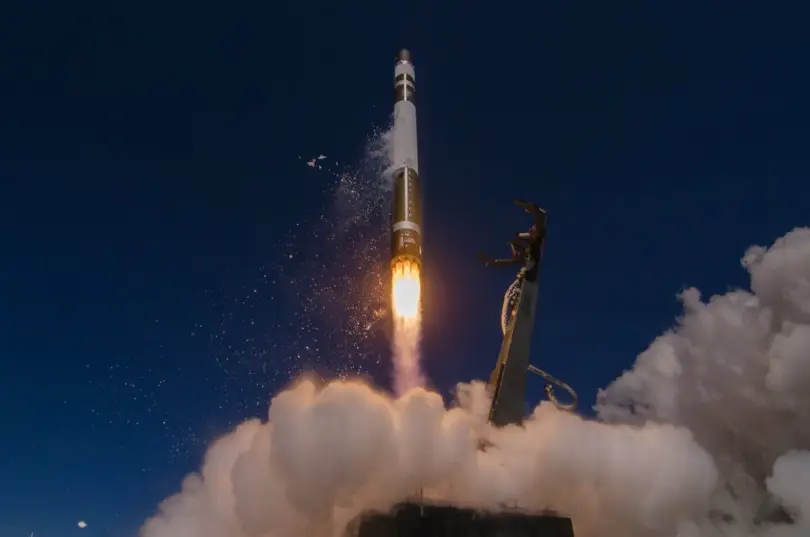
On Thursday, Rocket Lab launched its workhorse Electron rocket on its ninth total mission since its debut in 2017, and its fifth mission in 2019 – the most for the company to date. The payload consisted of a single satellite provided by California’s Astro Digital as part of a dedicated flight. The 14-day launch window opened on Monday at noon NZDT, but was subsequently postponed to Wednesday afternoon – with a T-0 of 14:22 NZDT – due to inclement weather.
Electron launch:
The mission was nicknamed “As The Crow Flies”, which was a reference to Astro Digital’s Corvus platform of satellites that range from 6U and 16U CubeSats to ESPA Class spacecraft. (Corvus is also a genus of birds that includes the crow). This was Astro Digital’s first flight with Rocket Lab.
The payload for Electron’s ninth launch was the Palisade technology demonstrator, a 16U CubeSat that features an onboard propulsion system, an Astro Digital-provided communications system, and an advanced version of Advanced Solutions Incorporated’s MAX Flight Software. The mass of the satellite has not been revealed.

Palisade encapsulated in Electron’s payload fairing after integration – credit: Rocket Lab
Like most previous missions, Rocket Lab’s Electron utilized its patented kick stage, which is propelled by the “Curie” 3D-printed thruster. The kick stage allows for more flexibility and precision when deploying satellites into their target orbits, and is also capable of deorbiting at the end of a mission.
The Electron rocket that launched the mission was delivered to Launch Complex 1, or LC-1, on September 12 for pre-flight testing and integration. The vehicle was fully stacked and then rolled out to the launch pad on October 2.
The following day, Rocket Lab launch teams conducted a wet dress rehearsal, which consists of a run-through of the pre-launch countdown and fueling procedures. The test was completed without incident.
Spaceflight news subscription
(adsbygoogle = window.adsbygoogle || []).push({});
Meanwhile, the Palisade payload was integrated onto Electron’s kick stage and safely encapsulated inside the fairing on October 9. These activities helped solidify the October 14 launch date.
However, thunderstorms began approaching the Launch Complex 1 area late on Sunday, October 13, thereby forcing Rocket Lab to stand down until the weather cleared up. The mission is now slated to launch no earlier than 13:00 local time on Wednesday (midnight Universal Coordinated Time on Thursday) – an hour past the opening of a four-hour daily window. The T-0 moved to 14:22 local due to red upper level winds. However, they cleared in the final minutes of the countdown.
The countdown to liftoff will officially begin at T-6 hours when the road to the Mahia launch site will be closed temporarily to ensure the safety of vehicles and residents. At T-4 hours, the Electron launcher will be lifted vertical at LC-1 and loaded with RP-1 fuel (a highly refined form of kerosene).
See Also
- Electron Flight 9UPDATES
- Rocket Lab Electron Forum Section
- L2 Master Section
- Click here to Join L2
The launch pad personnel finished up final preparations and departed the area at 2 hours and 30 minutes prior to liftoff. At T-2 hours, chilled liquid oxygen began flowing into both stages of the Electron rocket, and the marine safety zones (regions near the launch site where boats and ships are prohibited from entering) will be activated.
The airspace safety zones were activated at T-30 minutes – this prevented air traffic from passing close to the launch site and posing a threat to anyone onboard during the launch.
At 18 minutes before liftoff, Rocket Lab’s launch director conducted a go/no-go poll of the launch team and verify that the Electron’s systems were ready for flight. The launch team was in control of the countdown up until T-2 minutes, at which point the Electron’s onboard computers took over and began the launch sequence.
The nine Rutherford first stage engines ignited at T-2 seconds, and – after a final status check by the onboard computers – Electron lifted off at T-0.
Electron’s first stage motors fired up until the T+2 minute 35 second mark when they shut down simultaneously in an event known as Main Engine Cutoff (MECO). Four seconds afterwards, the first and second stages separated, and the single vacuum-optimized Rutherford engine ignited at 2 minutes and 42 seconds into the flight.
Electron’s protective payload fairing was jettisoned at T+3 minutes and 3 seconds – once the second stage and payload left the Earth’s atmosphere.
Electron reached orbit at 9 minutes and 8 seconds into the flight, with Second Engine Cutoff (SECO) – the shutdown of the vacuum Rutherford engine – occurring six seconds later. The Curie-powered kick stage with the Palisade spacecraft separated from the second stage at T+9 minutes and 18 seconds.
Following a nearly hour-long coast phase, the Curie engine will fire at T+1 hour, 8 minutes, and 33 seconds, with engine shutdown taking place at the 1 hour, 10 minute, and 36 second mark.
Finally, the Palisade satellite will separate from the kick stage at T+1 hour, 11 minutes, and 22 seconds. The kick stage will then fire its Curie engine one last time a short while later to deorbit itself, which will help to minimize the amount of debris left in orbit following the launch.
Launch Complex 2 pad work:
This launch comes nearly a month after Rocket Lab announced the completion of a key milestone regarding the construction of their second launch site at NASA’s Wallops Flight Facility in Virginia, which is known as Launch Complex 2 (LC-2).
The 66-ton launch platform that supports the Electron rocket during the pre-launch countdown was successfully installed sometime in mid-September, therefore allowing for the installation of the 44-foot long strongback at a later date. This work is just the latest at Rocket Lab’s newest launch site, which will begin hosting Electron launches from American soil in early 2020.
Rocket Lab selected Wallops Flight Facility at the Mid-Atlantic Regional Spaceport (MARS) as their first U.S. launch location in October 2018, and officially broke ground for LC-2 construction in February 2019. Wallops was picked in part due to its low orbital inclination launch abilities, as well as greater range availability for orbital flights.
In the few months since the beginning of construction at the site, over 1,400 cubic yards (37,800 cubic feet) of concrete has been poured to create the pad on which Electron’s launch platform is currently mounted. LC-2 is intended to mirror Rocket Lab’s Launch Complex 1, which sees the Electron rocket transported horizontally along the launch ramp and lifted to vertical once at the pad.
With the installation of the launch platform, all work at the site will be focused on the integration of the various pad systems that will support Electron launches, such as the propellant farms and electrical systems. Rocket Lab is looking to complete these activities by December 2019, at which point the company will begin final testing and commissioning of the launch site.

Aerial view of Rocket Lab’s Launch Complex 2 following launch platform installation – credit: Rocket Lab
Launch Complex 2 will be able to host up to 12 Electron launches per year, and is specifically tailored to launch U.S. government and commercial missions.
Rocket Lab will announce the customer and payload for the first U.S.-based Electron flight in the coming weeks.