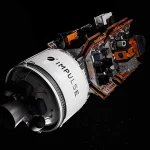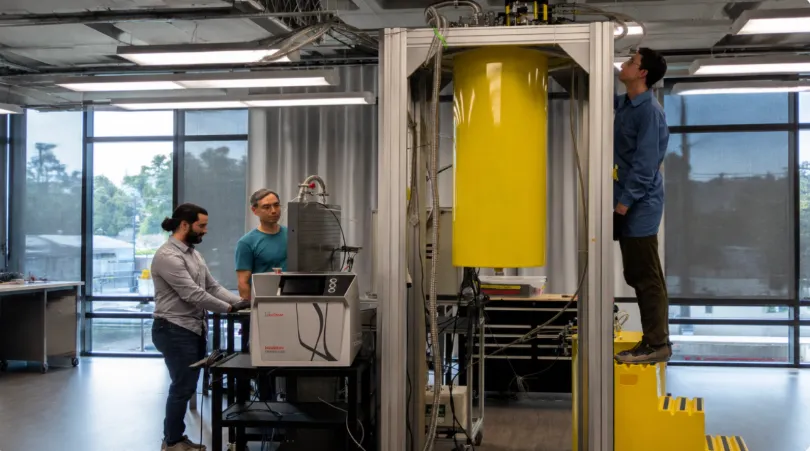
The Seattle-based startup announced that its proprietary Cold Capture™ technology successfully extracted and purified helium-3 from Grade A helium. Rather than waiting until the 2030s for material from the Moon, the company says the system can immediately expand Earth’s supply of one of the world’s rarest industrial gases while validating the same core technology it ultimately plans to deploy on the lunar surface.
Why Helium-3 Matters
Helium-3 is an exceptionally scarce isotope with a growing number of high-value applications. While it is often discussed as a future fuel for aneutronic fusion reactors, today’s commercial demand is primarily driven by quantum computing and national security.
The isotope is essential for dilution refrigerators that cool superconducting quantum computers to temperatures just a few thousandths of a degree above absolute zero. Absolute zero is the lowest possible temperature in the universe, where particles have the minimum possible thermal energy allowed by quantum mechanics. These dilution refrigeration systems underpin much of today’s quantum computing industry, including hardware developed by companies such as IBM, Google, and Rigetti. Helium-3 is also used in neutron detectors for nuclear security, cryogenic scientific instruments, medical imaging, and fundamental physics research. As quantum computing scales, demand for the isotope is expected to continue rising.
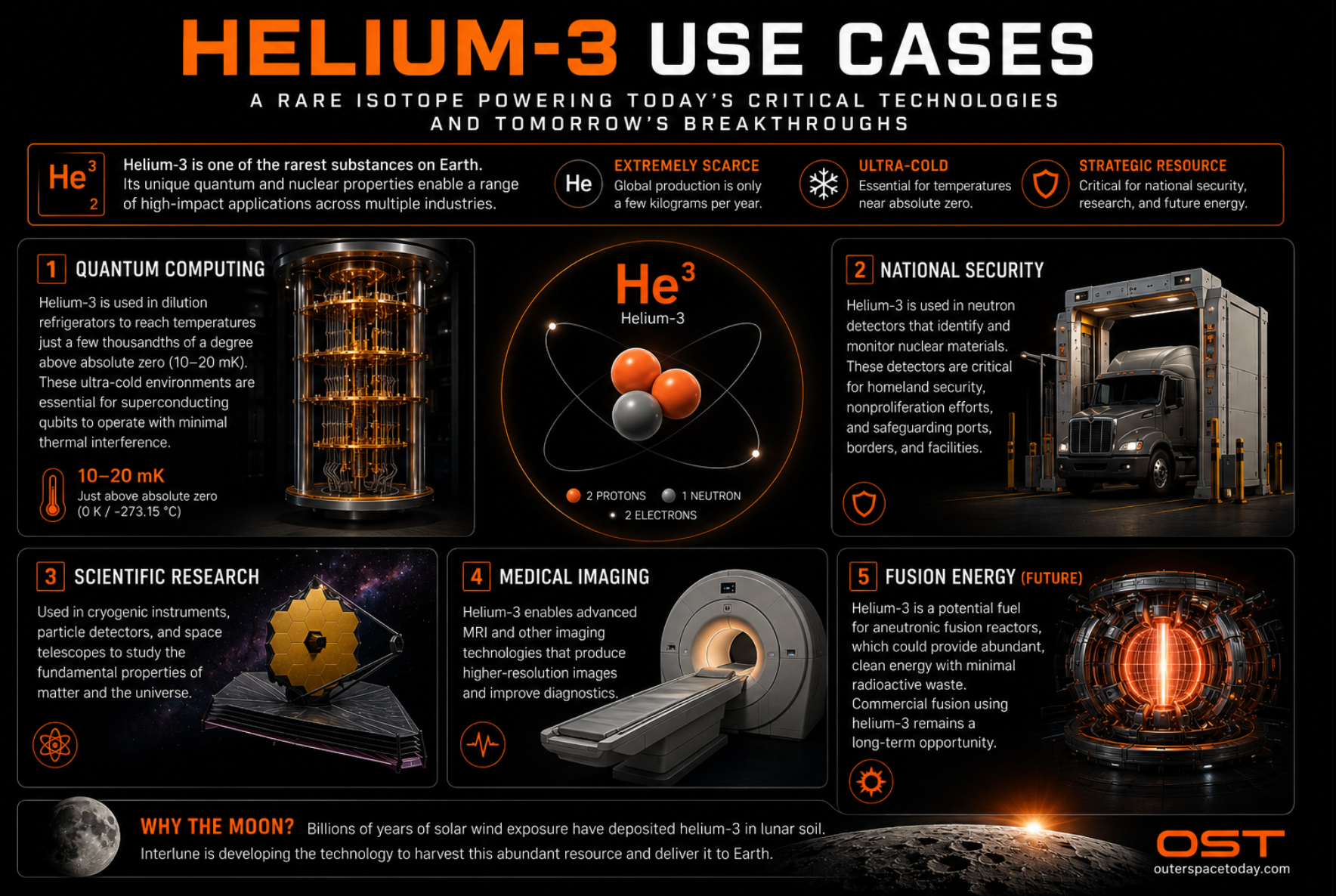
Despite its importance, helium-3 remains one of the rarest industrial materials on Earth. Unlike conventional helium, helium-3 is not mined in meaningful quantities. Most of today’s supply comes from the radioactive decay of tritium maintained in nuclear weapons programs, with smaller amounts recovered from certain nuclear reactors and government stockpiles. Global production is measured in only a few kilograms annually, making even modest increases in supply highly significant. Following the 9/11 terrorist attacks in NYC, much of the available U.S. helium-3 inventory was redirected toward homeland security neutron detection systems, further tightening an already constrained market.
A Potential Threefold Increase in U.S. Supply
Interlune estimates that widespread deployment of Cold Capture across existing U.S. helium liquefaction plants could increase domestic helium-3 production to as much as 2.5 kilograms per year, roughly tripling today’s available U.S. supply. Although that may sound like a small amount, helium-3 currently sells for approximately $20 million per kilogram, making it one of the world’s most valuable materials. Interlune has reported it has already signed approximately $500 million in binding purchase agreements for future helium-3 deliveries, underscoring the growing demand from industries including quantum computing and national security.
Rather than requiring new helium production, the novel ColdCapture system integrates with existing industrial helium processing infrastructure and separates helium-3 that would otherwise remain mixed within conventional helium streams. Because it leverages infrastructure already in operation, the technology could provide new helium-3 production without the cost and timeline associated with building entirely new facilities.
Building the Technology for the Moon
While terrestrial helium-3 production represents an immediate commercial opportunity, Interlune’s long-term objective remains harvesting helium-3 from the Moon.
Over billions of years, the solar wind has implanted helium-3 into the lunar regolith. Interlune plans to excavate lunar soil, process it, and recover the isotope for return to Earth. The same cryogenic separation process demonstrated by Cold Capture is intended to become a core component of that future lunar processing system. By commercializing the technology on Earth first, the company can validate critical hardware, establish customer relationships, generate revenue, and reduce technical risk years before its planned lunar mining missions begin.
Interlune’s Veteran Team
Interlune was founded by a team with deep experience in both commercial spaceflight and planetary science.
CEO Rob Meyerson previously served as President of Jeff Bezos’ Blue Origin, helping lead the company’s growth from an early-stage startup into one of the world’s leading commercial space companies. The executive team also includes former Blue Origin Chief Architect Gary Lai, who helped design the New Shepard launch system, and Apollo 17 astronaut and geologist Harrison “Jack” Schmitt, who has long advocated for the commercial potential of lunar helium-3. The broader leadership team brings decades of additional commercial space experience, including Chief Operating Officer Indra Hornsby, whose career spans Rocket Lab, MDA Space, Spaceflight Industries, and BlackSky, and Head of Product James Antifaev, who previously held roles at Maxar, Google’s Loon project, MDA, Spaceflight Industries, and the European Space Agency. Together, the team is pursuing a strategy that combines near-term terrestrial helium-3 production with long-term lunar resource extraction.

Rather than waiting for the first commercial lunar mining mission to generate revenue, Interlune is building a terrestrial helium-3 business today using technology designed for its future lunar operations.
If Cold Capture is successfully deployed at commercial scale, the company could become one of the world’s largest suppliers of helium-3 years before its first lunar mining mission launches. The technology would not only help alleviate an increasingly constrained supply chain for quantum computing, national security, and scientific research, but also validate one of the most technically challenging components of Interlune’s long-term vision to harvest helium-3 directly from the Moon.