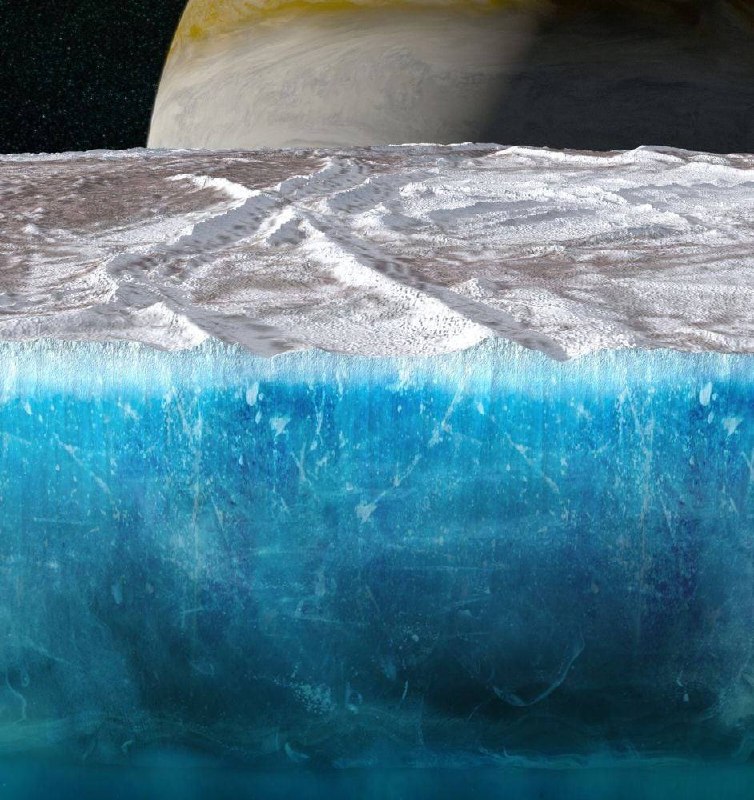
Juno was built primarily to investigate Jupiter, not to map Europa’s interior. Its Microwave Radiometer, or MWR, was designed to look beneath Jupiter’s clouds by measuring microwave emission at six frequencies. On 29 September 2022, the spacecraft passed within about 360 kilometers of Europa and collected measurements across roughly half of the moon’s surface.
The analysis, led by Steve Levin and published in Nature Astronomy, used 129 measurements in each frequency channel to estimate temperatures at different depths. Rather than sending a radar pulse through the ice, the team modeled how brightness temperature changed across MWR’s channels and how radio emission from Jupiter’s radiation belts and the Galaxy was reflected by Europa. The difference between the 0.6-gigahertz and 1.2-gigahertz measurements was particularly important because it constrained the vertical temperature gradient, which differs between thick and thin shells. Reflected radio emission from Jupiter initially complicated the signal, but its changing angle also helped the team constrain how reflective the ice was.
The best-fitting model produced an average conductive shell thickness of 29 kilometers, with a reported uncertainty of plus or minus 10 kilometers. NASA calls it the first measurement able to discriminate between thin-shell ideas of less than a kilometer and models extending to tens of kilometers. Using the officially adopted height of Mount Everest, 8.84886 kilometers, three Everests reach about 26.55 kilometers, and the central estimate for Europa’s ice would continue another 2.45 kilometers beyond their summit.
The figure is a model, not a ruler. The result applies to the sampled region and assumes pure water ice with no warmer convective layer beneath the rigid conductive ice. NASA says a modest amount of salt of the kind used in some Europa models could reduce the thickness estimate by about 5 kilometers, while a convective layer below could make the full solid shell thicker. MWR sampled about half of Europa during one close encounter, and the analysis used a laterally uniform model even though Europa’s ridged plains and disrupted chaos terrain are visibly different.
Even with those limits, the finding moves an old debate toward the thick-ice side and sharpens the habitability question. Europa’s proposed ocean may be global and 60 to 150 kilometers deep, containing more than twice the water in all Earth’s oceans combined, an inference supported by an induced magnetic response NASA’s Galileo spacecraft measured, best explained by a deep layer of electrically conductive salty water. Liquid water alone does not make an ocean habitable. The ocean floor may contact rock, and radiation breaks apart molecules in the surface ice to produce oxidants, but connecting the two environments across 29 kilometers of cold ice makes every proposed pathway longer and more demanding. Juno’s microwave data detected shallow scatterers that could be cracks, pores, voids or inclusions.
NASA’s Europa Clipper is en route to the Jupiter system. Its measurements of the ice shell will either confirm or revise this number, with consequences for what kind of follow-up mission is feasible.