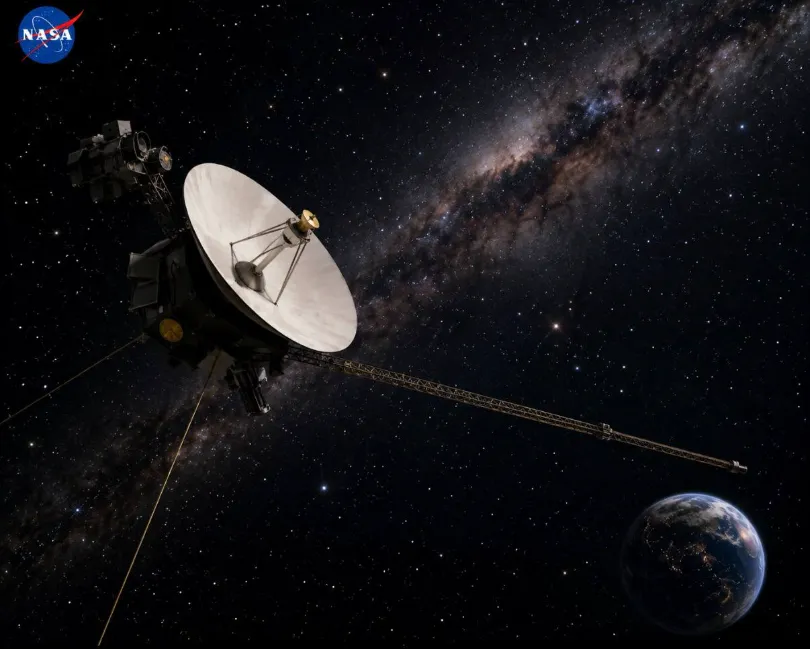
Voyager 1 needs the fix more urgently than its twin did. It has less power in reserve, has already lost more of its original instruments, and in February this year came close to tripping its own emergency shutdown during a routine roll manoeuvre. That event prompted NASA in April to switch off the Low-energy Charged Particles experiment, an instrument that had measured ions, electrons and cosmic rays almost continuously since launch. Engineers deliberately left a small half-watt motor inside it running, so the instrument could be switched back on if power conditions improved.
Voyager 1 currently has two working science instruments, a magnetometer and a plasma wave subsystem, compared with three still operating on Voyager 2. Both spacecraft launched in 1977 with ten identical instrument sets and have been shedding them ever since, in an order engineers settled on years in advance. The fix, nicknamed the Big Bang inside the mission, involves switching off several ageing devices at once, including tape recorders and heaters, and replacing them with lower-power alternatives, all while keeping the spacecraft’s electronics above the temperature at which they would fail permanently. On Voyager 2 the swap freed up close to ten watts a year.
Kareem Badaruddin, the Voyager project manager at NASA’s Jet Propulsion Laboratory, said a power test on Voyager 1 at the end of July went about as well as an engineer could hope. He also said plainly that although the two spacecraft share the same design, the team has observed real differences between them after forty-nine years of separate flight. Voyager 1 is now more than 25 billion kilometres from Earth, compared with roughly 21 billion for Voyager 2, meaning a command takes close to a day to arrive and just as long for confirmation to return.
NASA has said that if the fix frees up enough power on Voyager 1, there is a real chance the Low-energy Charged Particles experiment could be switched back on, resuming measurements it has taken since 1977. The agency has been careful not to promise this, and it depends on results NASA has not yet published. It would mark a rare reversal in a mission that has otherwise been a long, one-way process of turning instruments off.
Two dates sit ahead. A thermal test, provisionally scheduled for the end of August, will check whether the spacecraft’s temperature holds inside safe limits once the swap is made, since a heater or component that drops too cold in interstellar space does not recover. If it goes well, implementation on Voyager 1 follows on the mission’s cautious timeline. Separately, Voyager 1 is expected to cross one light-day from Earth in mid-November, the distance at which a signal travelling at the speed of light takes a full day to arrive.