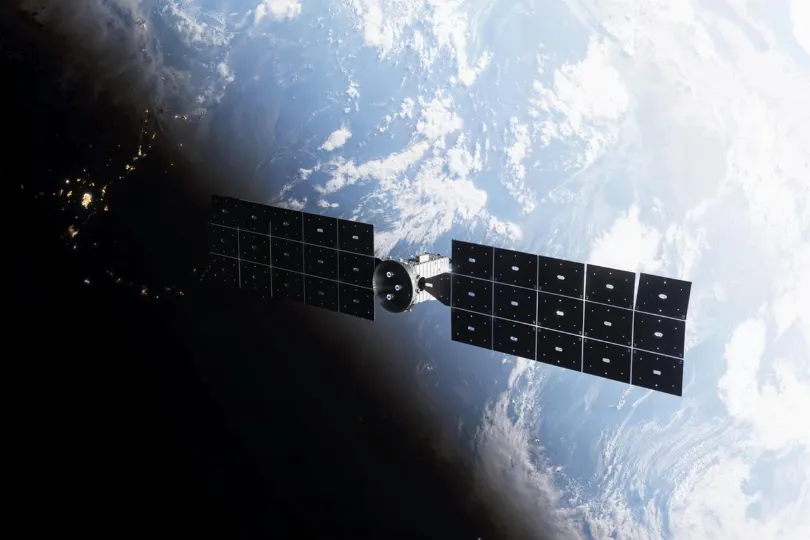
Link launched July 3 on a Pegasus rocket. Weeks later, during post-launch commissioning, the spacecraft lost attitude control and entered what Katalyst on July 28 described as a multi-axis spin. Two of the spacecraft’s three reaction wheels were not functioning after the incident, and its reaction control system thrusters were only partially working. The company has not said what caused the failure.
In a social media post last week, Katalyst said Link was spinning at approximately 9 degrees per second when recovery operations began. The team has since reduced the spacecraft’s body rate to 1.47 degrees per second, where it will remain while engineers prepare for the next phase of the mission. Controllers used one of the spacecraft’s electric thrusters to slow the spin, consuming less than 100 grams of fuel. Katalyst has not disclosed how much propellant remains but said it is conserving fuel for later phases.
The company said it plans to upload a significant flight software update in the coming days to enable attitude control in the spacecraft’s current configuration. That update is intended to restore full attitude control and allow Katalyst to resume the transit toward Swift. Current plans call for Link to reach the observatory in late August, a few weeks later than originally scheduled. Once there, Link will attempt to grapple Swift and use its thrusters to raise the observatory’s orbit.
The mission is Katalyst’s first attempt to grapple another satellite and boost it. NASA has acknowledged the mission is high risk but said it offers benefits to both the agency and the broader space industry. Without Link, the 22-year-old Swift observatory, which cannot raise its own orbit, is expected to deorbit late this year or early next year. As of Aug. 9, its altitude was just below 350 kilometers.
Attention now turns to the planned flight software update in the coming days and to whether Katalyst can restore full attitude control in time to reach Swift in late August. The reboost must begin before Swift descends past roughly 300 kilometers, expected no earlier than October.