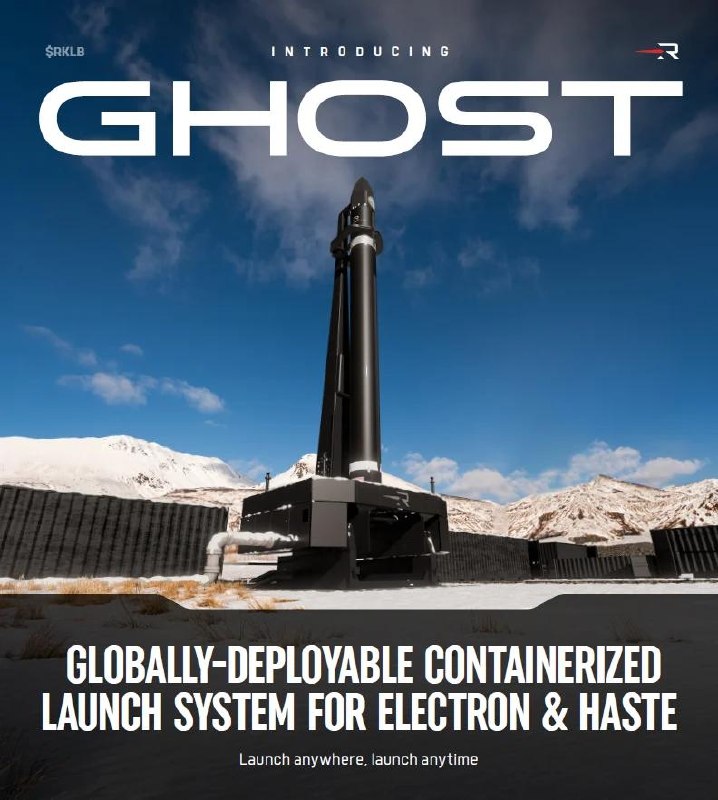
GHOST, which stands for Global Hypersonic and Orbital Spaceport Technology, transforms the company’s Electron and HASTE rockets into a rapidly deployable capability aimed at multi-launch flight campaigns and national security missions. Because both vehicles use the same ground infrastructure, GHOST delivers dual-launch capability across new locations, expanding the mission profiles of both rockets and addressing rising international demand for sovereign launch capability.
The first GHOST location, named Rocket Lab Launch Complex 4, will be at the Pacific Spaceport Complex at Kodiak, Alaska. Two pads will be established there to support high-frequency launch campaigns. These will complement Rocket Lab’s existing sites at Launch Complex 1 in New Zealand and Launch Complex 2 and Launch Complex 3 in Virginia, bringing the company’s total to six pads across two hemispheres. The system is set to make its operational debut with a suborbital launch from Alaska in 2027.
Rocket Lab describes GHOST’s modular and small footprint as purpose-built for responsive launch needs and time-critical national security missions, enabling rapid site activation and simultaneous launch possibilities. The company announced the system the same day it established Rocket Lab Germany GmbH.
Sir Peter Beck, founder and chief executive of Rocket Lab, said the company has been leading small launch for missile defense and national security for years. “Our reliability, repeatability, and affordability sets us apart from everybody else, and creating GHOST is about packaging that up into a deployable system that can serve the world’s most important programs from wherever those missions need,” he said. “Whether it’s for missile defense and deterrence, or opening up more trajectories, orbital missions, and sovereign launch capabilities in allied nations, GHOST is the answer to launching anywhere, anytime, and without compromise.”
The company positions GHOST as a direct response to the growing requirement for responsive launch, the ability to place a satellite in orbit quickly from an unprepared location. Such a capability matters for military customers who may need to reconstitute a constellation after an adversary attack, without relying on fixed pads and long scheduling queues. The system also gives Electron and HASTE an expanded role while the reusable Neutron medium-lift rocket remains in development.
The next milestone is GHOST’s operational debut, a suborbital launch from Alaska in 2027, followed by activation of the two pads at Launch Complex 4 for high-frequency campaigns. A question worth watching is whether commercial customers use GHOST to launch from locations that have never hosted a spaceport before.