China’s Wenchang Space Launch Site reached its milestone 50th launch at the end of July, but this week also experienced a third launch failure; while China’s other launch sites have all been active as the nation increasingly deploys more AI-powered and in-space computing technology into orbit.
Preparations for the launch of the seventh Chang’e mission, which will continue China’s exploration of the lunar south pole, are in full swing, while Galactic Energy is close to the debut of its Zhishenxing-1 rocket and LandSpace is awaiting a break in the weather to attempt recovery of the first stage of its ZhuQue-3 rocket.
Wenchang milestone
The state-run Wenchang launch site, located on Hainan Island off China’s southern coast, celebrated its 50th launch on July 29 when a Chang Zheng 7A (CZ-7A) launched the Tianlian-3-01 mission, a third-generation Tianlian-3 relay satellite which took flight just days after the final Tianlian-2 had launched from Xichang.
These satellites are used to relay communications and data for the Tiangong space station and visiting craft. Based on the Dongfanghong-4E geostationary satellite bus, Tianlian-3 satellites are more powerful and much heavier than their predecessors, supporting multiple simultaneous data links. They have a fifteen-year design lifespan.
The maiden flight from the Wenchang spaceport, a Chang Zheng 7, took place just over ten years ago in June 2016. Since then, the spaceport has launched the Tianhe, Wentian and Mengtian modules for the Tiangong space station, ten Tianzhou cargo resupply missions, the Tianwen-1 Mars exploration and the two most recent Chang’e lunar missions.

Chang Zheng 7A launches Tianlian-3 relay satellite from Wenchang on July 29 (Credit: CCTV)
Wenchang is part of a wider spaceport complex on the island that has already exceeded 70 launches, including traffic from the Commercial LC-1 and LC-2 pads at the neighbouring commercial site operated by the Hainan International Commercial Aerospace Launch Company (HICAL). Construction work on commercial pads 3 and 4 at this site began in January 2025 and is nearing completion.
Additional ground infrastructure will be added to the lightning towers and water storage, which are already in place. HICAL expects at least one launch to take place from these new pads towards the end of the year, less than two years after construction began. The ‘universal’ pads can accommodate a variety of new and upcoming vehicles, more likely the Chang Zheng 10B initially, with the capacity to host up to three launches per month per pad.
A recent launch from the commercial Hainan spaceport occurred on Aug.4 when an upgraded Chang Zheng 8A deployed the vehicle’s ninth batch of Guowang internet satellites into low-Earth orbit. The mission placed nine satellites directly into their target orbit for the first time, whereas previous batches would progressively raise their orbits over the following months to their destination altitude of 1,156 km, inclined by 50 degrees.

Construction of commercial pads 3 and 4 in the second phase of the Hainan Spaceport’s development (Credit: Hainan Business Development)
The last few weeks have not been without their challenges, however. A CZ-7A launched from Wenchang on Aug. 10 but appeared to suffer a structural failure around 83 seconds into flight, shortly after passing through the point of maximum dynamic pressure, or Max-Q.
The rocket’s flight termination system was triggered, destroying the vehicle and its payload over the South China Sea. Chinese state media identified the payload as Zhongxing-4B (ZX-4B, or ChinaSat-4B), a communications satellite bound for geostationary orbit.
Thomas (@_thomashayden) also edited a version for the mix. https://t.co/NwDJBS26oM pic.twitter.com/LkXvOxQ7Qf
— NSF – NASASpaceflight.com (@NASASpaceflight) August 10, 2026
This is the vehicle’s second failure in eighteen missions. Its maiden flight in March 2020 suffered a loss of pressure in one of its four boosters. The resulting shortfall in speed and altitude forced the termination of the mission during second stage flight.
This is also the third launch failure from Wenchang overall, with a Chang Zheng 5 having fallen into the ocean after losing thrust roughly 346 seconds after liftoff while attempting to deploy the Shijian-18 satellite in July 2017.
The CZ-7A failure came a little over two weeks after a Chang Zheng 3B (CZ-3B) was struck by lightning around 35 seconds into ascent from Xichang, while carrying the Tianlian-2-06 relay satellite on July 23. Despite the lightning strike, the CZ-3B launch was able to continue to a successful payload deployment.

Chang Zheng 7 is rolled out to pad LC-2 for the inaugural launch from Wenchang Space Launch Center in June 2016 (Credit: CCTV)
Recent launches and AI satellites
Up to the start of August, China had already launched 53 missions in 2026 across multiple launch sites inland, on Hainan Island, and at sea. Increasingly, many feature technologies utilize AI and either test or implement onboard computing for in-space data centers.
ADA Space has reported that it was able to maintain a continuous eight-day laser link between two of its 12 satellites, which were launched in May 2025 as demonstrators for both their own Star Compute platform and Zhejiang Lab’s ‘Three Body Computing’ constellation.
The pair were up to 1,000 km apart in a Sun-synchronous orbit and reported achieving a 99.99% uptime during the time they were connected. Zhejiang Lab has plans to launch up to 1,000 satellites, while ADA Space has designs on the Star Compute constellation reaching 2,800.
The company signed a deal with Shanghai-based AI company SenseTime in mid-July to deploy and utilize what will initially be a small constellation by the end of this year.

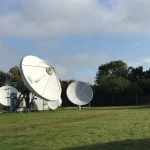
Aerial view of the Wenchang Space Launch Site on the Hainan coast, showing LC-1 (left) and LC-2 (right) (Credit: CCTV)
A Jielong-3 (Smart Dragon 3) rocket lofted a pair of Oriental Smart Eye (OSE) hyperspectral satellites in a seaborne launch from off the coast of Haiyang on Aug. 5. These will be used to provide remote sensing capabilities for partners in Uzbekistan and Indonesia. Equipped with onboard AI computing, they are designed to enable swift decision-making should they detect a disaster, enabling a response within minutes.
On July 22, OrienSpace launched nine satellites aboard its third sea-launched Yinli-1 (Gravity-1) from a ship in the East China Sea. The payload included the AI-powered Dongpo-13 and 14 satellites, developed by MinoSpace, which set a new record for transitioning to an operational state when they began transmitting high-definition images an hour and a half after reaching their target orbit. Two more Yinli-1 launches are expected before the end of the quarter.
China’s first debris-monitoring satellite reached orbit on July 24, as part of a five-satellite rideshare aboard CAS Space’s fifteenth Lijian-1 (Kinetica-1). Gande-1 is the first member of a planned 120-strong constellation which will be deployed across low, medium and high Earth orbits by the end of the decade, using AI to distinguish debris from background stars using wide- and narrow-field cameras.

Jielong-3 conducts a sea launch on Aug. 5 (Credit: CAST)
Launching from Site 130 at the Jiuquan Satellite Launch Center in northwest China, the mission also carried Chenguang-1, the first in a series of satellites for Orbital Chenguang, which will demonstrate technologies required for gigawatt-class orbital data centers. Zhejiang Lab, one of the principal architects of the onboard computing technology underpinning the Three-Body Computing Constellation, will validate new GPU computing technology aboard the Jitian-A-04 demonstrator ahead of incorporating it into future satellites.
The 660th launch of a rocket bearing the Chang Zheng name, a CZ-6A, launched two Tongxin Jishu Shiyan Weixing (TJSW) experimental communications satellites from Taiyuan on July 30. Although this type of satellite is usually sent to a geostationary or an elliptical Molniya-type orbit, these two were instead sent into a highly inclined low-Earth orbit.
Chang’e-7 and upcoming launches
Six previous Chang’e missions have visited the Moon since 2007, four of which have landed on its surface. Two missions, including the most recent one, have set down on the lunar far side, with Chang’e 4 becoming the first-ever landing, and Chang’e 6 becoming the first-ever sample return from the far side.
The Chang’e 7 mission will land near the Shackleton crater at the lunar south pole. The launch window opens on Aug. 24 at midnight UTC, with opportunities each day through to the end of the month. The Chang Zheng 5 launcher, which will carry the craft, arrived at Wenchang on July 13 to prepare for the mission.

A Chang Zheng 5 during assembly (Credit: CCTV)
Chang’e 7 will search for water ice as part of a wide-ranging science program involving 18 different science instruments distributed across the orbiter, landing, rover and a hopping probe. Six other nations have contributed instruments, including LunaHcam, a high-resolution hyperspectral imager aboard the orbiter, which was developed jointly with the Egyptian and Bahrain space agencies.
Russia has contributed an improved version of the lunar dust detector that was carried onboard the Luna-25 craft, which crashed into the lunar surface in August 2023. An Italian-made laser retroreflector will become the first of its kind deployed at the lunar south pole, following a similar first on the lunar far side during the Chang’e 6 mission. Chang’e 7 will also carry a radiation spectrometer from Switzerland, a hodoscope from Thailand, and a telescope from the International Lunar Observatory Association, which is headquartered in Hawaii.
Chang’e 7 will spend around 90 days on the lunar surface. The six-legged hopper will seek out water ice in permanently shadowed craters, drilling into the lunar regolith and analyzing samples for water, methane, and other volatile compounds. Capable of multiple flights of at least 10 km per ‘hop’, it will be able to cross steep crater walls and reach regions inaccessible to conventional rovers.

Renders of Chang’e 7 spacecraft separation, the rover and hopper (Credit:CMG/CCTV)
Meanwhile, tropical weather seems to be delaying Landspace’s second launch of its ZheQue-3 rocket, along with its plans to achieve China’s first successful propulsive landing of an orbital-class booster on solid ground. Landspace previously tried to land the first stage of its ZhuQue-3 during the rocket’s maiden flight in December 2025. The booster accurately targeted a pad roughly 390 km downrange in the Gobi Desert but did not successfully touch down, following an engine issue during the landing burn.
Initially anticipated this week, ZhuQue-3 launch has since been delayed until later in the month, with possible dates between Aug. 19 and 31. Previous Notice to Air Missions (NOTAMs) have been withdrawn; while Landspace has not officially provided a reason, a tropical weather system in the region is likely to be causing unfavorable launch conditions.

ZhuQue-3 Y2 comples static fire test in June 2026 (Credit: Landspace)
Finally, after months of anticipation, Galactic Energy’s Zhishenxing-1 (Pallas-1) is once again expected to take its maiden launch in the coming weeks. Both stages of the 42-meter-long vehicle have been separately static-fired towards the end of last year, and the stacked vehicle has been conducting tests at the pad since May. The company recently indicated that the rocket will take its maiden flight in the second half of August.
While the vehicle has reusability firmly on its roadmap, this first flight will be expendable. Meanwhile, the company continues to test restart-capable versions of the seven throttleable CQ-50 engines that will enable reuse. These engines are designed in-house and burn liquid kerosene and oxygen in a gas generator cycle.
Landing legs and grid fins are in development, but restartable engines will be critical to conducting landing burns on future attempts to land and recover boosters.
(Lead Image: The fifteenth Lijian-1 (Kinetica-1) ascends from Site 130 at the Jiuquan Satellite Launch Center on July 24 – Credit: CAS Space)

The post Amid failure, Wenchang celebrates milestone as China launches AI satellites and prepares for lunar south pole mission appeared first on NASASpaceFlight.com.