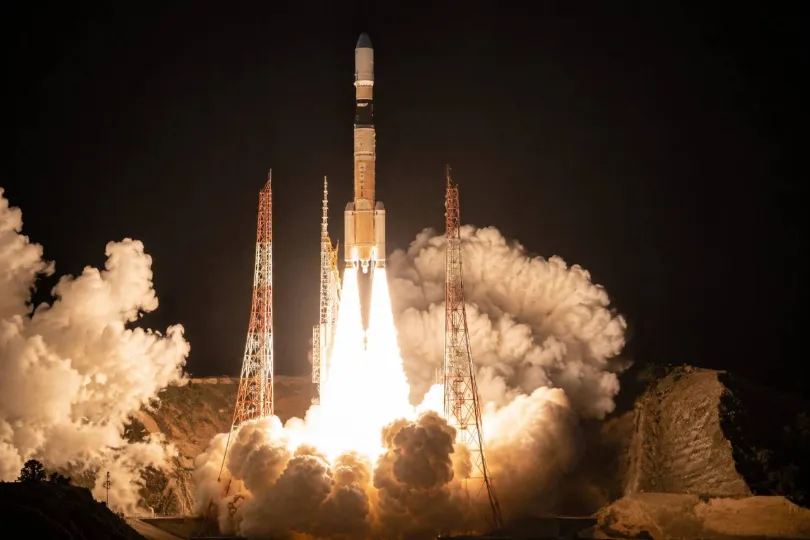
The QZSS-HP initiative stems from a December 2020 international agreement signed between the U.S. Space Force and Japan’s National Space Policy Secretariat. Managed under the Space Force’s Portfolio Acquisition Executive for Space Combat Power, the effort was created to enhance space domain awareness, operational interoperability, and collective deterrence across the Pacific theater. The second launch builds on broader Japanese satellite navigation plans, including expansion of the Quasi-Zenith Satellite System constellation to deliver sovereign positioning, navigation, and timing coverage alongside U.S. GPS signals.
The optical SDA hosted payload was engineered and built by the Massachusetts Institute of Technology’s Lincoln Laboratory in Lexington, Massachusetts. U.S. and Japanese technical teams worked with prime contractor Mitsubishi Electric Corporation for two years to integrate and test the sensor stack with the QZS-7 host spacecraft at facilities in Kamakura, Japan. The host spacecraft weighs approximately 4.9 metric tons and uses Mitsubishi Electric’s standard navigation bus architecture. Ground operations and command telemetry for the U.S. payload will run through the Multi-Mission Space Operations Center/Enterprise Command and Control Schriever enclave in Colorado.
Positioned in a quasi-zenith orbit above the Indo-Pacific region, the sovereign U.S. sensor will feed near-real-time tracking telemetry directly into the U.S. Space Surveillance Network to monitor satellite activity across geosynchronous orbits. USSF Col. Bryon McClain, Space Force portfolio acquisition executive for Space Combat Power, called the launch “a powerful testament to the enduring strength and rapid modernization of the U.S.-Japan alliance.” USSF Col. Gina Peterson, deputy commander of Mission Delta 2, said the program is “a key contributor to help us meet the threat of peer adversaries in space and build towards resilient capabilities to detect, understand, and maintain custody of objects in deep space.”
USSF Brig. Gen. Brian Denaro, commander of U.S. Space Forces Pacific, said the QZSS-Hosted Payload program “demonstrates how we enhance security across the Pacific” and that the milestone “reflects years of collaboration that strengthen our resilience, enhance interoperability, and reinforce the alliance’s ability to deliver operational advantage across our combined and joint forces.” The named officials framed the program as fortifying shared deterrence in a contested space domain across the Indo-Pacific.
Following orbital insertion and initial on-orbit checkout managed jointly by JAXA, Mitsubishi Electric, and USSF technical teams, primary operational authority over the U.S. sensor will transition to Combat Forces Command’s Mission Delta 2. Operating out of Schriever Space Force Base, Mission Delta 2 will integrate the payload’s deep-space optical tracking feeds into daily Space Domain Awareness operations to identify, characterize, and maintain custody of spacecraft maneuvering across high-altitude Indo-Pacific orbital regimes.