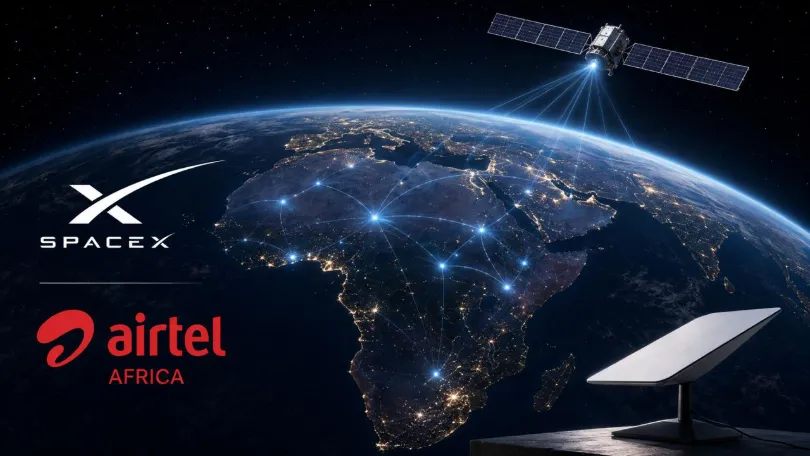
The commercial launch of Starlink Mobile in the Democratic Republic of the Congo (DRC) marks a more important shift in satellite communications than the headline “Africa’s first commercial direct-to-device service” might suggest.
On August 14, 2026, Airtel Africa and SpaceX began commercial Starlink Mobile operations in the DRC, allowing customers with compatible smartphones to connect to Starlink satellites in areas where Airtel’s terrestrial network does not reach. The service requires no satellite dish or dedicated satellite handset; users need a compatible phone and a relatively unobstructed view of the sky.
The launch follows successful tests in Kenya, Uganda and Madagascar and is part of Airtel Africa’s December 2025 agreement with SpaceX to introduce Starlink Direct-to-Cell connectivity across its 14 African markets, which together serve more than 170 million customers.
The significance is not simply that satellites can now reach phones in another African country. The larger development is that satellite connectivity is beginning to move from an emergency or specialist communications product into an extension of conventional mobile networks.
That could change how operators approach the economics of serving Africa’s remote areas, while also creating a new competitive arena between Starlink, traditional satellite operators, emerging direct-to-device companies and national satellite programs.
Airtel Africa commercially activated Starlink Mobile in the DRC on August 14, making the country the first African market where Airtel and SpaceX have moved the technology from testing into commercial service.
The initial service is aimed at locations outside terrestrial mobile coverage. Compatible 4G smartphones can connect directly to Starlink satellites without a special antenna, satellite terminal or separate handset.
The service is not equivalent to a conventional Starlink broadband connection. The first-generation Direct-to-Cell system is designed primarily around messaging and relatively light data applications. Airtel’s earlier Kenyan testing demonstrated applications including WhatsApp messaging and calling, Facebook Messenger, maps and financial transactions through the Airtel application.
This distinction is important. Direct-to-device satellite connectivity is initially a coverage-extension technology rather than a replacement for terrestrial 4G or 5G.
Airtel and SpaceX began testing the system in Kenya in March 2026, followed by Uganda in May and Madagascar in July. The sequence provides an indication of how the commercial rollout is likely to proceed: test the satellite link in areas without terrestrial coverage, obtain local regulatory approval, integrate the satellite network with the mobile operator and then gradually expand consumer availability.
The December 2025 agreement covers all 14 Airtel Africa markets. The commercial launch in the DRC therefore represents the beginning of a much larger deployment rather than a standalone national project.
The development of direct-to-device connectivity is the result of two previously separate industries converging: mobile telecommunications and satellite communications.
Traditional satellite phones generally required dedicated terminals because conventional satellites were not designed to communicate with ordinary mobile phones. LEO direct-to-device systems take a different approach by attempting to make the satellite behave more like a cellular base station in space.
Airtel’s partnership with SpaceX emerged as part of this transition.
December 2025 – Strategic partnership
Airtel Africa announced an agreement with SpaceX covering Starlink Direct-to-Cell connectivity across its 14 markets. The planned service was initially focused on messaging and selected data applications, with a future pathway toward higher-speed connectivity.
March 2026 – Kenya
Airtel and SpaceX successfully tested Starlink Mobile in areas without terrestrial coverage. Compatible 4G smartphones connected to Starlink satellites and supported lightweight data applications.
May 2026 – Uganda
Testing expanded to another Airtel market, demonstrating that the technology could be integrated into different national mobile environments.
July 2026 – Madagascar
Airtel Madagascar conducted a more advanced demonstration that included messaging and voice and video applications. The test illustrated the potential direction of the technology, although commercial service capabilities remain more limited than the most advanced demonstrations.
August 2026 – Democratic Republic of the Congo
Airtel and SpaceX moved into commercial operation, turning Direct-to-Cell from a demonstration into a customer-facing network service in Africa.
The significance of this sequence is that the satellite network itself is only one part of deployment. Regulatory approval, spectrum rights, handset compatibility, network integration and commercial arrangements with mobile operators are equally important.
Direct-to-device satellite connectivity solves a difficult radio problem: a satellite several hundred kilometers above Earth must communicate with a handset designed primarily to work with terrestrial cellular towers.
A normal smartphone has limited transmit power and a small antenna. A conventional satellite would normally require a much larger ground terminal to establish a reliable connection.
Starlink’s Direct-to-Cell architecture addresses the problem through large satellite antennas, advanced radio systems and integration with terrestrial mobile networks.
In simplified terms, the architecture works like this:
Smartphone → Starlink satellite → ground network → Airtel mobile network
The satellite provides the missing cellular coverage layer when a terrestrial tower is unavailable.
This creates an important difference from conventional satellite broadband. A Starlink broadband user normally communicates through a dedicated satellite terminal. Direct-to-device users communicate through the phone they already own.
The technology nevertheless has physical limitations.
The satellite-to-phone link has much less radio margin than a conventional satellite broadband terminal. Satellite motion also creates Doppler shifts, changing propagation conditions and requiring sophisticated network management. Capacity is another constraint: a satellite serving a sparsely populated rural region can provide useful coverage, but a large number of simultaneous users concentrated in a small area can quickly consume available satellite capacity.
This is why early Direct-to-Cell services emphasize text messages and lightweight data rather than unrestricted broadband.
SpaceX and Airtel have also positioned the current service as an early phase of a broader architecture. Next-generation Starlink satellites are expected to provide substantially higher direct-to-device data capacity, eventually making more demanding applications practical.
The long-term objective is therefore not simply “satellite texting.” It is a hybrid network in which terrestrial towers and orbital cellular infrastructure operate as complementary layers.
Africa presents an unusually strong business case for satellite-assisted mobile coverage.
Building a terrestrial mobile network requires towers, power systems, backhaul, fiber or microwave links, maintenance and physical access. Those investments are relatively efficient in densely populated cities but become increasingly difficult to justify as population density falls.
This creates a coverage paradox. The communities most difficult to connect can also be the least economically attractive locations for conventional infrastructure investment.
Satellite connectivity changes the economics.
One satellite can cover a very large geographic area without requiring a mobile tower to be constructed in every remote community. The operator can therefore extend the geographic boundary of its network without replicating the entire terrestrial infrastructure stack.
For Airtel, this also creates a strategic advantage over treating satellite connectivity as a completely separate service. Customers remain Airtel customers, while Starlink provides an additional coverage layer.
The result resembles roaming between two network environments, except that the second network exists in orbit.
Starlink is not alone in pursuing direct-to-device communications.
AST SpaceMobile is developing a competing model based on large satellite antennas designed to connect directly with ordinary smartphones. Its strategy relies heavily on partnerships with mobile network operators and is particularly relevant in markets where operators want satellite connectivity to appear as an extension of their existing networks.
Lynk Global has pursued another version of the “cell tower in space” concept, focusing on direct connections to conventional phones through partnerships with mobile operators.
The competitive difference is partly technological but also commercial.
Starlink has an enormous existing LEO satellite manufacturing and launch ecosystem behind it. That gives SpaceX an unusual ability to deploy satellites rapidly and continuously upgrade the constellation.
AST SpaceMobile, meanwhile, is pursuing very large satellite platforms with powerful communications payloads. Its approach emphasizes direct broadband connectivity to standard smartphones.
Lynk has historically focused more heavily on basic connectivity and coverage-extension applications.
There is therefore unlikely to be a single winner across every market. Mobile operators may select different systems according to spectrum arrangements, regulatory conditions, required capacity, satellite availability and commercial terms.
The competitive battleground will increasingly be determined by network economics rather than simply by satellite count.
The immediate impact will be felt by mobile operators.
For decades, African operators have had to choose between expanding terrestrial coverage and accepting coverage gaps. Direct-to-device systems introduce a third option: extending coverage through an orbital layer.
This could influence infrastructure investment decisions, particularly in remote regions.
It does not mean terrestrial networks will become unnecessary. Satellite capacity is finite, while terrestrial networks remain substantially more efficient in densely populated areas. Fiber and cellular networks will continue to carry the overwhelming majority of high-volume traffic.
Instead, the likely model is a layered network.
Cities and major transport corridors will continue to rely on terrestrial networks. Rural areas can use a mixture of towers and satellite coverage. Extremely remote locations can potentially receive satellite connectivity without a dedicated tower.
This model could be particularly valuable for:
- Emergency communications
- Rural communities
- Mining operations
- Agriculture
- Forestry
- Maritime transport
- Logistics
- Remote infrastructure
- Disaster response
The implications extend beyond consumers.
For governments, satellite-enabled mobile coverage can provide an additional communications layer during floods, cyclones, earthquakes or other events that damage terrestrial infrastructure.
For enterprises, it can reduce the need to deploy dedicated communications terminals across widely distributed assets.
For satellite manufacturers, the emergence of D2D creates a potentially enormous new market for high-capacity communications payloads.
For launch companies, the same trend translates into sustained demand for constellation deployment and replenishment.
China is developing direct-to-device technology, but its development path is somewhat different from the Airtel-Starlink model.
China Telecom has already commercialized satellite-to-phone services through the Tiantong-1 system, providing voice and messaging capabilities through compatible consumer devices. China Mobile has also been expanding satellite communications services, including integration with the Tiantong system.
The more strategically significant development is China’s move toward LEO direct-to-cell technology.
In April 2026, a satellite developed by GalaxySpace was launched as part of a technology demonstration involving direct-to-cell broadband connectivity and space-ground network integration. In June, GalaxySpace also announced the successful launch of the China Mobile 02 satellite for Direct-to-Cell technical verification.
Another Chinese satellite internet company, Spacesail, demonstrated direct-to-satellite voice calls using standard, unmodified commercial smartphones in June 2026. Its DTC 01 test satellite was specifically designed to verify direct-to-cell technologies and integration with terrestrial networks.
This places China in a transition similar to the broader global market: from satellite communication through dedicated or specially adapted terminals toward satellite connectivity integrated directly into ordinary cellular devices.
There is, however, an important distinction.
China’s development is closely tied to the country’s broader satellite internet and 5G/6G strategy. Large LEO constellation programs, mobile network operators, satellite manufacturers and telecommunications infrastructure are being developed in parallel.
That could eventually allow China to pursue a more integrated terrestrial-satellite architecture rather than simply adding satellite coverage as an external service.
For Chinese commercial space companies, the Airtel-Starlink deployment is particularly relevant because Africa represents a potential overseas market for satellite communications infrastructure. If D2D becomes a mainstream component of mobile networks, companies capable of supplying satellites, payloads, phased-array antennas and network infrastructure could eventually compete internationally.
The most important development in the Airtel-Starlink partnership is arguably not the satellite technology itself.
It is the business model.
Instead of asking consumers to become satellite customers, the model allows a mobile operator to use satellite capacity as part of its existing network.
That reduces several barriers to adoption.
Consumers do not necessarily need to understand satellite communications. They continue using their existing phone and mobile account. The operator controls the customer relationship, while the satellite provider supplies additional network capacity and geographic reach.
This could become one of the most commercially scalable models for satellite communications.
The same principle could eventually be applied beyond Africa. Operators in countries with large deserts, mountains, forests, islands or sparsely populated regions could use D2D to fill coverage gaps without building terrestrial infrastructure everywhere.
Over the next three to ten years, direct-to-device connectivity is likely to evolve from a niche coverage service into a standard component of mobile network architecture.
The first stage is messaging and emergency connectivity.
The second stage is lightweight data.
The next stage is higher-capacity data and voice services enabled by more capable satellites.
The long-term competitive question will then become how much traffic satellite networks can economically carry.
If satellite capacity increases fast enough, D2D could move beyond emergency coverage and become a routine network feature. Mobile phones could automatically switch between terrestrial towers and satellites according to availability, much as devices already switch between different terrestrial networks.
This would blur the traditional boundary between telecommunications and satellite communications.
The satellite industry would no longer be selling only satellite capacity to specialized customers. It would increasingly become part of the infrastructure behind ordinary mobile services.
For Africa, the potential impact is particularly significant because the technology offers a way to extend connectivity without requiring every new coverage area to receive a conventional tower.
For Starlink, the Airtel launch provides something equally important: a commercial operating model that can be replicated across multiple national mobile networks.
For competitors, it raises the pressure to demonstrate not merely that direct-to-device technology works, but that it can operate at commercial scale.
The DRC launch is therefore best understood as an early commercial milestone in the convergence of two networks: the terrestrial cellular network and the LEO satellite constellation. The ultimate significance will depend on how quickly satellite capacity, handset compatibility, regulation and pricing develop.
If those constraints can be overcome, the future mobile network may no longer end where the last cell tower ends. It may continue into orbit.