China has postponed the launch of its landmark Chang’e-7 lunar exploration mission after Tropical Storm Narra developed in the Gulf of Tonkin and created unfavorable conditions near the Wenchang Space Launch Site on Hainan Island. The delay affects one of the most ambitious robotic lunar missions ever attempted and a key element of China’s long-term strategy to explore and eventually utilize resources at the Moon’s south pole.
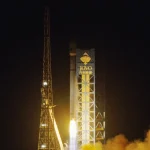
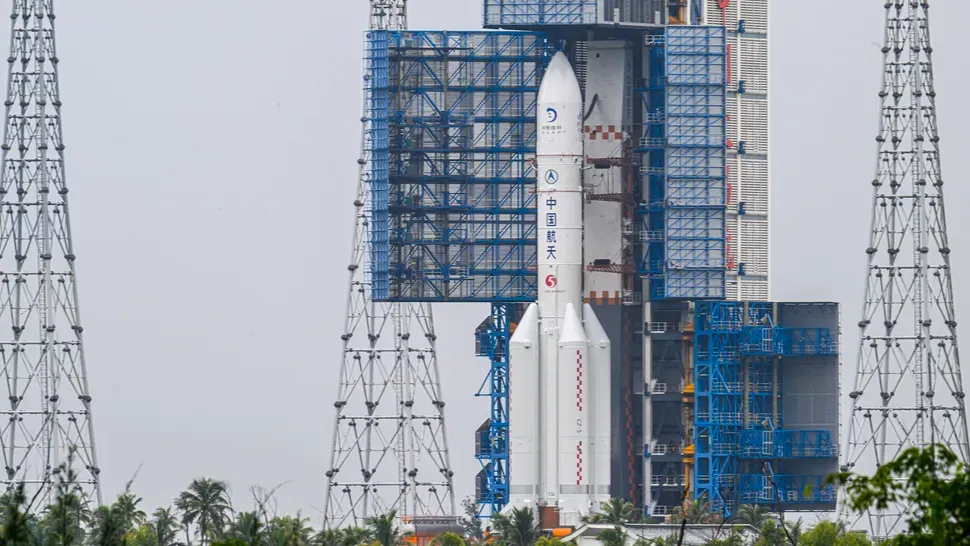
Chang’e-7 had originally been scheduled to launch from Wenchang on Hainan aboard a Long March 5 rocket. However, Narra began forming in the Gulf of Tonkin, just west of Hainan, prompting Chinese launch authorities to suspend launch operations. Officials stated that weather conditions no longer met required launch criteria, forcing the mission to stand down from its planned launch opportunity.
The postponement comes as China prepares to undertake a mission that could significantly expand scientific understanding of the Moon’s polar regions and support future plans for both robotic and human lunar activities.
Tropical Storm Narra Forces Delay at Wenchang
The Wenchang Space Launch Site, located on China’s southern island province of Hainan, is the country’s primary launch center for heavy-lift missions. Its coastal location provides favorable launch trajectories over the ocean but also exposes operations to tropical weather systems that frequently develop in the South China Sea and surrounding waters.
According to reports, Tropical Storm Narra emerged in the Gulf of Tonkin shortly before the planned launch attempt. The storm’s proximity to Hainan introduced unacceptable risks for launch operations, including high-altitude winds, precipitation, lightning potential, and uncertainties affecting both ascent and ground support activities.
Chinese authorities have not yet announced a new launch date. Because lunar missions depend on specific orbital alignments and trajectory opportunities, rescheduling is often more complicated than simply waiting for local weather to improve. Depending on mission constraints, the next launch opportunity could occur weeks or even months later.
China’s Most Sophisticated Lunar Exploration Mission
Whenever it launches, Chang’e-7 is expected to become the most complex robotic lunar mission ever undertaken by China.
Unlike previous Chang’e missions that focused on orbital reconnaissance, surface exploration, or sample return, Chang’e-7 combines multiple spacecraft elements into a coordinated exploration architecture. The mission includes an orbiter, a lander, a rover, and an innovative hopping probe designed to investigate terrain beyond the reach of conventional surface vehicles.
The mission is expected to target the lunar south polar region, where scientists believe significant quantities of water ice may exist inside permanently shadowed craters. These areas have become a primary focus of global lunar exploration because water could become a critical resource for future human activities on the Moon.
The orbiter will support communications and remote sensing operations, while the lander and rover will conduct in-situ investigations of the lunar surface. The hopping probe is designed to descend into challenging terrain, including permanently shadowed regions that receive little or no direct sunlight.
Searching for Water in One of the Solar System’s Coldest Environments
The primary scientific objective of Chang’e-7 is to investigate the presence, distribution, and characteristics of water ice near the lunar south pole.
Scientists have long suspected that water molecules delivered by comets, asteroids, and interactions with the solar wind accumulated within polar craters over billions of years. Because some crater floors never receive direct sunlight, temperatures remain extremely low, allowing volatile compounds such as water ice to survive for geological timescales.
These permanently shadowed regions are among the coldest known environments in the solar system. Direct exploration of such areas presents major engineering challenges, including extreme darkness, limited thermal energy, and difficult terrain.
Chang’e-7’s hopping probe is intended to help overcome these challenges. By making controlled jumps rather than relying solely on wheels, the vehicle can access locations that would otherwise be unreachable. Instruments carried by the mission are expected to analyze surface composition, subsurface properties, volatile materials, and environmental conditions that could reveal whether usable water resources exist.
The results could help determine the practicality of extracting local resources for future lunar operations.
Building on Two Decades of Chang’e Program Success
The Chang’e-7 mission represents the latest stage of China’s steadily expanding lunar exploration program.
China began its modern lunar campaign with the Chang’e-1 orbiter in 2007, followed by Chang’e-2 in 2010. The program achieved its first soft landing with Chang’e-3 in 2013 and made history in 2019 when Chang’e-4 became the first spacecraft to land on the far side of the Moon.
The country then demonstrated lunar sample-return capability through Chang’e-5 in 2020, returning nearly two kilograms of lunar material to Earth. In 2024, Chang’e-6 achieved another world first by returning samples collected from the Moon’s far side.
Each mission progressively expanded Chinese capabilities in navigation, landing, communications, sample handling, and deep-space operations. Chang’e-7 is designed to move beyond exploration and toward resource assessment, an essential step for sustained lunar activities.
A Foundation for Future Lunar Infrastructure
The mission is also a crucial component of China’s broader lunar strategy.
Data collected by Chang’e-7 will support the development of Chang’e-8, which is expected to test technologies related to in-situ resource utilization and future lunar infrastructure. Together, the two missions form part of preparations for the International Lunar Research Station, a long-term project led by China and international partners that aims to establish a permanent robotic research presence near the lunar south pole.
China has also stated its goal of conducting a crewed lunar landing before 2030. Understanding local terrain, illumination conditions, resource availability, and environmental hazards is essential before humans can safely operate in the region.
Information gathered by Chang’e-7 could therefore influence the design of future landing sites, habitats, power systems, and resource extraction technologies.
The Lunar South Pole Becomes the Center of Global Competition
Interest in the Moon’s south pole has intensified dramatically over the past decade.
NASA’s Artemis program plans to return astronauts to the lunar surface and eventually establish a sustained presence near the south pole. Commercial lunar landers operating under NASA’s Commercial Lunar Payload Services initiative are also targeting the region, while multiple international space agencies have identified polar exploration as a strategic priority.
The attraction is largely driven by the possibility of accessible water ice. If substantial deposits are confirmed and can be extracted economically, they could provide drinking water, breathable oxygen, and hydrogen-oxygen propellant for spacecraft operating beyond Earth orbit.
As a result, missions such as Chang’e-7 are increasingly viewed not only as scientific expeditions but also as pathfinders for future lunar economies and deep-space exploration architectures.
Delay Changes the Schedule, Not the Mission’s Importance
Although the postponement caused by Tropical Storm Narra has interrupted launch plans, it does not diminish the mission’s significance.
Weather-related delays are common in spaceflight, particularly for high-value missions involving narrow launch windows and complex trajectory requirements. Launch providers routinely prioritize vehicle safety and mission success over schedule considerations when weather conditions become uncertain.
Once launched, Chang’e-7 will attempt one of the most ambitious robotic investigations ever conducted at the Moon. By combining orbital observations, surface exploration, and direct investigations of permanently shadowed regions, the mission aims to answer one of the most important questions in lunar science: how much usable water exists at the Moon’s south pole and whether it can support humanity’s next phase of exploration beyond Earth.