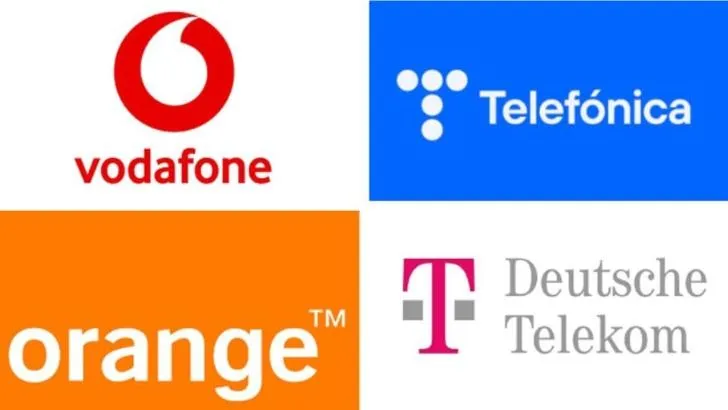
Deutsche Telekom, Orange, Telefónica and Vodafone are in preliminary talks to form a consortium that would bid for part of the European Union’s 2 GHz mobile satellite spectrum, potentially creating a European-controlled direct-to-device service to compete with SpaceX’s Starlink and other non-European satellite operators.
The discussions were reported on September 7 and remain at an early stage. No final decision has been made on forming the consortium or participating in the allocation process. Vodafone, Orange and Telefónica declined to comment, while Deutsche Telekom did not immediately respond.
The four companies are considering a joint bid for the commercial portion of the spectrum that the European Commission has proposed reserving for European operators. Together, they operate terrestrial mobile networks across most major European markets and could provide the customer base, network integration, roaming arrangements and national regulatory relationships required to commercialize satellite-to-phone connectivity at scale.
The talks mark a potential shift from bilateral agreements between individual mobile operators and satellite companies toward shared control of a strategic European spectrum asset.
EU Prepares to Reallocate the 2 GHz Band
The frequencies under consideration are part of Europe’s 2 GHz mobile satellite service band, which includes spectrum around 1.98–2.01 GHz for Earth-to-space transmissions and 2.17–2.20 GHz for space-to-Earth links. Existing EU authorizations held by U.S.-controlled operators Viasat and EchoStar are due to expire in May 2027.
The European Commission proposed a new allocation structure in May 2026. Under the plan, roughly one-third of the available capacity would be reserved for European sovereign communications, including government, security and defense applications. Another third would support commercial services operated by European-controlled entities, while the remaining third would be open to non-European providers.
The proposed telecom consortium would target the European commercial allocation. Starlink, Amazon Leo and other international satellite operators could compete for the portion open to non-EU participants.
Direct-to-device services allow satellites to communicate with mobile phones or Internet of Things terminals without requiring a conventional satellite dish. Depending on the network architecture, frequency band and handset standard, early services can include emergency messaging, text communications and low-rate data, followed by voice and higher-capacity broadband as satellite constellations and compatible devices expand.
A spectrum award, however, would not by itself give the four operators an operational satellite network. The consortium would still need access to a space segment, gateways, terrestrial network integration and compatible user equipment. It could obtain that capacity through partnerships with an existing satellite operator, hosted payloads, dedicated spacecraft or a future European constellation.
Existing Satellite Partnerships Complicate the Competitive Picture
Europe’s major carriers have already pursued separate satellite strategies. Deutsche Telekom has announced plans to use Starlink for satellite mobile coverage in Germany from 2028. Vodafone established Satellite Connect Europe with AST SpaceMobile, while Orange has also agreed to work with AST SpaceMobile and the joint venture on direct-to-device services.
These relationships demonstrate that the proposed consortium would not necessarily exclude cooperation with U.S. satellite suppliers. They could, however, complicate decisions over technology, procurement and the selection of a common space-network partner.
The four operators would also need to establish governance arrangements and address competition concerns arising from cooperation among Europe’s largest incumbent telecommunications groups. Any formal venture could face scrutiny over how spectrum capacity, wholesale access, customer data and commercial territories would be divided.
The spectrum process intersects with the EU’s broader effort to establish sovereign satellite communications through IRIS². The planned 290-satellite multi-orbit network is being developed by the SpaceRISE consortium led by SES, Eutelsat and Hispasat. Deutsche Telekom and Orange are already among the companies participating in the IRIS² industrial team.
IRIS² is intended to combine secure government communications with commercial connectivity, but its principal services are not expected to become available before 2030. The gap between the expiration of current 2 GHz authorizations in 2027 and the deployment of the new European infrastructure increases the importance of transitional arrangements and access to existing satellite capacity.
SpaceX has opposed the EU’s proposed nationality-based restrictions, arguing that limiting the spectrum available to international operators could reduce service quality and create interference and coordination problems. European officials have presented the allocation model as a way to strengthen regional capabilities and reduce dependence on foreign-controlled communications infrastructure.
The next milestones will be the European Union’s final decision on the 2 GHz allocation framework and whether Deutsche Telekom, Orange, Telefónica and Vodafone convert their preliminary discussions into a formal bidding consortium before the existing authorizations expire in May 2027.