Software-defined satellites and in-orbit upgrades are taking spacecraft operations toward a broader idea: managing satellites like servers in a data center. That means container orchestration, incremental updates and even running a 5G core network on an onboard server. It may sound ambitious, but Chinese in-orbit experiments are already exploring these capabilities.
Why Software Needs Standard Containers
Traditional onboard software is often built for a specific mission. Changing even one line of code can trigger extensive testing and review, making over-the-air updates difficult.
Cloud-native computing takes a different approach: package software into standardized containers. An application and its dependencies travel together, allowing the same package to run across compatible environments. Updates can replace the container image while preserving defined interfaces. The analogy comes from shipping: before standardized containers, dockworkers handled cargo according to its shape and size. Once ports adopted common handling standards, moving goods became much more efficient.
China’s Tiansuan Constellation, led by Beijing University of Posts and Telecommunications (BUPT), provides an example. Public reports describe a cloud-native software stack deployed on BUPT-1, followed by a high-performance server payload on BUPT-2 supporting experiments in container updates, incremental AI model updates and onboard core-network operation. Running a 5G core network in orbit follows the same broad direction as PEGA-SUS1: moving functions of the mobile network’s terrestrial “brain” onto a satellite.
Terms Explained: Containers and Distributed Satellite Operating Systems
Container: a standardized package containing an application and its dependencies, designed to reduce the changes needed when moving between compatible computing environments.
Distributed satellite operating system: software that coordinates computing, storage and networking resources across multiple satellites as a shared system.
In plain language, containers make software easier to move; a distributed operating system makes a group of satellites easier to manage as one computing resource.
A Constellation Needs to Work as a Cluster
A second cloud-native principle is centralized management. If every satellite operates independently, fleet operations quickly become complicated: dozens of spacecraft can mean dozens of interfaces, with engineers scheduling tasks manually.
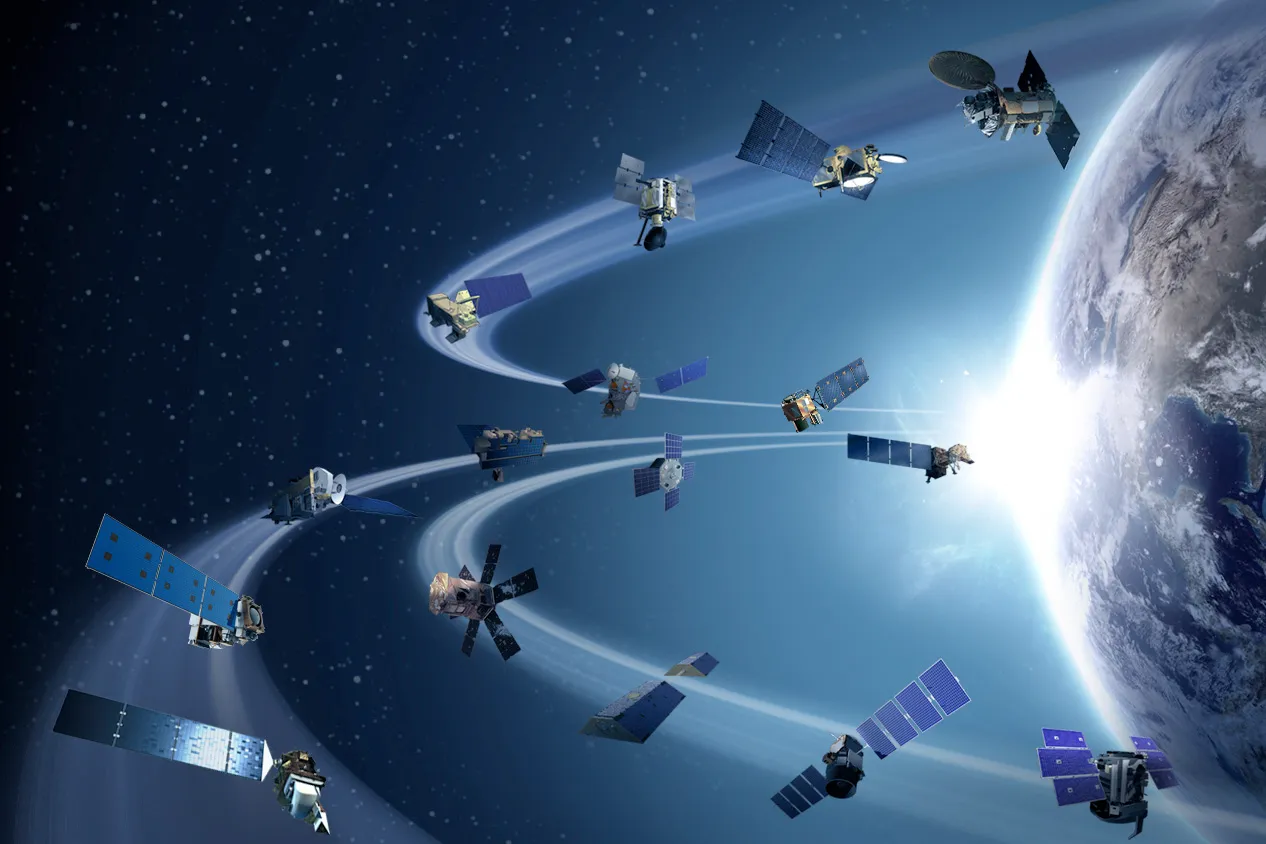
This helps explain the emphasis on a shared resource pool in the Three-Body Computing Constellation. Public reports describe a distributed space operating system that manages computing, storage and network connections across orbital nodes. By February 2026, the project had demonstrated interconnections among multiple satellites.
One application illustrates the value of processing data in orbit. When an astronomical AI model identifies a gamma-ray burst, the system can downlink a compact alert measured in kilobytes rather than hundreds of megabytes of raw observations.
That reduces transmission demand by extracting useful information onboard. Computing also consumes power and generates heat, so the balance between processing and transmission must be assessed across the whole system. The benefits depend on how the architecture works together, rather than on any single technology.
Two Ways Space Differs From a Terrestrial Cloud
1. Real-time constraints. Many terrestrial cloud applications can tolerate millisecond-scale scheduling variations. Satellite attitude control and precisely timed payload operations may have much stricter deadlines. Cloud-native application workloads therefore need appropriate isolation from critical real-time functions, with scheduling and resource allocation designed to protect those deadlines.
2. Intermittent connectivity. Terrestrial clusters generally assume persistent network access. Satellite-to-ground connections depend on available communication windows. Container-image updates and log transfers therefore need buffering, local storage and the ability to resume interrupted transfers.
Space systems can borrow cloud-computing principles, but they must account for a different operating environment.
Key Demonstrations
Tiansuan Constellation: public reports describe cloud-native software deployment on BUPT-1 and experiments supported by BUPT-2 involving container updates, incremental model updates and onboard core-network operation.
Three-Body Computing Constellation: its distributed space operating system coordinates onboard computing, storage and networking resources. Reports available by February 2026 described multi-satellite interconnections and astronomical AI processing that substantially reduced the volume of data requiring downlink. Attribution: Zhejiang Lab.
PEGA-SUS1: the satellite carries an onboard 5G core network, bringing functions traditionally hosted in terrestrial network infrastructure into orbit. Attribution: China Securities Journal, September 20, 2026.
The Engineering Trade-Off
Cloud-native software introduces additional layers of abstraction, which can consume memory, computing resources and power, and may add latency.
Option A: prioritize operational flexibility. Containers and orchestration can make deployment faster and software easier to reuse, but their overhead must fit within the spacecraft’s resource budget.
Option B: prioritize tightly optimized execution. Bare-metal or mission-specific software can offer greater control over resource use and timing, but changes may demand more integration and verification work.
The tighter the onboard computing budget, the more carefully engineers must weigh operational convenience against execution efficiency. The right balance depends on the workload and its timing, reliability and power requirements.
The Takeaway
Managing satellites like servers offers a way to simplify software deployment and constellation operations, provided the design accounts for real-time requirements and intermittent connections.
For Earth observation users, the practical value is getting useful results from satellite data more efficiently. STARPATH GLOBAL combines satellite imagery with data analysis to support monitoring, risk alerts and operational decisions. Organizations looking to integrate these capabilities into their workflows can contact our team to discuss suitable data sources, processing needs and delivery options.