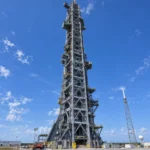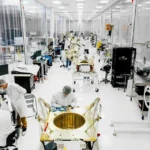

The company intends to develop and control the full stack required to deploy and maintain an orbital computing business. That includes rocket engines, reusable launch vehicles, satellite manufacturing, orbital data centers, and a planned dedicated manufacturing and launch complex known as Trailhead.
At the center of the plan is Stampede, a proposed constellation of 20,000 satellites, each delivering 1 megawatt of computing power. At full deployment, the network would provide 20 gigawatts of orbital computing capacity. Each satellite is designed around five racks of GPUs and six laser communication links, each rated at 1.2 terabits per second. The satellites would have a deployed span of approximately 132 meters, longer than an American football field, reflecting the large structures required to support the computing hardware and associated spacecraft systems.
Big Iron is an 86-meter-tall, stainless-steel rocket powered by liquid oxygen and methane. The vehicle is designed to deliver 15 metric tons to sun-synchronous orbit, with a gross liftoff weight of approximately 820 metric tons. Its propulsion architecture features nine engines and one upper-stage Clydesdale engine, according to the company’s published specifications. Unlike conventional launch vehicles that deploy independent satellites before their upper stages are discarded or deorbited, Big Iron is built around a dual-purpose upper stage. Once the rocket reaches orbit, the upper stage itself becomes part of the computing satellite, allowing hardware that would otherwise serve only a launch function to remain useful in space.
The company also introduced Big Iron Express, an 18-metric-ton orbital launch offering intended to provide transportation services to third-party customers. That offering could give Cowboy Space a commercial launch business alongside its own satellite deployment program, though pricing, launch cadence and customer commitments have not yet been disclosed.
Cowboy Space describes its approach as designing the entire launch stack, from engines to satellites, around multiple functions. By integrating the rocket’s upper stage directly into each satellite, the company says hardware normally limited to a launch role can continue operating in orbit, supporting the large-scale computing network it envisions.
The first launch is targeted for 2028. Big Iron Express pricing, launch cadence and customer commitments have not yet been disclosed, and the Trailhead manufacturing and launch complex remains a longer-term element of the company’s plan.