
Author: starpathwp-production
-
ISRO Verifies XPoSat’s Payload Performance with Cassiopeia A Supernova Observation
The XSPECT payload on ISRO’s XPoSat, India’s first X-ray polarimetric mission launched on January 1, 2024, captured its first light from the Cassiopeia A (Cas A) supernova remnant. XPoSat carries two co-aligned instruments, POLarimeter Instrument in X-rays (POLIX) and X-ray SPECtroscopy and Timing (XSPECT), aimed at unraveling the mysteries of cosmic X-ray sources. While the…
-

This Week in Launch: Axiom-3 launch week is upon us
This week’s launches: January 17 (Wednesday) CASC Long March 7 Tianzhou 7, 9:20 A.M. ET LC-201, Wenchang Space Launch Site, China SpaceX Falcon 9 Axiom-3, 5:11 P.M. ET LC-39A, Kennedy Space Center, Florida SpaceX Falcon 9 Starlink Group 7-11 SLC-4E, Vandenberg Space Force Base, California January 18 (Thursday) Rocket Lab Electron Four Of A Kind,…
-

Lockheed Martin’s SmartSat Equipped Satellite Uploads New Mission While On-Orbit
Much like driving a new car out of the lot, satellites that are launched into space see their onboard systems begin aging once they are just three inches off the ground. Once a satellite is on-orbit, or reached its target position in space, its operators work within the mission-defined parameters incorporated during the spacecraft’s production…
-
What is the difference between aerial and satellite imagery?
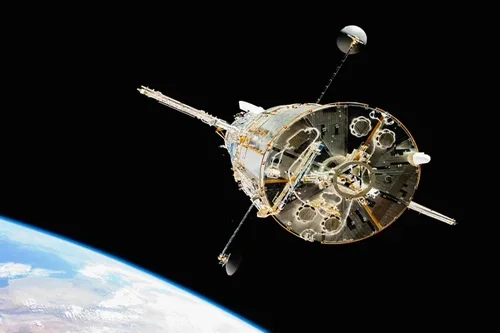
What is the difference between an aerial photo and a satellite image? Aerial photos and satellite imagery are two types of remote sensing data with different characteristics, advantages, and limitations. Aerial photos are captured at relatively low altitudes and offer higher spatial resolution than satellite imagery, which can provide global coverage and regular revisits to…
-
JAXA Initiates Landing Preparation Phase for Smart Lander for Investigating Moon (SLIM)
The Japan Aerospace Exploration Agency (JAXA) has confirmed that the Smart Lander for Investigating Moon (SLIM) is ready to begin preparations for landing descent, based on operational results since insertion into lunar orbit and future plans. It was therefore decided to move to the landing descent preparation phase on January 10, 2024, and the apolune…
-

Marlink Works with PGS to Achieve High Speed Data Collection
Marlink, working alongside geophysical company PGS, has achieved an uplink speed of more than 250 Mbps as it helps the company collect offshore data. It has upgraded the smart hybrid VSAT installation on the seismic research vessel Ramform Hyperion to achieve this uplink speed using GEO VSAT. Marlink’s in-house team of engineers designed a technical…
-

China prepares to launch Tianzhou-7 cargo spacecraft
The combination of the Tianzhou-7 cargo spacecraft and a Long March-7 Y8 carrier rocket was vertically transferred to the launching area on Monday. The cargo spacecraft will be launched in the near future at an appropriate time, according to the China Manned Space Agency. The facilities and equipment at the Wenchang Spacecraft Launch Site in…
-
China’s Tianzhou-6 cargo craft separates from space station combination
The Tianzhou-6 cargo craft, tasked with carrying supplies for China’s space station, separated from the station combination at 4:02 p.m. Friday (Beijing Time) and switched to independent flight, according to the China Manned Space Agency (CMSA). The cargo craft will re-enter the atmosphere in a controlled manner in the future. Most of its components will…
-

Boryung and Axiom Space Form a Joint Venture to Revolutionize Space Industry in Korea
Boryung Corporation, a pioneer in innovative solutions based in South Korea, and Axiom Space, one of the leaders in commercial human spaceflight and architect of the world’s first commercial space station, announced the formation of a joint venture aiming to leverage the unique strengths of both companies to advance the commercialization of low-Earth orbit (LEO)…
-

Daily Telescope: Life on Earth, and maybe in the heavens above, in a single photo
Welcome to the Daily Telescope. There is a little too much darkness in this world and not enough light, a little too much pseudoscience and not enough science. We’ll let other publications offer you a daily horoscope. At Ars Technica, we’re going to take a different route, finding inspiration from very real images of a…