
Tag: Atlas V
-

Starliner OFT-2 launch makes it to orbit, heading to ISS
Nine months after valve issues caused its previous launch attempt to be scrubbed, Boeing’s Starliner spacecraft has launched on its Orbital Flight Test 2 mission atop a United Launch Alliance Atlas V rocket Thursday. OFT-2 departed Space Launch Complex 41 at Cape Canaveral at 6:54:36 p.m. EDT (22:54 UTC), bound for the International Space Station…
-

As Centaur turns 60 years old, ULA prepares to evolve Centaur V
60 years ago, on May 8, 1962, Atlas-LV3C Centaur-A – designated Atlas Centaur-1 (AC-1) – lifted off from the newly-constructed Launch Complex-36A (LC-36A). AC-1 was the first flight test of the hydrogen-powered Centaur upper stage. Since the maiden flight of Centaur, the stage has flown on several different rocket families across six decades. Centaur has…
-

As Centaur turns 60 years old, ULA prepares to evolve Centaur V
60 years ago, on May 8, 1962, Atlas-LV3C Centaur-A – designated Atlas Centaur-1 (AC-1) – lifted off from the newly-constructed Launch Complex-36A (LC-36A). AC-1 was the first flight test of the hydrogen-powered Centaur upper stage. Since the maiden flight of Centaur, the stage has flown on several different rocket families across six decades. Centaur has…
-

Arianespace, ULA, Blue Origin discuss executing ambitious Kuiper constellation missions for Amazon
Amazon’s announcement of three launch contracts totaling 83 flights split across Ariane 6, Vulcan, and New Glenn represents the largest commercial launch block buy in history and will unite Arianespace, United Launch Alliance, and Blue Origin in a multi-year effort to deploy the Kuiper internet constellation. The contracts represent unique challenges to some providers and…
-

NOAA, NASA’s GOES-T weather satellite launches on ULA Atlas V
United Launch Alliance (ULA) has launched the Geostationary Operational Environmental Satellite (GOES)-T advanced weather satellite for the US National Oceanic and Atmospheric Administration (NOAA). GOES-T launched on an Atlas V 541 from Space Launch Complex (SLC)-41 from Cape Canaveral Space Force Station (CCSFS). The launch took place on March 1, 2022, at 4:38 PM EST…
-

ULA’s Atlas V launches satellite-inspection mission for Space Force
United Launch Alliance carried out an Atlas V launch Friday with the third pair of GSSAP satellites for the US Space Force. Flying in its never-before-used 511 configuration, Atlas lifted off from Cape Canaveral Space Force Station at 2:00 PM EST (19:00 UTC) for a lengthy mission that injected the satellites into a near-geostationary orbit.…
-
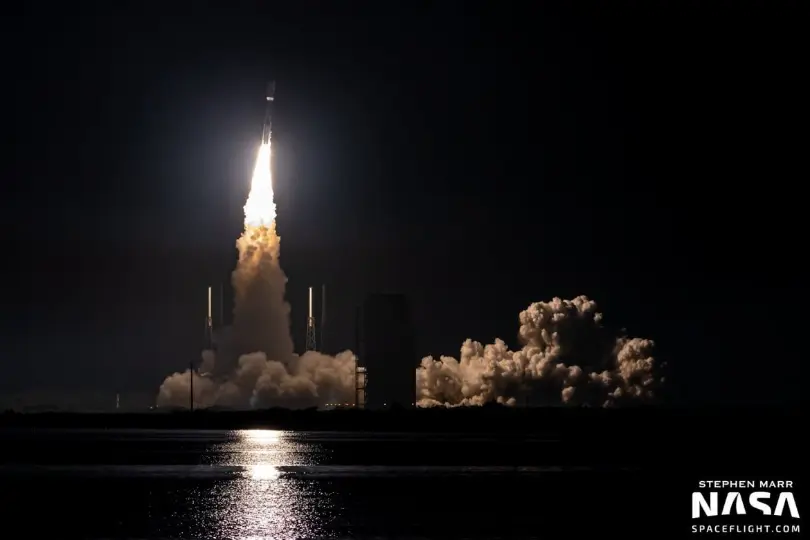
ULA launches Atlas V on long duration mission for Space Force
ULA (United Launch Alliance) launched its 90th flight with an Atlas V rocket and its fifth and final mission of 2021. Launching from SLC-41 (Space Launch Complex 41) in Cape Canaveral, Florida, the STP-3 mission is lofting two experimental satellites for the United States Space Force. The mission will also test several new technologies onboard…
-

NASA, ULA launch historic Lucy mission
NASA and ULA (United Launch Alliance) launched NASA’s next asteroid exploration mission — Lucy — from Florida early Saturday morning, kickstarting the spacecraft’s 12-year journey through the solar system. Liftoff of Atlas V and Lucy occurred at 5:34 AM EDT (09:34 UTC) on Saturday, October 16, from SLC-41 (Space Launch Complex 41) at Cape Canaveral…
-
NASA’s Landsat 9 successfully launched aboard Atlas V from Vandenberg
United Launch Alliance has launched NASA’s most powerful Earth-imaging satellite, Landsat 9, on an Atlas V rocket. Liftoff occurred at 11:12 AM PDT (18:12 UTC) on Monday, September 27, from Space Launch Complex-3 East (SLC-3E) at Vandenberg Space Force Base in California. Atlas V placed the satellite into a near-polar, sun-synchronous orbit at an altitude…
-

Atlas V’s launch of Starliner OFT-2 test flight delayed
Boeing has scrubbed Tuesday’s planned launch of their Starliner spacecraft on its second uncrewed Orbital Test Flight, called OFT-2, aboard United Launch Alliance’s Atlas V rocket. The issue at hand, according to Boeing, related to incorrect valve position indications in the propulsion system. The issues were first detected during checkouts after thunderstorms storms over launch…