
Tag: ESA
-

Perseverance’s first sample collection fails, new science points to subsurface Martian clay lakes
NASA’s Perseverance Mars rover recently attempted its first-ever sample collection of the Martian surface on August 6. However, data shows that while the rover’s drill successfully drilled into the surface, no regolith was collected in the sample tube. Meanwhile, as Perseverance was preparing for the sample collection event, a team of researchers using ESA’s Mars…
-

Previewing EnVision: ESA’s newest mission to Venus
On June 10, the European Space Agency (ESA) announced that they had selected their next mission to Venus — EnVision. The mission, set to operate alongside NASA’s newly announced DAVINCI+ and VERITAS missions, will study Earth’s sister planet in extreme detail. Selected as the agency’s fifth medium-class mission in their Cosmic Vision program, EnVision will…
-

Previewing EnVision: ESA’s newest mission to Venus
On June 10, the European Space Agency (ESA) announced that they had selected their next mission to Venus — EnVision. The mission, set to operate alongside NASA’s newly announced DAVINCI+ and VERITAS missions, will study Earth’s sister planet in extreme detail. Selected as the agency’s fifth medium-class mission in their Cosmic Vision program, EnVision will…
-

James Webb passes critical mission review for 2021 launch, final testing nearing completion
The joint NASA/ESA/CSA James Webb Space Telescope (JWST) has passed its critical final mission analysis review — clearing the way for a late 2021 launch from the Guiana Space Centre in Kourou, French Guiana on an Arianespace Ariane 5 rocket. With this review completed, Arianespace and JWST teams can now begin final launch preparations. With…
-

Titan impact craters reveal connections to planetary weather, set the stage for Dragonfly
Titan, the atmosphere-shrouded moon of Saturn, has captivated scientists’ attention since its formal discovery on 25 March 1655. While in-situ observations of the moon ended in September 2017 when the Cassini spacecraft was purposely plunged into Saturn’s atmosphere at the end of its mission, data from the 13 year scientific voyage continues to reveal information…
-
Mars Ascent Vehicle from Northrop Grumman takes shape for Mars Sample Return mission
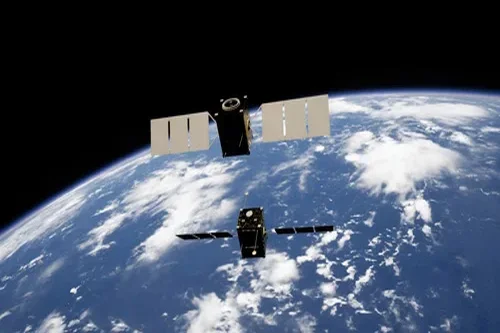
Since Mariner 9 entered orbit around Mars on November 14, 1971, NASA has been continuously studying the Red Planet. The Viking landers reached the surface of Mars five years later and began sampling the soil. Since then, numerous landers and rovers with instruments from institutions across Earth have studied and traveled the red terrain in…
-
Arianespace launches Vega’s return to flight with rideshare mission
After a five month grounding, Vega returned to flight following a launch failure in November 2020 — the rocket’s second in as many years. For its 18th mission, Vega launched the Pléiades-Neo 3 satellite along with several smaller rideshare payloads, taking advantage of the Small Satellite Mission Service offering from Arianespace, to Sun-synchronous orbit (SSO).…
-
Off the Earth, for the Earth; Endeavour lifts off with international crew for six month mission
SpaceX’s Crew Dragon Endeavour began its second mission Friday with a crew of four astronauts on a long-duration trip to the International Space Station. Liftoff, atop a Falcon 9 rocket from Florida’s Kennedy Space Center, occurred right on time at 05:49:02 EDT / 09:49:02 UTC on Friday, 23 April 2021. The Crew-2 mission will see…
-
Mars Express and the case of the large, mysterious Martian volcano cloud
Throughout the southern Martian hemisphere’s spring and summer seasons, a large, expansive cloud emerges daily from the volcano Arsia Mons. Why this cloud only forms at this location on Mars, what kind of cloud it is, and other puzzles to this phenomenon have plagued researchers for years — as observing Martian weather usually only happens…
-
SpaceX, Crew-2 mission cleared for launch as eyes turn to the weather
The Crew-2 mission’s Launch Readiness Review, or LRR, has been completed at the Kennedy Space Center, with managers from NASA, SpaceX, the European Space Agency (ESA), and the Japan Aerospace Exploration Agency (JAXA) formally clearing the SpaceX Falcon 9 rocket and the Crew Dragon Endeavour for launch of four international astronauts to the Space Station…