
Tag: ESO
-

ESO’s VLT reveals inner wind layers of distant exoplanet
Using data from the four telescopic units of the European Southern Observatory’s (ESO) Very Large Telescope (VLT), a team of scientists has successfully peered into the atmosphere of an exoplanet for the first time. Moreover, the data allowed the team to create a three-dimensional map of the atmosphere. The results showed powerful winds within the…
-
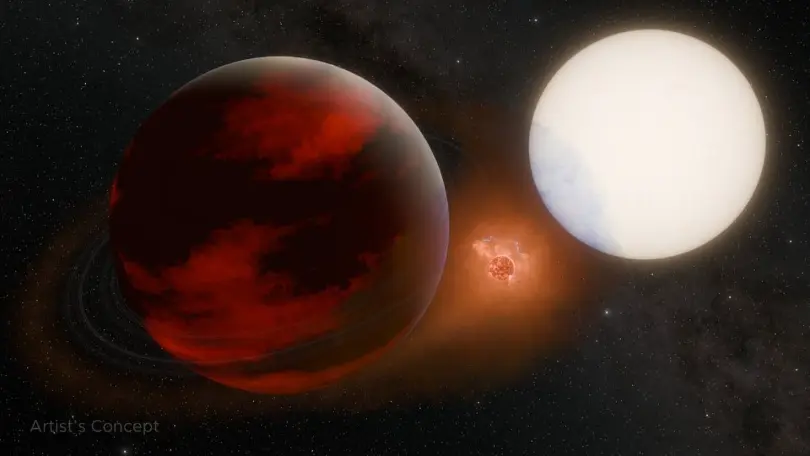
Astronomers find evidence of a volcanic exomoon
Astronomers have found evidence for a volcanic moon orbiting an exoplanet 635 light-years from Earth. No moons have been confirmed to orbit planets outside our solar system, but a sodium cloud hints at the existence of one around exoplanet WASP-49 b. Moons orbiting planets outside our solar system — also known as exomoons — are…
-

Hubble and VLT discover spiraling structure of young stars, hints at star formation in early universe
In a recently released study, data from the joint NASA/European Space Agency (ESA) Hubble Space Telescope and the European Space Observatory’s (ESO) ground-based Very Large Telescope (VLT) has been used to discover young stars spiraling into the center of a star cluster within the Small Magellanic Cloud, a small satellite galaxy of the Milky Way.…
-

New research finds first clear detection of circumplanetary disk surrounding an exoplanet
In recently published research using the Atacama Large Millimeter/submillimeter Array (ALMA), astronomers announced that they had found the first clear detection of a circumplanetary, moon-forming disk surrounding the exoplanet PDS 70c — a first in astrophysics. The circumplanetary disk, or CPD, has been seen in past research from other groups. However, due to the inability…
-

Breakthrough Watch and ESO kick off the search for more planets at Alpha Centauri
The NEAR instrument, shown here mounted on one of the telescopes at the European Southern Observatory’s Very Large Telescope facility, came into use with ESO’s VISIR imager and spectrometer on May 21. (ESO / NEAR Collaboration Photo) The European Southern Observatory and the billionaire-backed Breakthrough Watch program say they have achieved first light with a…
-
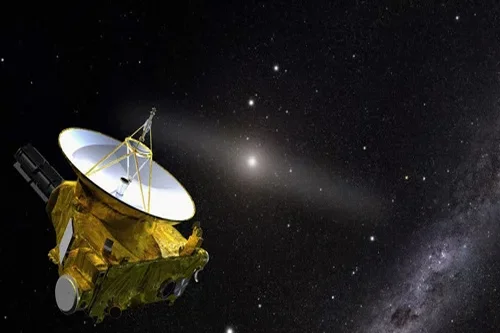
Scientists report a super-Earth orbiting Barnard’s Star, a mere 6 light-years away
An artist’s conception shows what the surface of the reported planet known as Barnard’s Star b might look like. (ESO Illustration / M. Kornmesser) The astronomical team that found the nearest exoplanet at Proxima Centauri has done it again with the reported detection of a super-Earth orbiting Barnard’s Star, the second-closest star system to our…
-

Einstein’s right again: Star obeys relativity as it whirls around Milky Way’s black hole
News Brief: A 26-year-long observational campaign provides clear evidence of the effect that general relativity has on the motion of a star known as S2 as it boomerangs around the supermassive black hole at the center of our Milky Way galaxy. The redshift observations, made in infrared wavelengths using instruments on the European Southern Observatory’s…
-

Ross 128 redux: Red dwarf sparks interest as a potentially not-so-weird locale for life
This artist’s impression shows the temperate planet Ross 128 b, with its red dwarf parent star in the background. (ESO Illustration) A red dwarf star that was previously thought to be the source of a weird signal from aliens turns out to have a temperate Earth-sized planet, astronomers reported today. The “Weird! Signal,” detected this…
-

Very Large Telescope joins Breakthrough search for Alpha Centauri’s planets
The ESO’s Very Large Telescope looms in the foreground of this image, and a star map has been superimposed on the night sky to show the locations of Alpha Centauri and Proxima Centauri. (ESO Photo) One of the most powerful observing instruments on Earth, the Very Large Telescope, will join the search for potentially habitable…
-

NASA keeps its eye on a trio of potentially habitable planets just 40 light-years away
An artist’s impression shows an imagined view from the surface one of the three planets orbiting an ultracool dwarf star just 40 light-years from Earth. (Credit: ESO) Three potentially habitable and definitely weird planets have been detected orbiting an ultracool dwarf star that’s 40 light-years away from Earth. They’re too far to visit anytime soon,…