
Tag: exoplanets
-
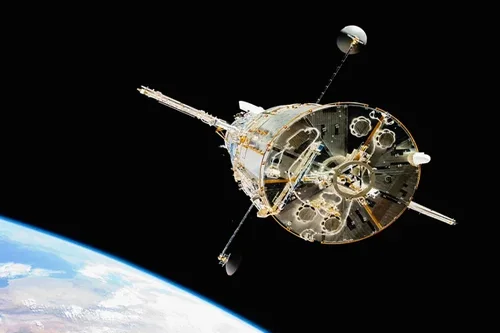
SpaceX rocket test-fired at Cape Canaveral for NASA telescope launch
SpaceX’s Falcon 9 rocket, without its payload fairing or the satellite passenger, fired its nine Merlin 1D booster engines for several seconds Wednesday at Cape Canaveral’s Complex 40 launch pad. Credit: Stephen Clark/Spaceflight Now SpaceX’s launch team loaded super-chilled liquid propellants into a two-stage Falcon 9 rocket Wednesday and fired the booster’s nine first stage…
-

Exoplanet telescope selected as ESA’s next space science mission
Artist’s concept of the ARIEL space telescope. Credit: UCL A mission to investigate the atmospheres of planets around other stars has been selected by the European Space Agency for launch in the late 2020s, officials announced this week. The space telescope will observe 1,000 exoplanets, using a spectrometer to measure the chemical make-up of their…
-
What if scientists find signs of alien life? Experiment suggests we won’t freak out
An artist’s conception shows the Transiting Exoplanet Survey Satellite, or TESS, monitoring a distant star and its planets. (NASA Illustration) AUSTIN, Texas — If extraterrestrial life exists, there’s a chance we’ll detect it sometime in the next 20 years. And then what? A recently published study suggests that most folks will take the news calmly, if…
-

Exoplanet-hunting satellite arrives in Florida for April launch
The Transiting Exoplanet Survey Satellite is pictured inside the Payload Hazardous Servicing Facility at NASA’s Kennedy Space Center in Florida after arriving Feb. 12. Credit: NASA/Kim Shiflett NASA’s Transiting Exoplanet Survey Satellite has arrived at the Kennedy Space Center in Florida for final testing, fueling and attachment to a Falcon 9 launcher for liftoff in…
-

Trump budget aims to kick-start lunar exploration, cancels space telescope
Artist’s concept of NASA’s proposed deep space station near the moon. Credit: NASA The White House’s $19.9 billion NASA budget outline released Monday would continue development of NASA’s heavy-lift Space Launch System rocket and Orion crew capsule and begin the deployment of a mini-space station around the moon as soon as 2022, but the proposal…
-

How scientists are expanding the spectrum for SETI and the search for alien life
This map from the University of Puerto Rico’s Planetary Habitability Laboratory shows the known planetary systems within about 100 light-years from Earth, plotted on a logarithmic scale. The systems with potentially habitable exoplanets are highlighted with red circles. (PHL @ UPR Arecibo) BERKELEY, Calif. — Twenty years after the movie “Contact” brought the search for…
-
Jupiter’s moons, black holes, exoplanets among JWST’s first scientific targets
Artist’s concept of the James Webb Space Telescope. Credit: NASA/Northrop Grumman The James Webb Space Telescope should start returning its first scientific results by the end of 2019, and scientists recently announced a slate of observations selected to whet the appetites of astronomers who will use the multibillion-dollar facility well into the 2020s. The observatory’s…
-

‘Sónar Calling’ campaign broadcasts music and messages to an alien super-Earth
The target of the “Sonar Calling” binary-coded radio transmission is a planet known as GJ273 b. (METI International Illustration / Danielle Futselaar) Scientists and artists have banded together to beam coded radio transmissions toward a star that has a potentially habitable planet, just 12.4 light-years from Earth. “Sónar Calling GJ273b” is the latest effort to communicate…
-
Ross 128 redux: Red dwarf sparks interest as a potentially not-so-weird locale for life
This artist’s impression shows the temperate planet Ross 128 b, with its red dwarf parent star in the background. (ESO Illustration) A red dwarf star that was previously thought to be the source of a weird signal from aliens turns out to have a temperate Earth-sized planet, astronomers reported today. The “Weird! Signal,” detected this…
-
WFIRST astronomy mission faces cuts to contain rising costs
Artist’s concept of the WFIRST observatory. Credit: NASA/GSFC NASA has directed the team developing the Wide-Field Infrared Survey Telescope, a flagship astronomy mission set for launch in the mid-2020s to study dark energy and exoplanets, to reduce the observatory’s scientific capabilities and keep it under a $3.2 billion cost cap. Fresh off their experience with…